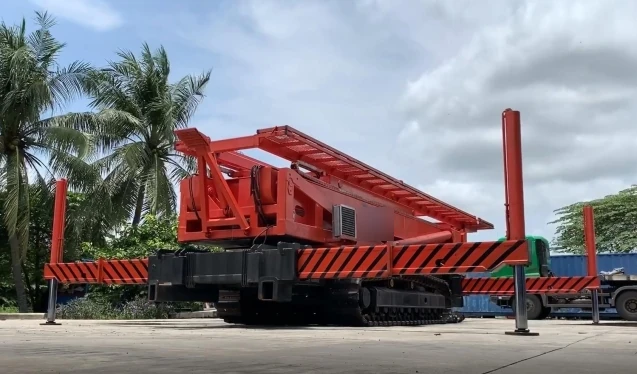
A crawler roll-forming lift proposal should answer the roof-production sequence, including places the equipment may need to revisit. Moving a compatible former to another ground position changes its relationship with the panel receiver, feed equipment, supports and services. Returning to an earlier position can raise the same questions again if the surrounding construction has progressed. A useful buying brief therefore describes the production task at each visit, rather than simply requesting a mobile machine.
Crawler roll-forming lifts combine a tracked base, lifting structure and equipment platform for a compatible roof-panel former. Tracks are relevant to site positioning, but do not establish a permitted travel state. This guide helps buyers compare coverage of proposed work-zone transitions; the access-route survey covers first entry, and the roof-zone survey covers the detailed geometry at an individual position.
Contents
- Define the production task at each visit
- Compare the physical arrangements between zones
- Compare one-pass work with return visits
- Request coverage of the actual zone sequence
- FAQ
Define the production task at each visit
Name the roof area and remaining panel work
For every proposed visit, identify the roof area to be served, the panels still required and the first receiving point for those panels. A label such as Zone A is useful only when it leads to a defined task. Distinguish an initial run serving an open bay from a later run for a remaining strip beside completed work. The machine may be unchanged while the useful output position is different.
Connect the task to the construction stage. If another contractor’s work prevents completion in one visit, show what remains and when the area is expected to become available. The supplier can then respond to the intended sequence instead of assuming that each zone is finished before the equipment leaves.
Keep inlet and outlet references on the same drawing
Mark the former’s inlet and outlet, the panel receiving direction and fixed building references on each zone drawing. A roof arrow alone does not describe the equipment arrangement. When the outlet direction changes, the feed side and nearby service connections may no longer have the relationship shown for the first position.
Use plan and section together so changes in elevation are visible alongside direction. Retain the distinction between platform height, forming outlet height and roof receiving elevation. Those references help identify which part of the proposal changes; a nominal height or model suffix cannot answer the whole geometry question.
Identify the proposed equipment state once
Separate transport on a carrier, crawler movement and stabiliser-supported elevated work. Identify the former, feed equipment, coil, unfinished panel and accessories proposed in each state. The applicable equipment documents and project method must establish which states and transitions are permitted. Do not infer elevated or loaded travel from the presence of tracks, a travel-speed entry or the word mobile.
A folded apparatus with supports deployed is a stationary reference state. A crawler carried on a low-bed vehicle is a transport arrangement, not a truck-mounted forming lift. Keep those distinctions in the enquiry so a production plan never depends on a movement capability that the proposed configuration has not established.
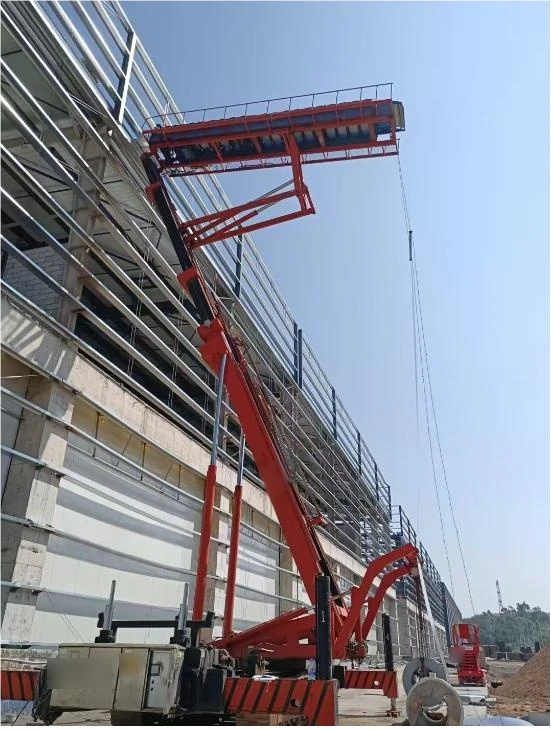
Reference photograph showing elevated equipment and ground supports beside a building. It does not establish that this working arrangement is permitted to move or fits a different roof zone.
Compare the physical arrangements between zones
Follow the changed receiving direction
Consider two neighbouring roof areas with different panel receiving directions. Copying the first ground-side layout into the second area can leave the inlet facing space that is no longer available, even though the ground positions are close together. Ask which objects change position or orientation: the former and lift, the separate feed equipment, the receiving point, or some combination.
One proposal might retain the described feed relationship while requiring another receiving arrangement. Another might address the receiving direction but leave the material-side space unexplained. These are alternatives for review, not findings that either layout is feasible. The useful response identifies the changed interfaces and the information required to assess them together.
Check the feed space at the intended time
Describe where coils or other supplied material arrive and the space assigned to the proposed feed equipment. That space can become a façade work area, storage area or shared route later in the programme. A return visit needs the material-side arrangement that will actually exist then, not the one photographed during the initial survey.
State which material functions belong to the equipment order and which come from another provider. If a new feed position is proposed, request the relevant equipment and connection information. Treat that as an interface question; the buying brief should not prescribe a feed or reconnection method.
Compare route and working support areas separately
Show the route between positions at the relevant construction stage, including changed openings, crossings and temporary obstructions. Then show the arrival area with the working support space, rather than only the crawler footprint. A route can be available while the intended support area is occupied, or the proposed position can remain available while its approach has changed.
The ground-support review covers the specialist ground and floor inputs. For relocation procurement, the important question is which positions the offer addresses and what site evidence is needed for each. Similar-looking surfaces do not establish equivalent support conditions.
Locate services and shared access for each visit
Mark the supply point, service route and access needed by the receiving and material teams. These may change while the former remains the same. A temporary power source for the first zone, for example, does not describe the later connection boundary. Ask the responsible providers what information is needed for the revised electrical and control interface.
Also identify which other activities need the same space during each visit. A narrow time window affects the practical proposal if the material delivery, machine position and panel receiving area cannot all be available together. Procurement needs that dependency before relying on a repeated-move concept in the programme.
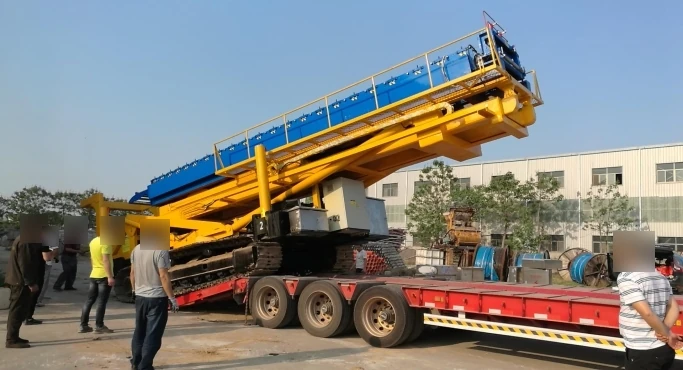
Reference photograph showing yellow crawler equipment near a low-bed carrier and the ground. It does not identify a movement direction, authorize loading or provide an unloading method.
Compare one-pass work with return visits
Set out a hypothetical one-pass sequence
Imagine a project intending to finish the panel work in Zone A, then Zone B, then Zone C. For the one-pass concept, show the complete remaining panel task, receiver and feed arrangement for each zone’s visit. The comparison is not a count of moves: it asks whether the necessary roof and ground areas are expected to be available together.
If Zone A cannot be completed because an adjacent work package is unfinished, the one-pass concept no longer describes the full production requirement. The remaining task needs a separate row. Hiding it beneath a general allowance for mobility makes the purchase look more complete than the proposal actually is.
Describe what changes on a return visit
In a second hypothetical concept, the equipment serves A, then B, then returns to A for the remaining panel strip. By that return, materials occupy part of the earlier feed area and completed construction changes the receiving-side approach. The buyer should identify the remaining panel task and ask whether the original arrangement still answers it. The zone name and panel profile alone do not resolve those changes.
The return might require a revised site concept, different material coordination or a separately assessed equipment arrangement. The responsible parties must compare those possibilities against the same remaining panel work. This example illustrates enquiry scope; it supplies no movement method, transition time or permission to use the earlier position.
Compare coverage rather than presumed convenience
| Part of the production sequence | One-pass question | Return-visit question |
|---|---|---|
| Required panel work | Can the stated zone task be completed in the planned window? | Which panels remain when the equipment comes back? |
| Outlet and receiver | Which direction and height relationship serves the visit? | Does the remaining work use the same receiver and direction? |
| Feed equipment and material | Is the proposed feed space available throughout that visit? | What occupies the earlier feed space at the later stage? |
| Route and supports | Which route and working position are included in the proposal? | Have either the approach or support area changed? |
| Power and controls | Which site connection boundary is assumed? | Is the same boundary available for the return? |
| Shared work areas | Which activities need to release space for production? | Which completed or ongoing works affect the later visit? |
The trade-off concerns what each position must serve and the additional site interfaces introduced by further visits. Fewer positions can mean fewer transitions to assess, but may ask each position to serve a more demanding receiving relationship. More local positions can change that relationship while adding route, support and service dependencies. Neither pattern establishes faster production. Compare the stated tasks, required site arrangements and unresolved exceptions before selecting the preferred supply concept.
Relate inspection questions to the changed arrangement
For Great Britain context, HSE work-equipment inspection guidance addresses installation-dependent equipment after reassembly at a new location and risk-based inspection needs. It does not prescribe an identical inspection for every move or authorize any crawler travel state. Ask the responsible project parties which requirements apply to the proposed equipment, transition and destination.
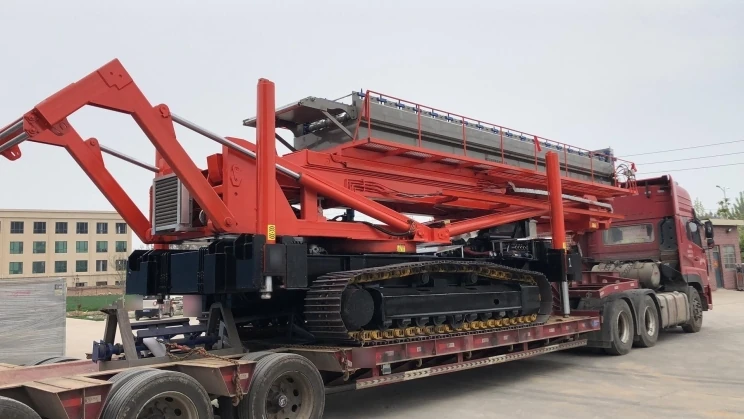
Reference photograph showing folded crawler equipment on a separate low-bed carrier. It does not show independent crawler travel or identify the equipment as a truck-mounted forming lift.
Request coverage of the actual zone sequence
Prepare a concise visit-by-visit brief
Use one coordinated zone plan with a row for every intended visit, including returns. Supply the following inputs where they affect that row:
- The remaining panel task, profile or material requirements and receiving area.
- The inlet, outlet and roof height references, direction and building geometry.
- The former, accessories and proposed material disposition at the transition.
- The equipment documentation describing the requested transport, movement and work states.
- The route, standing location and ground or floor information for site review.
- The feed and coil delivery space available at that construction stage.
- Power, controls and service routes, including changes from the previous visit.
- Wind or other environmental inputs that affect the intended work window.
- Shared access, temporary obstructions and the expected availability of the work area.
- Destination and carrier boundaries, and the local services needed for the proposed sequence.
This brief lets the supplier explain which arrangements are included and where more project information is required. It also makes an exception visible without duplicating a full site survey for every row.
Ask what the supply proposal includes
Compare the scope of equipment information, configuration review and any requested site support. An offer addressing the initial former-and-lift arrangement may leave later zone layouts with the buyer and its specialists. Another offer may describe additional coordination for named positions. Ask for the actual scope, deliverable and commercial assumptions instead of treating all relocation support as included in the machine price.
Arrival at a position is a useful programme milestone, but the panel task also depends on the receiver, supports, feed and services described for that visit. Keep those concrete dependencies attached to the quotation; a general promise of easy relocation cannot replace them.
Identify a sequence that still needs another concept
A proposed relocation sequence may not fit the production plan if it relies on an undocumented equipment state, an unavailable route or a receiver and feed arrangement that have not been described together. Ask whether a revised position, construction window or equipment concept needs comparison. If the former or other equipment changes, use the configuration-change guide to keep that decision separate from ordinary zone planning.
FAQ
Does a crawler base permit frequent moves in any equipment state?
No. The configuration documents and project review must establish the permitted state and conditions. Tracks alone do not authorize elevated travel or movement with a former, coil or other material in a particular position.
Does returning to the same zone repeat the first arrangement?
Only if the relevant conditions still match. Identify the remaining panel work, receiving direction, feed space, route, supports and services at the later construction stage, then ask which earlier information remains applicable.
Should the buyer prefer the proposal with fewer positions?
There is no automatic preference. A smaller number of positions may ask more of each receiving and material arrangement. Compare coverage of the complete task and its dependencies, including the exceptional or return visits.
What is the most useful output from the relocation enquiry?
A response tied to the visit sequence that identifies the equipment arrangement discussed, the production tasks it addresses and the local interfaces outside the quoted scope. It should leave no remaining roof task hidden behind a general mobility claim.
Request a response to the zone sequence
Ask ARCLIFT about the crawler configuration with your zone map and the remaining panel task at each visit. Ask which visits the supply proposal addresses, which changed interfaces need further information, and what coordination is included for the return positions.
Include outlet height references, site access and the destination transport boundary. This editorial comparison defines the purchase question; final movement and work arrangements require the applicable equipment information and project review.