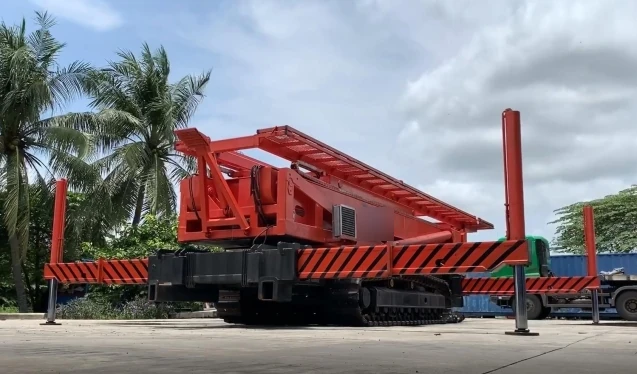
A crawler roll-forming lift has a visible tracked base, but its ground-support enquiry must also describe how the proposed machine is supported while the compatible roof-panel former is raised. Travel contact and stationary support points are different equipment cases. The buyer needs the right case for the actual site location before comparing forming positions or accepting a proposal that depends on one of them.
Start with the machine-to-ground relationship: which arrangement carries the former, where that arrangement meets the surface, and what construction lies beneath those locations? This guide connects those questions. It provides neither a bearing calculation nor a support design. The crawler forming-lift category introduces the equipment route; the specific proposal must supply its applicable support inputs.
Contents
- Understand the equipment case before reading the ground
- Locate the supports within the actual construction
- Compare candidate positions as complete proposals
- Bring the two sides of the support question together
- FAQ
Understand the equipment case before reading the ground
Separate crawler contact from stationary support
Tracks describe a mobility arrangement. They do not, by themselves, establish whether the proposed machine works on its tracks, uses outriggers, or relies on another configuration-specific support arrangement. Obtain that distinction from the equipment documents before asking a site engineer to assess the position.
The distinction changes the question. A travel case may involve a particular contact representation along a route, while a stationary work case may supply reactions at defined support points. Neither input can be substituted for the other. Even where the same visible components remain near the surface, the approved equipment information must establish the applicable load path and conditions.
Include the former and the agreed accessories
The supported equipment includes the agreed roll-forming line and whatever attachments or materials the relevant state document includes. A discussion based on the lifting structure alone may omit a significant part of the intended arrangement. Conversely, adding every material expected anywhere on the site can create a case that does not describe the machine at all.
Confirm the boundary with the equipment party: which forming modules, auxiliaries and materials belong to the stated configuration, and what changes between arrival and work? The forming-line mounting interface review addresses how the line is matched to its support. This page follows the resulting equipment case down to the site.
Keep the geometry attached to the equipment input
An equipment support input is useful only with its stated assumptions. Where the issuing party identifies a particular height, arrangement or operating condition, retain it alongside the supplied reactions or contact information. Do not detach a convenient number from the configuration and apply it to every proposed location.
Request clarification if the information refers only to a product family or does not say which state it represents. Model labels, maximum-height descriptions and photographs cannot supply the missing assumptions. The buyer’s task is to obtain the compatible inputs; the competent project reviewer determines how they apply to the site’s supporting construction.
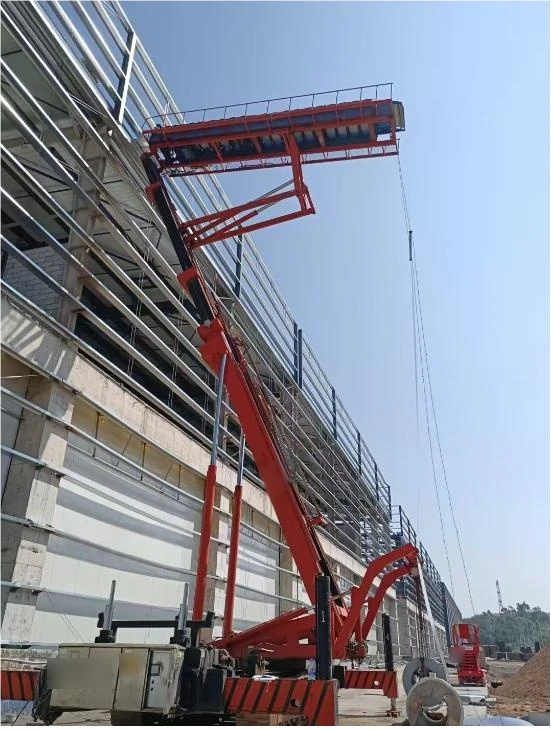
Reference photograph showing elevated equipment, supports and materials beside a building. It does not identify support reactions, subsurface construction or a permitted configuration for another site.
Locate the supports within the actual construction
Look beneath the visible paving or floor finish
Concrete, asphalt, paving and compacted-looking ground describe what can be seen. They do not fully describe the layers, structure or condition carrying the equipment. Record the actual location and obtain the available construction drawings, investigation records and relevant current observations. Let the appointed reviewer identify what further evidence is necessary.
A paved yard can include repairs, changes in build-up and buried features. An indoor floor can have a supporting structure that requires a different review from ground-bearing construction. Use the indoor floor and ground-pressure guide where the proposed location involves a building floor; do not treat all hard surfaces as equivalent.
Plot local features against the proposed support area
Plot covers, drainage channels, trenches, service routes, slab edges and known changes in construction against the proposed equipment support locations. An overall site plan may identify a service corridor without showing whether a particular support point falls within its influence. The relationship must be resolved at the scale needed by the project reviewer.
The HSE guidance on excavations explains why underground structures, services and loads from nearby plant matter to excavation planning in Great Britain. It helps frame questions about adjacent work. It does not supply a setback, support capacity or design for a roll-forming lift.
Match record coverage to the individual locations
A report for the site can contain different zones, exclusions or investigation locations. Ask the ground specialist to relate that coverage to the proposed equipment supports. The useful overlay shows the equipment arrangement and the relevant site-record boundaries together. Having a report in the project folder does not establish that every support location falls within its assessed area or assumptions.
Consider a hypothetical yard where the proposed support arrangement crosses an original paved area and a later drainage repair. The available report describes the original construction; the repair record identifies a trench but leaves its final extent unclear. The purchasing question is whether the equipment case can be assessed at the proposed locations with that evidence. Neither the continuous-looking surface nor the absence of visible damage answers it. The specialist may need information about the repaired area and its relationship to the other support locations before returning a bounded conclusion.
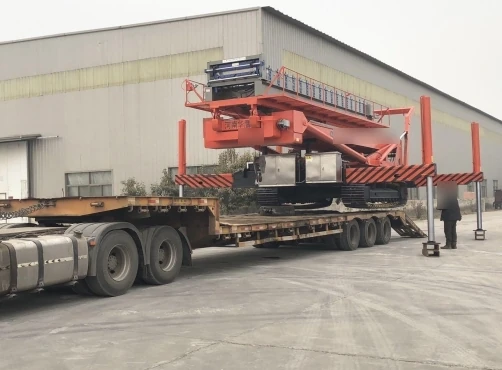
Reference photograph showing crawler equipment on a carrier with support legs visible. It cannot establish a road-ready state, ground load distribution or an approved loading arrangement.
Compare candidate positions as complete proposals
Test an old paved area beside a later repair
Record a boundary that is uncertain as uncertain. Do not draw an invented dividing line or allocate part of a support load to each side using a simple area ratio. Likewise, shifting the machine on the sketch to place a support inside a documented zone changes the proposed geometry and needs review. The buyer’s comparison should show which candidate positions have relevant evidence, which cross different construction zones, and which still need investigation. It should leave capacity and support-design decisions with the appointed specialists.
A candidate that crosses both construction zones needs a response describing that actual relationship. A candidate wholly within a documented area still needs its equipment case assessed there. The useful comparison is which positions have applicable information and what further investigation each requires; it is not a ranking based on surface appearance.
Include the construction expected during forming
An outdoor forming position can remain in the same place while the construction around it changes. Record nearby excavation or backfilling, temporary material stacks, other equipment positions and temporary works against the proposed support locations. Include when those activities are expected to be present. Separate plans for the forming lift and the neighbouring work may describe different moments in the construction programme.
Consider a hypothetical roof-forming proposal beside a yard used for deliveries. The equipment support case describes elevated forming; a separate site record describes temporary material storage near a drainage repair. The buyer needs to establish whether that storage is expected to remain during the proposed forming period and whether the ground specialist’s response covers that combined site condition. Separate reports for each activity do not answer that question unless their assessed conditions connect. Equally, proximity alone does not establish that the activities affect the same supporting construction.
Connect a changed position to the panel outlet and access
If one proposed support location cannot be assessed, another position may be worth investigating. However, changing the position can change the forming outlet relationship, access route and material supply. Compare those effects with the roof-level production planning guide before treating relocation on the drawing as a solution.
A position with clearer site records may simplify the evidence exchange while making the panel receiving geometry harder to achieve. A position close to the roof may have the opposite trade-off. The appropriate choice depends on the actual equipment arrangement and project review, rather than which rectangle looks most convenient on the site plan.
| Site/equipment combination | Question for the review | What the buyer should keep separate |
|---|---|---|
| Crawler entry across the yard | Which travel case applies to those route segments? | Stationary work-state support inputs |
| Raised forming beside the building | Where do the documented supports meet the site? | An average crawler contact description |
| Support arrangement across a drainage repair | Which construction records cover each location? | Continuous-looking paving and continuous construction |
| Nearby storage during the forming period | Does the assessment cover the proposed surrounding condition? | A response assuming the area is clear |
| Another candidate position | How do evidence coverage, access and outlet geometry change? | A sketch shift and an assessed revised position |

Reference photograph showing ground-level coils and elevated equipment near a building frame. It does not establish ground capacity, load cases or the condition beneath the visible surface.
Bring the two sides of the support question together
Recognize when authentic documents answer different questions
Consider a hypothetical proposal with a surface drawing for a paved yard and an equipment sheet describing crawler travel contact. The intended activity is elevated forming using a separately defined support arrangement. Both documents may be authentic, yet together they do not answer the work-position question. Request the applicable work-state input and the site information needed for its actual locations.
Similarly, a general floor-use description may not address a particular local support case. The solution is to clarify the two bases with their issuing parties. Do not create an editorial bearing value, average reactions equally between supports or choose a plate size to make the documents appear compatible. Those are engineering decisions outside this selection guide.
Ask the specialist to identify the assessed location and case
The useful return from the appointed specialist identifies the equipment information, state, site zone and surrounding conditions assessed. For the hypothetical yard, it should make clear whether the response covers the forming position with the nearby storage present, a different construction stage, or neither until more information is available. A conclusion based on the area being clear is not evidence for a proposal that assumes simultaneous storage there.
Keep this conclusion separate from the equipment operating authorization. A completed ground assessment does not establish line compatibility, wind limits, roof receiving readiness or permission to travel while elevated. Each decision uses its own evidence. Connecting them in the project record prevents one approval from quietly expanding into another.
Pair the location records with the equipment case
- Identify the crawler lift and forming-line configuration, with current technical-document revisions and inclusions.
- State the proposed height and geometry where they define the equipment support case; retain the source datum.
- Describe the coil, forming module or other material state only where it belongs to the supplied load basis.
- Map travel access, slope and surface transitions separately from the final stationary work position.
- Locate outriggers or other supports according to the configuration documents, with their applicable input references.
- Provide ground, floor, slab and underground records for the actual locations, with nearby construction, temporary storage and other equipment identified for the same proposed period.
- Identify transport or unloading interfaces that use the same ground, without assuming those cases are already covered.
- Record the site’s weather and wind change procedure where it affects the proposed state or review assumptions.
- Confirm destination documentation requirements and who can return the final ground or structural decision.
When this proposal may not fit
The proposed position may not fit when its actual support locations cannot be connected to defensible ground or structural evidence, or the equipment-side work case is missing. A continuous surface, a crawler base and an earlier assessment elsewhere do not settle that question. Changes to position, nearby work or support provision require the appointed parties to assess the new proposal. This guide gives no mat, plate, foundation, setback or bearing design.
Connect the equipment case to the site position
Discuss the equipment support inputs with ARCLIFT. Send the proposed site position, former/lift scope, required outlet height, destination and transport interface, together with the available ground records and the specialist’s specific missing-input question. ARCLIFT supports equipment selection and integrated supply; final project-specific ground, structural and temporary-support decisions belong to the appointed competent parties. These editorial photographs illustrate equipment/site relationships and cannot establish reactions, subsurface conditions or permission to work at the position.
FAQ
Does a crawler chassis remove the need for support review?
No. The review must address the actual travel and work-state arrangements. Tracks do not establish the capacity of the ground, buried structures or individual locations used by other supports.
Can machine mass divided by track area settle the question?
No. That simplification does not establish the applicable equipment case or the response of the site’s supporting construction. Use the configuration-specific inputs requested by the competent reviewer.
Is a paved surface stronger than an unpaved surface?
Appearance alone cannot decide suitability. The actual construction, condition, underlying features and proposed support case matter. The reviewer determines the necessary evidence for each location.
Does a change of forming machine require another review?
It can change the configuration or assumptions behind the support information. Compare the new line with the assessed basis and ask the responsible parties which affected equipment and site decisions must be revisited.