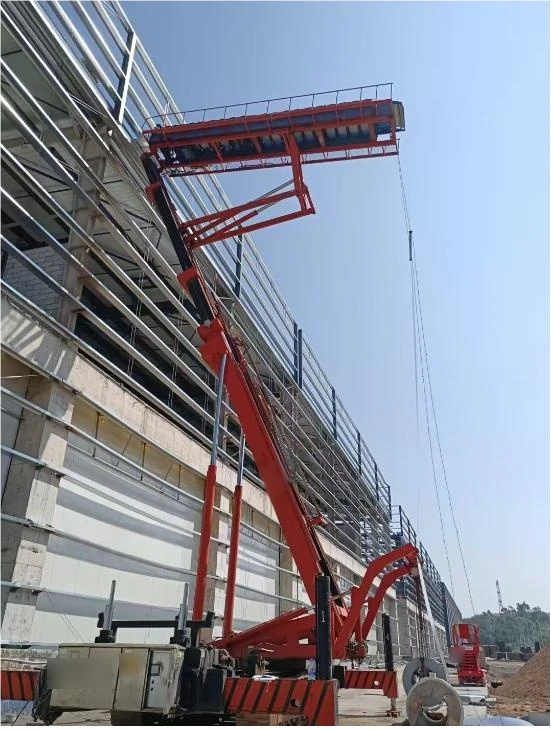
Choosing a crawler roll-forming lift includes choosing how the delivered equipment can reach the intended forming position. The useful access comparison follows a connected journey: transport handoff, approach, turn or opening, surface transition and arrival beside the roof work. A gate measurement alone cannot answer that question, because the machine and its attachments occupy space before, within and beyond the gate.
The crawler system positions a compatible roof-panel roll former near the required output level. Its delivered arrangement, permitted entry state and supported working arrangement must remain distinct. This guide covers first arrival at the setup area. The work-zone relocation guide covers later changes of production position.
Contents
- Start with the equipment and its arrival boundary
- Read the approach, opening and transition together
- Compare a complete arrival concept
- Send the restriction that can change selection
- FAQ
Start with the equipment and its arrival boundary
Identify the delivered assemblies
Ask whether the proposed delivery comprises an assembled machine, a particular prepared transport arrangement or separately delivered components. Record which forming-line elements and attachments accompany the machine on the initial site route. A transport photograph cannot establish those details for a new order, and the outline of the lifting structure alone may not describe the arriving equipment.
Connect this information to the transport data package. That package addresses the machine-to-carrier handoff. The access survey starts with the site condition it creates: the arriving arrangement, the location of the handoff and the state proposed for the next part of the journey.
Locate the carrier-to-site handoff
Locate the proposed delivery and unloading area on the site logistics plan. Identify the transport party, equipment party and site party that must establish the actual transfer arrangement. The route reviewer needs to know where the entering equipment will be, in what state, and with which restrictions once that transfer is complete.
Do not use a route survey to prescribe ramps, lifting points, restraint removal or a driving sequence. Those require the actual equipment, carrier and approved method. If the transfer location is unresolved, the internal route has an unresolved starting point even when its gate and corridors have been measured.
Request the documented entry state
The proposed entry state should have a controlled arrangement reference. It must identify the equipment envelope and relevant attachments, including components that change the usable clearance. A maximum working-height description is not an entry height. A folded appearance in a photo does not establish a permitted travel state.
Where packages or modules follow different routes, identify both their individual journeys and the place where those journeys must meet. An access concept can cover each item on an empty site while leaving their shared destination unresolved. Record what the receiving area is expected to contain when each separate item arrives, using the proposed delivery states supplied by the responsible parties.
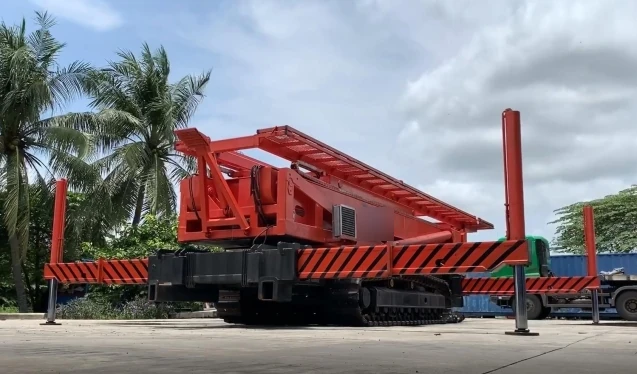
Reference photograph showing folded crawler equipment with supports visible. It does not confirm a permitted travel state, entry dimensions or the state proposed for this site.
Read the approach, opening and transition together
Measure the spaces on both sides of the opening
A gate or doorway has an opening, but the machine also needs an approach and a space beyond it. Record the opening, obstructions on either side and the direction from which the proposed state would approach. Columns, barriers, stored materials and a nearby corner can make the surrounding geometry as important as the opening itself.
Keep the measurement source and date beside the location. A nominal architectural dimension may describe the unfinished opening rather than the available space after doors, services or temporary works are present. The responsible parties must compare the surveyed condition with the actual equipment information and define any required clearance; this article supplies no generic allowance.
Describe the area occupied by a turn
On a plan, a route line can turn sharply at a corner. The equipment occupies an area throughout the manoeuvre, and its relevant geometry must be assessed by the appropriate parties. Record the surrounding boundaries and approach directions so a reviewer can examine the turn using the actual state.
Crawler tracks do not justify an assumption that the complete machine can turn anywhere within its parked outline. Attachments and the selected configuration still matter, as do the permitted movement conditions. If a turn is unresolved, identify it as a specific selection constraint rather than replacing it with a straight-line width check.
Keep vertical transitions and support questions visible
Survey thresholds, ramps, drainage channels, crowns and changes in slope or crossfall where they occur. A route that is open in plan may still have a vertical or transition constraint. Include relevant overhead structures and services, using the project process for identifying their required controls.
Record the geometry without converting it into an equipment capability claim. Gradeability, approach geometry, traction and permitted movement conditions require configuration-specific information. A single clear overhead measurement does not describe the whole transition if the surface changes under the proposed equipment path.
Mark where the route changes between pavement, slab, fill or other surfaces, and identify covers, repairs, buried features and adjacent excavations. These observations show where support questions arise; they do not establish the capacity of the route. A hard or dry-looking surface can still have unresolved construction beneath it.
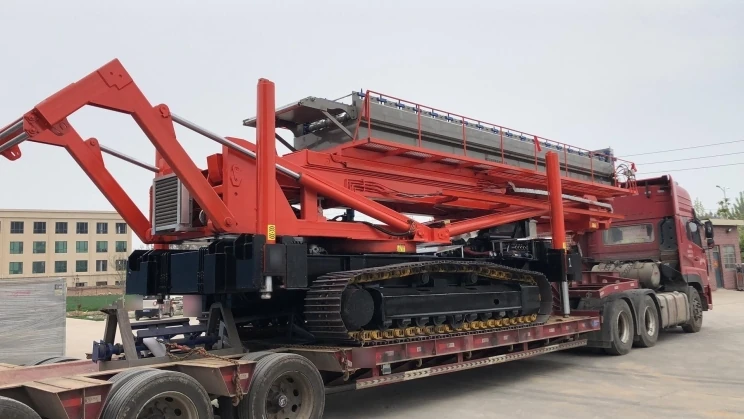
Reference photograph showing folded red crawler equipment on a low-bed carrier. It cannot establish a transport approval, restraint design or the configuration that will enter a particular site.
Compare a complete arrival concept
Check the missing connection between two surveyed spaces
Read neighbouring segments together before treating the route as continuous. The end of one survey should connect to the beginning of the next through a described space, with the same proposed equipment state and relevant construction stage. Two width measurements can each be accurate while omitting the area in which the equipment changes direction between them. A line joining their centre points does not supply that missing geometry.
Consider a hypothetical entrance with a measured approach lane and a measured passage inside the building. The entrance opens into a shared unloading bay before the passage begins. If the survey records only the two narrow sections, it may omit the bay boundaries, the direction of approach to the passage and the time when stored deliveries occupy that space. The equipment reviewer needs that connecting area described before considering the route as a whole. This is an information gap, not a finding that the machine can or cannot pass.
Show what already occupies the receiving area
For a hypothetical split delivery, the crawler is already in the nominated area when a separately supplied forming module reaches its final approach. The crawler’s presence may occupy space shown as available on the module’s earlier route sketch. The question is whether the module’s described route still connects to its agreed receiving boundary in that occupied condition. This is different from asking whether either item fits through the entrance alone.
Ask for a common plan showing the arriving items, the equipment already present and the actual handoff locations at that destination. A route ending beside the area and a receiving plan beginning inside it can leave an unexamined gap. The relevant parties must reconcile that gap before procurement treats the separate routes as one complete arrival concept. This comparison does not select an arrival order, assembly sequence or way of moving the module.
Compare another entrance or equipment architecture
A crawler arrangement and a truck-mounted arrangement can place different demands on site logistics. Compare how each is delivered, where its transport interface occurs, what enters the internal route and how it reaches the production position. The crawler-versus-truck comparison explains that broader decision.
Do not select solely on the narrowest advertised width or the presence of tracks. One arrangement may simplify an internal journey while requiring a different unloading area or support position. Another may simplify delivery but not align with the desired forming outlet. The useful comparison includes all these interfaces for the actual proposed configurations.
| Arrival proposal | Controlling relationship | Useful next enquiry |
|---|---|---|
| Main crawler and former arrive together | The complete entry envelope against the connected site route | Which documented state applies to that arrangement? |
| Former and crawler arrive separately | Individual routes against the same occupied destination | Where do the two journeys actually meet? |
| One entrance leads through a shared bay | Approach direction, turning area and expected deliveries | Is that connecting space available in the proposed window? |
| Another entrance avoids the restriction | Changed arrival route against the final outlet position | Which access and setup assumptions change together? |
| Delivery moves to a later building stage | Installed services and storage against the earlier survey | Which specific segment needs new observations? |
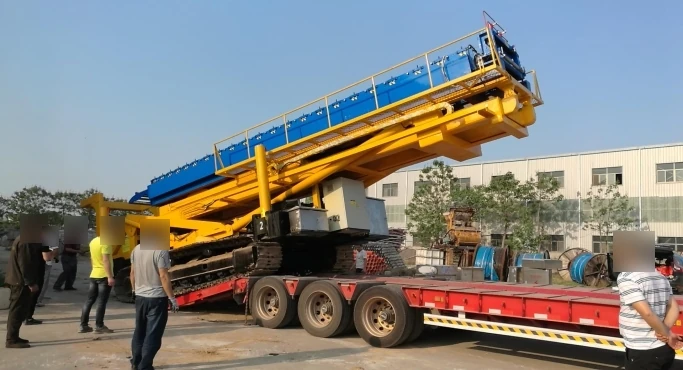
Reference photograph showing crawler equipment at a transport transition. It does not establish an unloading procedure, allowable slope or an approved transfer arrangement for this project.
Send the restriction that can change selection
Separate missing geometry from missing equipment information
“Measurement missing” means the project needs a better description of a physical restriction. “Equipment input missing” means the site is described but the proposed state cannot yet be compared. “Access concept unresolved” means the available information reveals a conflict that requires a different position, sequence or delivery concept to be evaluated.
These outcomes should not all become “access pending.” They ask different parties to do different work. For example, a measured opening does not settle an unknown travel-state height. Conversely, a confirmed equipment outline does not make an occupied approach available. If individual routes are described but their shared destination is not, report that endpoint question explicitly. Procurement can then request the missing combined arrangement without repeating surveys of unchanged remote route segments.
Keep construction timing and later departure in the comparison
Consider a hypothetical entry route that passes an unfinished doorway before internal services are installed. The survey may describe a clear opening on its visit date. If delivery moves to a later construction stage, the completed services and stored materials may change the route. The earlier measurement remains a historical fact but no longer establishes the available condition.
An initial entry decision should identify dependencies that could prevent departure, such as a planned closure, completed façade or stockpile location. Record the expected later state of the route and who will review it. This does not mean the first-entry survey can approve withdrawal months in advance.
Likewise, later movement between work zones belongs in the separate relocation review. Preserve the initial route references so they can inform that work, but do not reuse them as a blanket permission to move. The value here is a well-defined first arrival at the production area, with future dependencies visible before equipment is committed.
Prepare the connected arrival-route brief
- Identify the transport vehicle handoff and the proposed equipment state entering the site route.
- Record entry height and width from the controlled configuration, keeping working-height claims separate.
- Survey route geometry, turns, slope, crossfall, thresholds and approach space at the actual restrictions.
- Identify forming modules, coil-related attachments or other material carried only where included in the proposed entry state.
- Map the ground or floor construction and unknown underground features for each relevant segment.
- Show where each item’s route meets the receiving or setup zone, what already occupies that space, and where the separate work-support review begins.
- Identify the site’s weather and wind change procedure where it affects the proposed movement conditions.
- Mark power cables, temporary services and other obstructions that change the available access space.
- Record destination access requirements, traffic ownership and the documents needed to close each unresolved constraint.
The HSE workplace-transport guidance discusses obstructions, separation of vehicles and pedestrians, and changing temporary routes. Use it as general Great Britain planning context. The destination site must establish its own traffic arrangements and review the actual equipment; the guidance supplies no crawler capability or route approval.
When this proposal may not fit
An access concept may not fit when a turn, opening or transfer boundary cannot be matched to the documented entry state, or the shared receiving area is unavailable at the expected construction stage. A clear final work area does not overcome an unresolved restriction earlier in the route. Another entrance or delivery concept needs its own assessment; component removal, a different arrival order or a changed travel state cannot be assumed available.
Send the restriction that controls entry
Send the controlling entry restriction to ARCLIFT, with the site route, carrier handoff, entering configuration, measured height references, work-zone destination and construction stage. Identify whether the missing answer concerns the machine envelope or the available site space. ARCLIFT can coordinate preliminary equipment questions as an integrated equipment supplier and technical selection and supply partner. Final project-specific unloading, access, floor and movement decisions remain with the appointed reviewers. The editorial reference photographs cannot replace the route survey or establish a permitted travel state.
FAQ
Is the gate width enough to check crawler access?
No. The approach, space beyond the gate, turns, overhead conditions and surface transitions must be considered with the actual equipment state. A clear opening is only one segment of the route.
Should the survey begin after unloading?
It should identify the transport and unloading boundary that creates the entering state. The actual unloading method remains a separate task, but an unresolved handoff leaves the route’s starting point undefined.
Can folded equipment be assumed ready to travel?
No. Folded appearance does not establish a permitted travel configuration. Use the applicable equipment documents to identify the state and its conditions before comparing it with the surveyed route.
Can the initial survey also approve later relocation?
No. It can supply relevant references, but later relocation requires review of the departure and arrival conditions, equipment state and changed construction context. Keep those decisions distinct.