
A truck-mounted forming-lift proposal needs a clear account of three kinds of item: permanent installed equipment, material or accessories carried for a particular journey, and items transported separately. The roof-panel former, lift structure and connecting equipment may come from different quotations. A single total can hide an omitted assembly or count the same assembly twice.
The purpose of this review is to give the vehicle specialist coherent mass and position inputs for the actual chassis and state. Vehicle payload is a separate question from the lift’s ability to carry a compatible former near the roof receiving level. This guide supplies no axle-load calculation or available-payload result. Use chassis integration for the physical vehicle pairing.
Contents
- Build one non-overlapping equipment account
- Describe what is present in each proposed state
- Compare a changed item and a changed position
- Reconcile the evidence before asking for a vehicle answer
- FAQ
Build one non-overlapping equipment account
Identify the actual vehicle baseline
Identify the chassis specification and the configuration represented by its mass data. Options and installed equipment can make a general model description insufficient. Ask which fuel, fluid and equipment assumptions are included in the supplied baseline. The buyer does not need to reconstruct a chassis specification from photographs; the chassis supplier must identify the actual proposal and its applicable information.
If the vehicle is already owned, distinguish its current condition from its original specification. Record relevant changes and the available documentation or measurement information. Do not assume that an old unladen figure describes the vehicle after modifications. The integration reviewer needs to know which physical starting point the subsequent additions will be applied to.
Separate the lift, former and installed auxiliaries
Identify the lifting assembly, forming machine, intermediate support, hydraulic or electrical equipment, access components, guards and permanent accessories as applicable. Each should have an owner who can explain the mass scope. If one supplier provides a combined figure, identify exactly which of these items that figure includes before adding figures from another quotation.
The truck-mounted roll-forming lift reference helps identify the product family, but a public model name cannot define an order-specific mass schedule. The schedule must describe the proposed assembly. An item supplied by the buyer still belongs in the review when it is carried or installed on the vehicle.
Keep carried materials and temporary packaging distinct
List coils, tools, spares, support accessories and other carried items separately from the permanent installed assembly. Record whether each is included in the proposed road journey, delivered by another vehicle, or present only for a particular site activity. Do not infer any of these arrangements from a coil-handling photograph.
Temporary transport frames and packaging also need a stated boundary. A component shipped in protective packaging may have a different declared mass from the installed component. The useful question is not which figure is larger, but which physical item and condition each figure describes. That distinction prevents a shipping gross mass from quietly becoming an installed-machine value.

Reference photograph showing a suspended blue machine module. It does not show a coil, disclose the module’s mass or establish whether the module travels installed on a particular vehicle.
Describe what is present in each proposed state
Name the documented road arrangement
Identify the installed and carried items for the road-going arrangement, together with their proposed positions. Show which components remain on the vehicle and which arrive separately. Ask the responsible equipment party to identify the documented transport configuration rather than describing it only as folded or lowered.
A road review also needs the actual chassis information and destination requirements. Keep that work with the appropriate vehicle and transport specialists. The road-transport document guide connects these inputs to the transport task. It should receive an identified configuration, not a total assembled from different states.
Show the changes at arrival without losing the items
Arrival can introduce separately delivered components or materials, while transport-only items may be removed under the applicable arrangements. List those changes as changes of state. If an accessory is stored beside the equipment after arrival, that does not establish whether it was included on the vehicle during the preceding journey.
Use a simple presence field for each item: included, excluded or unresolved for the named state. An unresolved entry is an information request, not a zero mass. This keeps the arrival account connected to the road account without assuming they are identical.
Distinguish removal from an assembly from removal from the vehicle. In a hypothetical return arrangement, a transport frame is detached from the machine but placed elsewhere on the same vehicle. Its installation status and position change; it has not disappeared from that vehicle’s contents. If the frame instead leaves on another carrier, identify that separate journey. The schedule should state where the item is in the named case, rather than using “removed” as an unexplained exclusion.
Keep the supported working case separate
During the proposed roof-forming work, support conditions and component positions may differ from those represented by the road arrangement. The equipment parties must define the applicable working cases and their own mass, load and support inputs. A road mass schedule is not a substitute for that review.
For example, identifying the mass of a forming line does not establish a lifting rating at the requested outlet height. Nor does a completed-vehicle weight settle ground reactions at extended supports. Keep those questions visible and route them to the responsible specialists through the jobsite setup review.
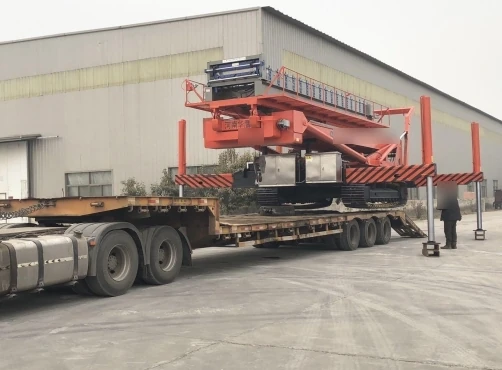
Reference photograph showing crawler equipment on a low-bed carrier. It is a carrier-and-cargo scene, not evidence of a truck-mounted roll-forming configuration or an approved road-load distribution.
Compare a changed item and a changed position
Ask where the coil is proposed to travel
Consider a hypothetical proposal in which the forming equipment travels on its assigned vehicle and coil material arrives on a separate carrier. A later request asks to carry a coil with the forming equipment. That request changes the road configuration and requires a stated coil scope, proposed position, handling interface and review by the responsible parties. It is not a scheduling detail that can be absorbed into an old equipment-weight figure.
The alternative arrangement may affect logistics, but the trade-off cannot be decided by counting vehicles alone. The project must establish the configuration and review requirements associated with each proposal. This example supplies no permission to carry a coil, no restraint design and no estimate of spare vehicle capacity.
Follow an auxiliary component whose mass stays unchanged
Suppose a supplier proposes moving an auxiliary cabinet to provide service access. Its declared mass may remain unchanged, while its position on the vehicle changes. The overall mass total therefore cannot show the complete effect of the proposal. Send the revised arrangement and position information to the vehicle specialist as well as to the integration designer.
Volvo’s official VNL body-builder instructions, Section 0 include a weight-distribution discussion that relates loads to their positions. It is a manufacturer document for its stated vehicle scope, used here to explain why position inputs matter. Its examples do not select a chassis or validate an ARCLIFT arrangement, and its calculations are not reproduced here.
Use the position references requested by the specialist
For the vehicle review, ask the specialist which position references and input format are required. Item locations and centre-of-gravity information must relate to a shared vehicle coordinate system. A location measured from the rear of one assembly cannot be combined with another measured from the front axle without a defined relationship.
Preserve the supplier’s stated uncertainty and the status of provisional inputs. An assumed centre position should not be recorded as measured. If the relevant mass location is unavailable, show the gap and request the needed information. Drawing a box at the centre of a machine does not establish its centre of gravity.
| Item or record | Road proposal | Arrival/working comparison |
|---|---|---|
| Permanently installed lift and former | Identify actual inclusions and positions | Retain their identity while the support/geometry case changes |
| Coil or other material | State carried here, separately transported or unresolved | Do not infer its earlier journey from its onsite location |
| Transport frame | Record whether and where it travels | Detached from the machine does not mean absent from the vehicle |
| Auxiliary cabinet | Preserve mass basis and position reference | A changed position needs review even if the mass is unchanged |
| Combined supplier figure | Identify its included subitems before adding anything | Distinguish an explanatory breakdown from extra equipment |
| Whole-vehicle measurement | Identify vehicle, contents and fluid assumptions | Keep it as a record of that state, not every later proposal |
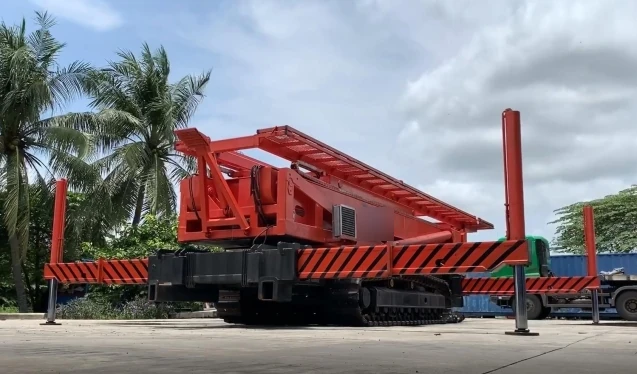
Reference photograph showing folded crawler equipment on extended supports. It does not show a confirmed travel state, a truck chassis or a usable vehicle-payload allowance.
Reconcile the evidence before asking for a vehicle answer
Check whether a supplier total already includes its subitems
Consider a hypothetical quotation that gives one total for the lifting assembly, then lists a connecting frame and hydraulic power package on separate commercial lines. Separate prices do not establish separate masses to add: those items may already be inside the assembly total. A second quotation for the forming machine may include a transport frame and loose accessories that will not all remain installed. Reconcile the physical inclusions before combining the figures.
For each combined total, record which identified subitems it covers and whether their individual figures are an explanatory breakdown or additional items. A breakdown can help locate a later change without being added to its own parent total. Where one subitem is excluded from the combined figure, identify that exclusion explicitly and retain its separate basis. The aim is one complete, non-overlapping description of the named state, not the largest total obtainable from all available numbers.
If the suppliers cannot yet establish whether the connecting frame or power package is included, keep that specific scope question open. Do not silently drop the item or invent an allowance. Ask the issuing party to return the reconciled assembly scope, with any remaining provisional inputs visible. The vehicle specialist can then decide what further evidence or assumptions are needed for its assessment. This example explains how to organize mass inputs; it supplies no mass value, permitted vehicle load or calculation method.
Keep whole-vehicle observations tied to their actual contents
A measurement record for the completed vehicle describes the vehicle state identified in that record. It can provide a useful whole-vehicle observation without establishing the mass or location of every component. Keep it alongside the item schedule and identify the relationship between their scopes. Neither record should silently replace the other.
For a hypothetical offer, the supplier returns a vehicle measurement while the item schedule still describes a proposed arrangement. The measurement includes loose transport accessories, but the schedule has not resolved whether those accessories travel on that vehicle; the two records also use different fluid assumptions. If the reported total differs from the schedule’s expected total, that difference cannot simply be assigned to the roll former. First ask the issuing parties to reconcile what was actually present with what the schedule describes.
The comparison needs the vehicle identity, installed and carried items, relevant fuel or fluid condition, and configuration at the time of the measurement. Preserve anything that the record does not establish as an open input. Agreement between overall totals would still not identify where individual items sit, while a difference would identify a question without identifying its cause. The responsible specialist determines how the records can be used and whether further evidence is needed.
Prepare the item-and-state input schedule
- Identify the actual chassis proposal, configuration and mass-data source with its included options and fluids.
- List the forming machine, lifting assembly, mounting structure and permanent accessories without overlapping scope.
- State the material and coil assumptions for the road journey separately from site-only handling tasks.
- Record each item’s mass basis and position in the coordinate format requested by the vehicle specialist.
- Describe road, arrival and working states, including which items are present, absent or unresolved.
- Tie any whole-vehicle measurement record to the vehicle identity, installed and carried items, fluid assumptions and arrangement represented at that time.
- Identify the roof task and required outlet height so the working review is kept distinct from road transport.
- Connect proposed outrigger or other support arrangements to the separate ground or floor review.
- Mark the access route and destination transport requirements relevant to the intended vehicle journey.
- Include power, hydraulic and control accessories where they form part of the installed or carried scope.
- Identify container packaging or transport frames separately where their gross mass differs from installed equipment.
- State the documentation owner for unknown masses, provisional positions and changes to the proposed configuration.
When this proposal may not fit
The proposed vehicle arrangement may not fit when installed and carried items cannot be reconciled with the selected chassis, required position information is unavailable, or the responsible assessment identifies a conflict. A different chassis, separately transported item or altered assembly is a changed proposal. This schedule supplies no allowable payload, axle-load formula, centre-of-gravity limit or stability result; remaining arithmetic margin is not a permission.
Send the item or position that changes the proposal
Send the changed mass or position input to ARCLIFT, with the actual chassis, former/lift scope, item schedule and proposed road arrangement. Include the roof task height, site zone, destination and transport boundary so road and working cases stay distinct. ARCLIFT supports technical selection and integrated supply and can coordinate equipment-side input questions. Final project-specific vehicle, support and transport conclusions remain with the appointed specialists. These editorial reference photographs cannot establish an item mass, spare payload or an accepted configuration.
FAQ
Is vehicle payload the same as the lift’s rated load?
No. They concern different boundaries and conditions. Vehicle review addresses the completed vehicle and its contents; the lifting review addresses the identified equipment arrangement and applicable working cases.
Can the buyer subtract equipment weight from a truck rating?
That subtraction does not provide a complete vehicle assessment. The responsible specialist needs the actual chassis, included items, positions and applicable requirements before examining the proposed arrangement.
Should a coil appear in the road mass schedule?
Only according to the proposed road configuration, with its status stated explicitly. If it travels separately, identify that arrangement. If its travel location is unresolved, retain an open question rather than treating it as absent.
Does moving an accessory matter if its mass stays the same?
Yes, it changes a position input and may affect other interfaces. Submit the revised arrangement to the responsible reviewers instead of treating the unchanged total mass as proof that earlier conclusions still apply.