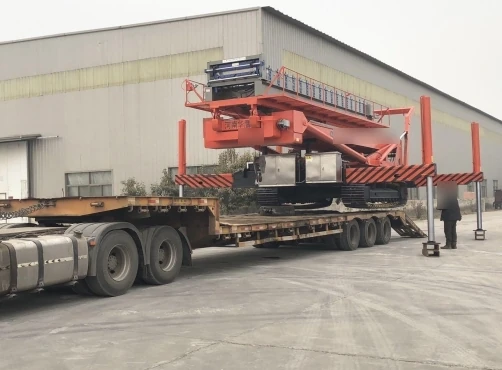
A road-delivery offer for a roof-forming lift can describe three different arrangements: equipment installed on the vehicle being driven, modules carried to a destination chassis, or a complete crawler machine carried as cargo. These arrangements can serve related project goals while needing different vehicle, load and handover information. The first buying question is what actually travels, on what carrier, and in which documented state.
The working system raises a compatible roof-panel former near the intended output position. That use does not establish public-road status. This guide compares the journey boundaries of a truck-mounted forming-lift proposal; the destination’s competent parties must determine registration, permissions and the requirements for the actual movement.
Contents
- Choose the road-transport question behind the offer
- Connect dispatch, road legs and site arrival
- Compare complete journeys rather than category labels
- Prepare a movement brief that closes the right gaps
- FAQ
Choose the road-transport question behind the offer
Separate the installed vehicle from equipment carried as cargo
Write a plain description before collecting a folder of certificates or drawings. Is the forming equipment installed on the vehicle being driven? Is a crawler machine carried on a separate trailer? Are lifting modules and the forming line shipped separately for assembly after arrival? Name the vehicle or carrier separately from the equipment it supports.
These descriptions guide the next review; they are not legal classifications. The destination adviser must determine the applicable classification from the actual arrangement and local requirements. Where the commercial offer uses “truck-mounted,” ask whether it includes an identified chassis, describes an intended integration route, or refers only to the lifting assembly.
Identify the attached assemblies and loose items
List the forming machine, ancillary equipment, support components, feed equipment and loose items present during the journey. Identify anything removed or carried separately. A module omitted from the transport drawing but included in the shipment still needs a defined packing unit and receiving responsibility.
Do not assume that an item visible in a work photograph remains attached in transit. Equally, do not assume that removal is permitted or straightforward. The equipment and integration records must define the relevant transport arrangement, including dependencies on competent preparation. This page does not provide dismantling, locking or securing instructions.
Match every dimension and mass to its named state
Use distinct labels for the installed work arrangement, its defined transport state and any separately packed modules. Link dimensions and mass records to those labels. A “folded” description alone does not establish a permitted travel state: the document must identify what is folded, what remains supported and which configuration it covers.
The same discipline applies to photographs. They can show a carrier, a visible folded structure or deployed supports. They cannot show the complete securing design, the condition of hidden connections or the approval status of the journey. Use them to clarify the question, then request the appropriate records.
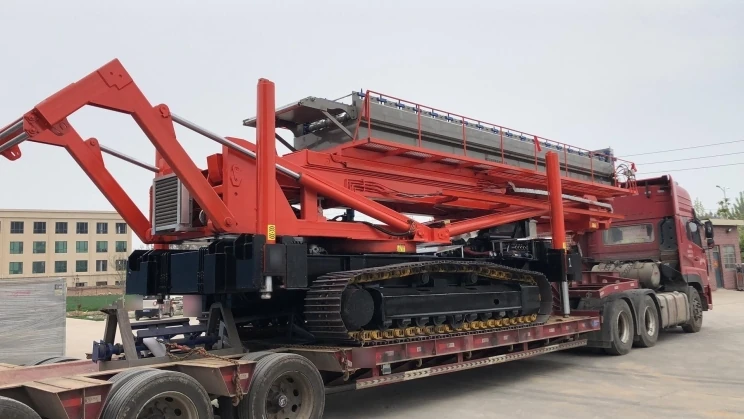
Reference photograph of crawler equipment carried on a separate vehicle. It does not show a truck-mounted installation driving under its own chassis or establish road approval, transported dimensions or load security.
Connect dispatch, road legs and site arrival
Locate the carrier changes and receiving boundaries
Describe the journey in stages: dispatch location, public road, any intermediate carrier handover, destination gate, unloading area and internal route. Identify what carries the equipment on each road leg. A single delivery destination can conceal a change of vehicle or trailer before the equipment reaches the site.
For a hypothetical proposal, an unchanged equipment module is carried to an intermediate terminal and a different carrier is proposed for the remaining road journey. Its equipment identity may remain applicable, but the first carrier’s acceptance does not establish the second loaded arrangement. Ask which party supplies the information for the onward carrier, what receiving boundary has been proposed at the terminal, and who resolves missing inputs before the onward movement is agreed. This describes a scope question, not a transfer method.
The final destination may also involve a different equipment state. A packed module can arrive before a local chassis is ready. A machine carried on a trailer may need a separate internal-movement review after unloading. State the intended handover condition so logistics does not assume the receiving team will resolve an undefined transition.
Retain the destination and source jurisdiction
The DVSA guidance on securing loads on HGVs and goods vehicles covers loading, securing and unloading goods, and states that it applies to England, Scotland and Wales. It is a relevant source to consult for a movement within that scope, not a global road-approval checklist or confirmation of an ARCLIFT transport arrangement.
For another destination, identify the corresponding competent local sources and advisers. Even where a general guide is relevant, the carrier still needs information about the actual load. A link to official guidance should not replace the configuration data or a project-specific transport decision. Record the date and scope of the local response so the team can recognize a later change.
Define the condition handed over at the site
A road proposal should end at an identified receiving boundary, not merely a postcode. State whether the site expects an installed vehicle, a prepared crawler or separately packed modules, and where the transport party hands those objects to the project. The site then needs its own access, support and transfer review for that condition.
A module can reach a destination while its local chassis is still unavailable; a crawler can reach a gate without an assessed internal route. These are delivery-scope dependencies. Ask which party provides the information needed at the handover and what remains outside the transport allowance. This does not choose an unloading or assembly method.
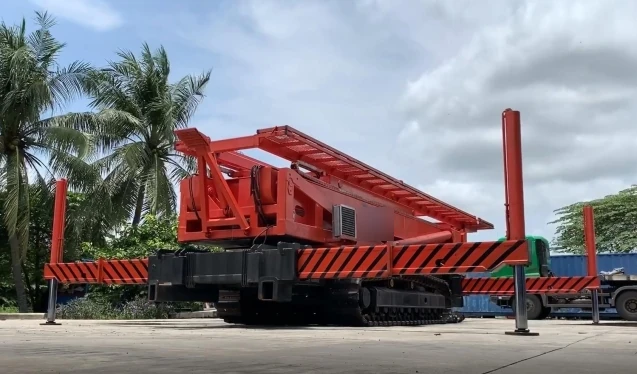
Reference photograph of folded crawler equipment standing on deployed supports. It cannot establish a road-travel state, permission to move on those supports, or the configuration of a truck-mounted roll-forming lift.
Compare complete journeys rather than category labels
Keep chassis integration with the installed vehicle
For a proposed truck-mounted installation, the review must identify the relationship between the chassis, mounting structure and equipment. Vehicle integration information and the relevant destination decisions need to concern that actual arrangement. A general vehicle record does not, by itself, explain an added lifting system or a changed forming module.
The chassis interface guide addresses that integration boundary. This road-transport article does not repeat its engineering review or calculate axle loading. If the proposed chassis changes, the transport file should flag the change rather than carry forward conclusions based on the previous vehicle.
Keep the onward load arrangement with its actual carrier
When equipment travels on a separate trailer, the carrier and cargo remain distinct objects. Information about the equipment alone does not describe the loaded combination. A change of carrier can leave the machine record intact while changing the vehicle, trailer, proposed cargo position and overall transport geometry that the onward reviewer needs.
This comparison does not require every equipment document to be recreated. It prevents an unchanged module description from being used as if it also described a different carrier and load. Any change in the module’s own preparation or packaging needs to remain visible in its state information as well.
Compare destination work and return cargo
Keeping equipment integrated may reduce some destination assembly interfaces, while introducing vehicle-integration questions that need closure before dispatch. Separating modules may move work into the destination assembly stage. These are possible scope differences, not promises of lower cost, quicker travel or simpler approval.
The delivery record describes the journey to the site. A later departure can involve a different set of installed items, carried equipment and packaging, even when the same vehicle returns along the same road. Ask the vehicle and carrier parties to identify the intended return configuration alongside the outward configuration. The comparison should say what remains installed, what travels as separate cargo, what stays at the site and what leaves by another carrier.
For a hypothetical delivery, a module and its protective frame arrive together, but the module stays for installation while the empty frame returns with loose accessories. The outward cargo description no longer identifies the return load. In another hypothetical arrangement, an accessory is detached during site preparation and subsequently travels on the same vehicle in a different location. Detachment alone does not establish that the vehicle has less cargo or that an earlier transport decision remains applicable.
| Movement proposal | Identify before comparison | Separate destination question |
|---|---|---|
| Installed truck-mounted equipment | Actual chassis, installed assembly and documented transport state | Vehicle integration and local road-use review |
| Module for a destination chassis | Cargo units, carrier and receiving condition | Chassis availability and assigned integration scope |
| Crawler carried on a trailer | Crawler state and actual carrier/load combination | Transfer boundary and internal site route |
| Different onward carrier | Continuing machine data and new loaded arrangement | Intermediate handover and onward receiving responsibilities |
| Return packaging or loose accessories | What actually leaves and on which vehicle | Revised load/state records for that departure |

Reference photograph of a coil-handling scene beside vehicle-mounted equipment. It does not describe a road-ready loading state, verify the vehicle installation or establish any permitted lifting operation.
Prepare a movement brief that closes the right gaps
Preserve unchanged equipment data through a carrier change
At an intermediate terminal, a new onward carrier can leave the equipment identity unchanged while changing the loaded geometry, support interface and receiving arrangement. Keep the continuing machine records and request information for the new carrier-and-cargo combination. A previous carrier response has value within its stated scope; it is not the onward movement decision.
The trade-off is between reusing applicable data and making a changed journey appear fully reviewed. The buyer should identify the new physical boundary and the party who answers it. Recreating every machine document adds little if the missing answer is the onward load arrangement.
Ask which supply items make the delivery complete
Compare the transport allowance with the equipment scope and the destination work it assumes. An integrated vehicle proposal may retain assembly work before dispatch; a module proposal may depend on a local chassis, integration and later checks. Those are different commercial boundaries, not evidence that either journey is cheaper, quicker or easier to approve.
Use the 40HQ planning guide only when container shipment is actually proposed. Use the destination receipt guide to establish what arrived and its observed condition. Neither document closes a public-road decision before or after that boundary.
Describe the actual journey for destination review
- Identify the transported object and its relationship to the vehicle or carrier.
- Identify any intermediate carrier change, the onward combination and the party responsible for connecting the two receiving and dispatch boundaries.
- State the transport height and other envelope data sources, with their applicable state.
- Link the intended roof work and site geometry to the destination setup location.
- Identify forming material, panel length, coil and feed items included or carried separately.
- Record wind and weather review responsibilities at loading and receiving locations.
- Provide ground or floor information for the receiving area and internal route.
- Map access, turning, overhead and route constraints at the destination gate.
- Distinguish outrigger or support deployment from the defined carriage state.
- Name the destination transport, chassis and container review owners where relevant.
- State power, control and documentation needs for any post-arrival assembly boundary.
When this proposal may not fit
A transport proposal may not fit when the offer does not identify whether it supplies a vehicle installation or modules, when records describe different load states, or when the actual carrier and destination responsibilities remain undefined. Another vehicle or route requires its own review. Do not fill missing dimensions from photographs or carry an earlier journey decision onto a different loaded combination. This article grants no road, unloading or site-movement permission.
Define the road-to-site handover in the enquiry
Define the road-to-site handover with ARCLIFT. Send the equipment scope, proposed carrier/vehicle arrangement, destination and receiving site, including entry height references, work-zone location and floor or ground questions. Ask which transport and post-arrival integration items the offer includes. ARCLIFT can coordinate equipment information and supply boundaries as a technical selection and supply partner. Final project-specific road, vehicle, unloading and site decisions remain with the appointed parties. Editorial photographs illustrate different arrangements and cannot authorize a journey or verify the proposed load.
FAQ
Does “truck-mounted” mean the system is approved for road travel?
No. The phrase describes a proposed relationship to a vehicle. The actual chassis, installation, transport state and destination requirements still need review. A public product reference cannot establish those decisions.
Is equipment on a low-bed trailer a truck-mounted system?
Not necessarily. The photograph may show equipment carried as cargo on a separate vehicle. Identify the machine and its carrier separately; do not infer the intended operating installation from the transport scene.
Can one transport file cover several journeys?
Only the responsible parties can determine which records remain applicable. Compare the configuration, load state, vehicle, route and destination conditions for each journey. A shared folder does not establish that these factors are unchanged.
Does receiving the machine complete the road-transport review?
Receipt records show what arrived and the handover condition within their scope. They do not retrospectively establish road authorization or approve unloading, internal travel, assembly or operation. Those decisions need their own relevant information and responsible reviewers.