
A destination-chassis purchase has two deliverables to define: the equipment package being supplied and the completed vehicle arrangement the buyer expects. The truck-mounted roll-forming lift family carries a compatible roof-panel roll former on a vehicle-mounted lifting structure. Its truck, stabilisers, machine layout and interfaces must be considered together. Buying a locally available truck resolves vehicle supply only; it does not purchase the missing integration work.
Compare a new local chassis, an existing fleet vehicle and a supplier or integrator’s actual offer by asking what each needs to reach the same completion point. This guide addresses that commercial sourcing choice. The chassis-interface review develops the physical pairing using the exact vehicle and equipment information.
Contents
- Choose who supplies the chassis
- Make the equipment and vehicle offers comparable
- Close the candidate review before ordering
- Manage arrival and changes as one purchase
- FAQ
- Ask for a supply route with visible boundaries
Choose who supplies the chassis
Choose the vehicle source and the finished deliverable
A new local chassis lets the buyer request a candidate build from a dealer, but its options and technical records must match the integration brief. An existing truck begins with the actual vehicle’s build, condition and modifications. An integrator-led offer can bring vehicle sourcing and installation into one commercial scope, provided that offer identifies what it includes. These are different starting points for the same completed-equipment question.
The catalog describes truck-mounted architecture without establishing chassis inclusion. Discuss a vehicle-included route only when an actual provider offers one, and compare its remaining destination work with the local route. No general saving or delivery advantage follows from where the chassis is bought.
| Candidate supply route | Information that makes it reviewable | Deliverable to request from the offering parties |
|---|---|---|
| New chassis bought locally | Exact proposed build, options and candidate-specific technical records | Vehicle supply plus separately identified integration and completion scope |
| Existing fleet vehicle | Vehicle identity, current condition, build records and modification history | Candidate assessment and the work needed for the proposed arrangement |
| Dealer or integrator coordinates supply | Identified candidate and its connection to the equipment brief | A stated vehicle, integration and handover package with exclusions |
| Vehicle included, if actually offered | Specified vehicle and installed equipment arrangement | The physical delivery condition and any unfinished destination work |
The final deliverable may be received equipment, an installed assembly or a defined completed handover. Name it explicitly before asking for prices. Otherwise a cheaper offer may simply end before the work the buyer needs.
Identify the party joining the two purchases
The equipment seller and vehicle dealer may each describe their own scope accurately while leaving the connection between them unpriced and unassigned. Name the integrator who will coordinate the candidate vehicle, equipment requirements and completed arrangement. Confirm what that party is engaged to review and deliver before expecting it to approve a combination developed elsewhere.
The ARC-T25 truck-mounted reference can identify the equipment discussion, but the actual proposal needs its own lifting assembly, forming machine and interface description. A model reference does not choose the local chassis or appoint a provider for installation.
Separate availability from suitability
A dealer may have a vehicle immediately available while the preferred configuration has a different delivery schedule. Record availability as a commercial input, separate from the technical candidate status. A stock vehicle should not gain an assumed compatibility advantage merely because it can be purchased quickly.
If the buyer already owns a truck, request the records and condition information the reviewer needs. Prior use, modifications or missing build information can change the review effort. Do not treat ownership as evidence that conversion is feasible, or assume that an existing registration covers the completed equipment arrangement.

Reference photograph of a truck-mounted arrangement and nearby suspended coil. It does not identify an approved candidate chassis, included delivery scope or permissible handling method.
Make the equipment and vehicle offers comparable
Price the same completion boundary
Choose the point at which the buyer expects the quoted work to end. “Equipment received at the integrator” leaves vehicle supply, installation and later checks to other scopes. “Equipment installed on the identified vehicle” includes a physical assembly but still needs its handover deliverables defined. These descriptions make an offer easier to assess than a broad promise of a complete solution.
Compare actual products and services to that endpoint. The equipment package should identify the lift, compatible forming machine if included, controls, support arrangement and accessories. The vehicle package should identify the candidate build and specified options. The integration package should identify connecting structures, engineering information, installation resources, connections and agreed verification or documentation work.
A combined quotation can include all three packages or only some of them. The buyer needs to see the boundary, not necessarily one seller. If the equipment supplier provides drawings while a local installer provides labour, ask which party supplies the unresolved design input and who coordinates the two answers.
Identify the services that fall between offers
Put interface engineering, local attendance, connection work and handover records beside vehicle and equipment supply. A dealer may provide candidate records without taking responsibility for equipment installation. An installer may quote work to an agreed design while excluding design development. The useful comparison shows the missing service and its required deliverable, so it can be obtained before the two purchases depend on it.
Locate the vehicle information before placing the order
Ask the dealer how the integrator will obtain the candidate-specific drawings and technical records, and which details can be confirmed before ordering. A general sales brochure can establish a model family but may not describe the actual component positions or options under consideration. Missing information should have a named source and a due date tied to the purchase decision.
The official Volvo bodybuilder resource overview is one example of a vehicle maker describing chassis drawings, wiring diagrams and data sheets for body integration. It illustrates the information category to seek from the candidate’s own supplier. It is not a recommendation of that brand or evidence that a particular vehicle suits a roll-forming lift.
Compare support as a defined service
If separately supplied equipment and vehicle records disagree, the buyer needs an engaged party to coordinate the technical answer. Ask whether each offer includes document review, destination measurements, onsite attendance or revised supply, and identify exclusions. A contact number is different from an agreed service. This is a commercial scope comparison, not an assumed allocation of liability or warranty coverage.
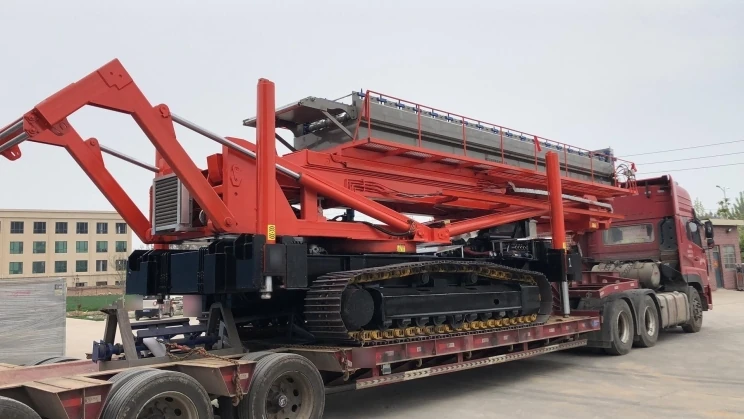
Reference photograph of crawler equipment on a low-bed carrier. It cannot establish the shipping scope, road status or transport method for a proposed truck-mounted system.
Close the candidate review before ordering
Link the equipment version to the exact candidate
Give the equipment proposal and the vehicle candidate separate identifiers, then record which versions were reviewed together. This makes a later substitution visible. The same model family with another wheelbase, installed component layout or option package is a changed candidate, not automatically the reviewed one.
The payload allocation guide explains the mass-property inputs needed by the vehicle specialist. Keep that work connected to the integration drawing and the equipment included in the offer. A new accessory or changed module location should reach both reviewers before it disappears into a revised commercial schedule.
Resolve the candidate before a difficult-to-reverse purchase
An exact vehicle offer, the proposed equipment arrangement and the integrator’s accepted scope should describe the same candidate before the buyer relies on them. A vehicle model family alone leaves build options and component positions open. Ask which information is sufficient to place the order and which conditions still control that decision.
This review can produce a different candidate or a revised equipment scope. The trade-off is between the convenience of an available vehicle and the integration questions its exact build may introduce. A truck should not become a fixed design constraint merely because its commercial quotation arrived first.
Keep the site duty visible in the vehicle discussion
The proposed equipment serves a roof-panel forming task, so the vehicle brief must stay connected to the required outlet position, line arrangement and site approach. A candidate that is easy to buy may still leave the work position unresolved. Pass these constraints into the equipment discussion without trying to solve vehicle integration from a site sketch.
The supplier and local integrator should also identify the intended transport state and separately arriving items. This allows procurement to distinguish the vehicle arrangement being bought from the shipment and the stationary forming arrangement. The jobsite setup guide uses the resulting configuration to examine the complete work position.
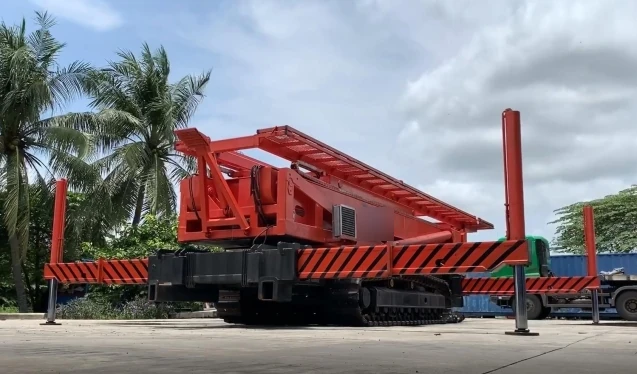
Reference photograph of a supported crawler arrangement. It does not show a destination chassis conversion or verify the configuration offered for a truck-mounted purchase.
Manage arrival and changes as one purchase
Recognize when destination sourcing does not fit
The local-chassis route may not fit when no appointed integrator can reconcile the equipment and vehicle, candidate-specific records cannot be obtained, or necessary local work cannot be included in an acceptable delivery plan. It also remains incomplete when vehicle availability is known but the finished-vehicle review responsibility is not. In those circumstances, compare another candidate or supply route before committing to the first truck.
A named integrator alone does not settle the issue if its quotation excludes the unresolved interface. Check the accepted scope. Where destination transport or vehicle requirements are unclear, assign a competent local reviewer; do not convert a generic equipment description into a claim of local approval.
Complete a purchase-ready question list
- State the destination market, intended road and site duty, and the party reviewing the completed arrangement.
- Match the proposed chassis build to the equipment scope and intended transport state before comparing vehicle offers.
- Identify required production height and roof-panel handover geometry so the intended application remains visible to the equipment review.
- List the forming machine, panel profile, material and coil-related items assumed in the equipment offer.
- Record site access and ground conditions that may constrain the equipment choice or require a separate setup review.
- Confirm who supplies power and control connections, interface documents, assembly resources and verification work, including the response scope if the separately supplied parts present an integration discrepancy.
- Show container or other shipping boundaries, destination receiving arrangements and the integration activities excluded from freight.
- Record the owner of each unresolved requirement and the decision needed before the vehicle is ordered.
Align arrival with the integration workspace
Either purchase can arrive first. Equipment arriving before the chassis may need an agreed holding area and specified storage conditions; a vehicle arriving first may still be waiting for equipment drawings or interface parts. Compare dates with the installer’s actual prerequisites, including the workspace, equipment and information its scope requires. Receipt establishes what arrived, while the integration plan establishes what can be completed with those arrivals.
Distinguish delivery from completed integration
“Truck delivered,” “equipment received” and “identified equipment installed with agreed handover records” describe different outcomes. Ask each offer which outcome it provides. Where another party must supply a prerequisite, make that dependency part of the purchase comparison rather than assuming that two timely deliveries create a complete system.
The comparison may reveal a need for temporary holding, another technical service or a different arrival arrangement. Price that work alongside the equipment and chassis. It is more useful than adding a generic completion milestone that no provider has accepted.
Use the 40HQ logistics guide for shipment-scope decisions and the destination receipt plan for arrival discrepancies. Neither document should imply that receipt authorizes assembly or use. The handover plan needs to name the later stages separately.
FAQ
Can I buy a local truck before choosing the lift?
You can investigate candidates, but purchasing before the equipment scope and integration inputs are reviewed can constrain the later design. Ask which candidate details must be fixed and which technical decisions must close before making a difficult-to-reverse commitment.
Does local sourcing mean the vehicle is excluded from the equipment quotation?
Not necessarily. Read the actual scope schedule. It should say who supplies the chassis, which party integrates the equipment and what the delivery boundary includes. The phrase “truck-mounted” does not answer those commercial questions.
Can an existing fleet vehicle be used?
It may be considered as a candidate if its identity, build records, condition and modification history can support the required review. Ownership or previous use does not establish compatibility, an acceptable load arrangement or approval of the completed conversion.
What should happen if the dealer substitutes a vehicle?
Record the changed build and return it to the equipment and vehicle reviewers. Ask which geometry, load, power, documentation or transport assumptions need another review before accepting the substitution. Do not carry over the earlier candidate’s decision without checking its scope.
Ask for a supply route with visible boundaries
Request a truck-family supply proposal with the destination, candidate vehicle or sourcing preference, intended equipment package and local integration work to include. Add the site approach, production height and transport expectations so the equipment duty stays clear. Ask ARCLIFT, as an integrated equipment supplier, for a project-specific equipment scope and explicit local-work exclusions. Final vehicle selection depends on the reviewed pairing. The editorial photographs retain their stated scene limitations and do not document a local conversion.