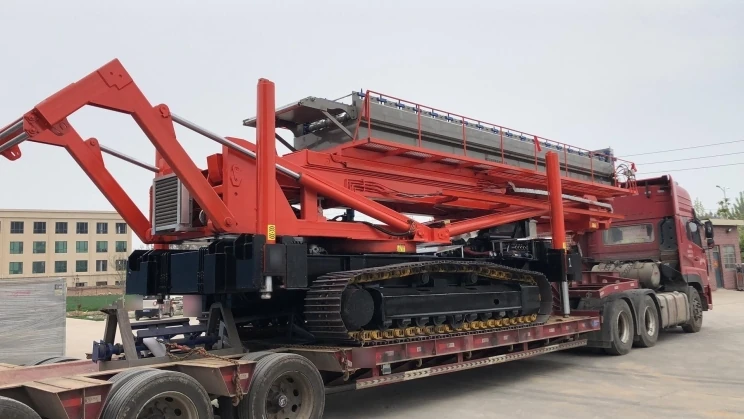
A crawler roll-forming lift and the vehicle carrying it are separate purchases unless the quotation explicitly combines them. The crawler raises a compatible roof-panel former near the intended roof receiving level; its tracked base does not turn it into a road vehicle. When requesting delivery, ask what the carrier price includes between collecting the prepared machine and handing it over at the destination. “Transport included” leaves too much undefined if one party expects a machine at the gate and another expects it inside the work area.
This guide helps compare that commercial boundary. Use the road-transport guide for journey classifications and the crawler forming-lift family for equipment context. The outcome here is a carrier enquiry that identifies the cargo, services and receiving point without selecting a trailer or prescribing loading.
Contents
- Define the cargo behind the carrier price
- Connect collection with the receiving boundary
- Compare two carrier offers on equal terms
- Request the delivery scope you actually need
- FAQ
Define the cargo behind the carrier price
Name the crawler and its prepared condition
Ask the equipment provider which exact arrangement will be presented for collection. Identify the forming machine, lifting structure, attached options and separately packed items. The transport description should correspond to the equipment being bought, rather than a convenient photograph of a similar crawler. A folded structure alone does not identify an authorised carriage condition.
Request the applicable equipment dimensions and mass information from the responsible provider. Keep any preparation still required visible beside that information. The carrier can then explain what it has priced against. Procurement should not reconstruct missing dimensions from a model suffix, picture or unrelated quotation.
Separate equipment preparation from carriage
A carrier may price collection of equipment already prepared by others. An equipment supplier may quote a machine without including all services needed at the collection location. Ask both parties where their responsibilities meet and who supplies the instructions and equipment information required by their respective competent planners.
This commercial question does not tell either party how to prepare, secure or load the crawler. It identifies whether the quoted price assumes work that the buyer still needs to procure. A named preparation allowance is more useful than an unexplained claim that delivery is straightforward.
Count companion cargo as part of the purchase
The former, loose accessories, protective frames, supplied spares and separately packaged components may not travel as one object. Compare the carrier allowance with the full equipment packing scope. Ask whether all identified cargo units are included, whether they share the journey and where any separate delivery ends.
Keep an item that is not yet packed visible as an unresolved cargo description. Do not assign it an imaginary package size. A carrier response can be provisional while stating exactly which missing information prevents a final proposal. That is different from treating unspecified accessories as automatically included.
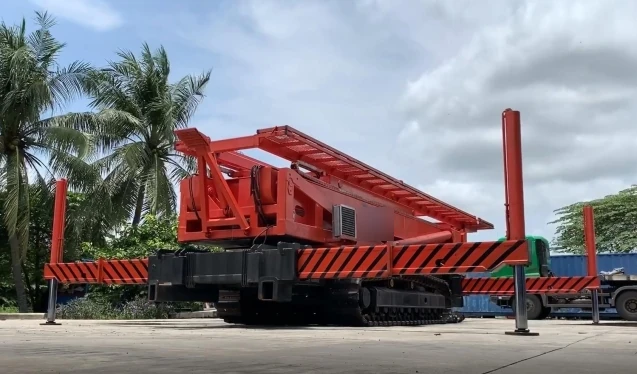
Reference photograph of folded crawler equipment with supports deployed. It does not verify a travel-ready state, transport preparation or permission to move.
Connect collection with the receiving boundary
Ask what happens at the collection location
Describe the actual collection boundary: the equipment provider’s dispatch area, another holding location or a named terminal. Ask which collection services the carrier proposes and what it expects the dispatch party to provide. Include who controls access to that location and which contact can confirm readiness.
For a hypothetical purchase, the supplier’s quotation ends with prepared equipment at its dispatch area. A carrier price starts only after cargo has been placed on the vehicle. The missing service is therefore between two commercial boundaries. Clarify who will propose and price it; do not silently assign it to the driver or machine supplier.
Describe arrival beyond the destination name
A town, site address or project name is insufficient to establish the receiving service. Identify whether the requested delivery ends at an external holding point, a designated receiving area or another agreed boundary. Tell the carrier about known approach restrictions and ask which additional route information it needs.
The initial crawler access survey starts where transport hands equipment to the site. It should receive a defined handoff. A carrier quote does not automatically include internal crawler movement, installation, commissioning or assessment of the eventual forming position.
Keep site resources beside the service they support
Ask the receiving organisation what it can actually provide during the intended delivery period. The relevant answer may concern controlled access, an available receiving area, nominated attendance or a separate handling service. Avoid listing a resource as available merely because it was present during an earlier survey.
If a quoted service depends on a local contractor, identify that dependency beside the corresponding offer. The buyer then knows whether the carrier proposal is complete for its intended boundary or requires another purchase. This comparison gives no unloading method and does not establish the suitability of equipment already on site.

Reference photograph of a suspended blue machine module, not a steel coil. It does not verify the module mass, attachment, supply inclusion or an approved handling method.
Compare two carrier offers on equal terms
Compare an inclusive label with a defined service
Consider two explicitly hypothetical offers for the same crawler and companion cargo. Offer A prices a road journey to the site gate. Offer B identifies a receiving location and includes a separately described arrival service. Their headline transport prices concern different completion boundaries.
Ask A what would be needed to reach B’s stated boundary, and ask B which site resources its arrival service assumes. The trade-off is between included service and work the buyer must arrange. Neither offer is inherently cheaper or more complete until its scope is connected to the same cargo and destination conditions.
| Quote item | Response needed from each carrier | Difference that affects purchasing |
|---|---|---|
| Prepared crawler | Equipment identity and applicable carriage description | An undefined preparation task remains outside the road price |
| Companion cargo | Included packing units and separate delivery exclusions | A second shipment may remain unpriced |
| Collection service | Exact start boundary and dispatch resources assumed | The supplier and carrier may leave an unpurchased interface |
| Destination service | Exact handoff location and stated attendance scope | Gate delivery differs from the requested receiving boundary |
| Changed collection date | Conditions for revising the proposed service | A project programme is not a reserved vehicle commitment |
| Return packaging | Whether any identified return cargo is included | Outward carriage does not define a later collection |
Distinguish cargo information from a transport decision
The equipment provider supplies information about the prepared machine. The carrier addresses its proposed vehicle and service. The responsible project parties resolve the applicable movement requirements. These contributions connect, but none should be presented as a substitute for the others.
The international IMO/ILO/UNECE CTU Code publication describes packing and securing advice. Its publication scope helps explain why cargo preparation is a defined responsibility. It does not select a trailer, provide a securing design or approve this delivery.
Price changed facts before assuming the old quote applies
A different former, extra packed module or revised receiving boundary can change the information on which a carrier quoted. Send the actual difference and request a response limited to its effect on the proposed service. A quotation for the earlier scope should remain distinguishable from the revised request.
The same applies when an intermediate carrier is introduced. Continuing equipment records can remain useful, while the onward service needs its own boundary. Ask who connects the incoming and outgoing cargo information. Do not assume that an unchanged crawler means an unchanged carrier allowance.

Reference photograph of elevated forming apparatus beside building steelwork. It does not verify height, lifting capacity, an approved feed route or active production.
Request the delivery scope you actually need
Use one cargo brief for competing quotations
Give each carrier the same prepared-machine description, cargo list and requested start/end points. Identify what is confirmed, what the equipment supplier will provide later and what the receiving organisation has yet to agree. This makes differences in assumptions visible without forcing premature technical answers.
Keep commercial comparisons in a short scope sheet. Attach the appropriate machine and site information rather than copying selected numbers into an email without their configuration. When a provider qualifies its offer, connect the qualification to the specific missing cargo or service input.
Connect delivery cost with the equipment purchase
An apparently low delivery allowance can leave a separate receiving or handling service to procure. An apparently broader allowance can still exclude internal access or final installation. Use the purchase-cost scope guide to keep those remaining costs visible alongside the equipment proposal.
Where a local contractor is proposed, request its own defined service instead of assuming it performs whatever the carrier excludes. The useful purchase comparison describes how equipment reaches the agreed receiving condition. It does not need a guessed total or a promised completion time to expose a missing service.
Send a specific receiving enquiry
- Identify the crawler, former and companion material or equipment cargo included.
- Supply the provider’s transport height and envelope records for the named prepared state.
- Describe the destination receiving site and the requested handoff location.
- Mark access restrictions, roof-side work areas and routes relevant to the arrival boundary.
- Identify ground or floor information needed by the receiving-service reviewer.
- Distinguish deployed outrigger/support scenes from the documented carriage condition.
- State power or control-related preparation questions for the equipment provider.
- Identify who supplies collection, arrival and any separate container or onward-transport services.
Recognise an incomplete carrier proposal
The proposal may not fit when the cargo condition is undefined, collection and arrival services leave an unassigned interface, or the receiving location differs from the site expectation. Missing information is a reason for a precise follow-up, not permission to estimate a safe arrangement. This guide supplies no trailer selection, ramp instruction, securing method or road authorisation.
Ask for the equipment-to-carrier boundary
Discuss the crawler delivery scope with ARCLIFT. Send the machine purchase scope, destination, transport handoff, site access, height records and receiving floor or ground questions. Highlight which collection or arrival service remains outside the carrier quote. ARCLIFT can coordinate equipment information as a technical selection and supply partner. Final project-specific carrier, receiving and movement decisions remain with the appointed parties. These editorial photographs show reference contexts and cannot verify a quoted service or transport permission.
FAQ
Does a crawler lift include a road carrier?
Only an explicit supply quotation can establish that inclusion. The crawler machine and the vehicle carrying it are separate objects. Ask whether carriage is supplied, separately priced or arranged by the buyer, with the start and finish boundaries stated.
Does delivery normally include unloading?
There is no universal inclusion to assume. Ask each proposed provider to define its arrival service and the resources it expects from others. The buyer needs a complete commercial boundary before comparing offers, without choosing an unloading method from this article.
Can a folded-machine photograph settle the cargo description?
It can help explain the question, but cannot establish the prepared transport state, dimensions, mass or load security. Obtain the applicable equipment information and ask the actual carrier to address that identified cargo.
What if the site cannot yet confirm its receiving area?
Name the uncertainty and request a provisional service scope stating what remains dependent on the receiving decision. Keep the unresolved area beside the quote. Do not represent delivery to the gate as completion of an unconfirmed internal handoff.