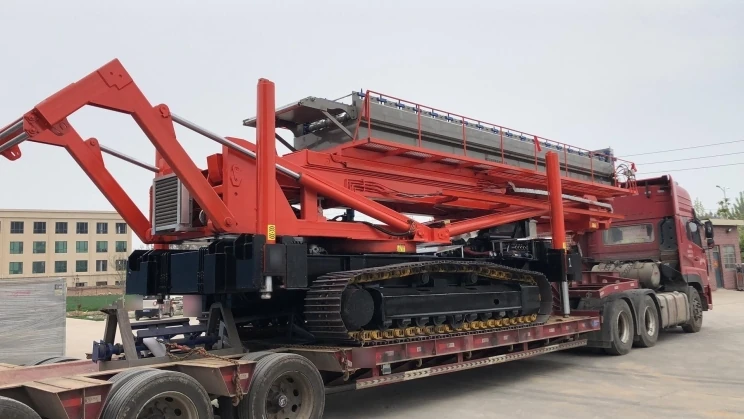
A large crawler-platform shipment can include the prepared main machine, a removed deck section or option, and separately packed accessories. The main machine’s dimensions do not describe every one of those objects or decide how they arrive at the site. Before requesting a delivery proposal, define which items travel together and which configuration items the first handover will actually contain.
This article connects equipment information to carrier and destination questions. For a ceiling-platform enquiry, keep the prepared crawler work-platform configuration identifiable; do not borrow the state of a different machine from a transport photograph. The approved reference photographs here show crawler equipment scenes, including forming apparatus. They illustrate transport boundaries without verifying the shipment under discussion.
Contents
- Define the prepared machine and companion cargo
- Match the machine information to actual transport interfaces
- Compare delivery groupings and their destination effects
- Issue a shipment brief that the next reviewer can use
- FAQ
Define the prepared machine and companion cargo
Identify the state that will leave the preparation point
Identify the machine, attachments, removable items, platform position, track or support arrangement, packaging and loose components included in the shipment. The same model name can lead to different transport data when options or preparation states differ. The reference photograph below shows equipment on a carrier with support legs visible. That observed state cannot establish that the machine is prepared for road travel. Link the actual shipment’s preparation record and dimensions to its state identifier, rather than using visual resemblance as confirmation.
Request dimensions and mass for that state
Include machine and configuration identifiers, prepared transport length, width and height, total mass, detachable component masses and dimensions, and the coordinate convention used for drawings. Add tolerances or verification requirements where the responsible specialist needs them. Do not infer these values from public product cards or editorial imagery. If a weighbridge, drawing or measurement will supply the final value, state the pending evidence and hold point.
Describe items outside the main machine record
Confirmed dimensions for the prepared machine do not describe every item in the shipment. A removed option, separately packed component or accessory can have its own outer dimensions and mass information. Ask which items are included in the machine record and which are separate cargo. Keep the actual package outline distinct from the unpacked component outline wherever packaging changes the information supplied to the transport party.
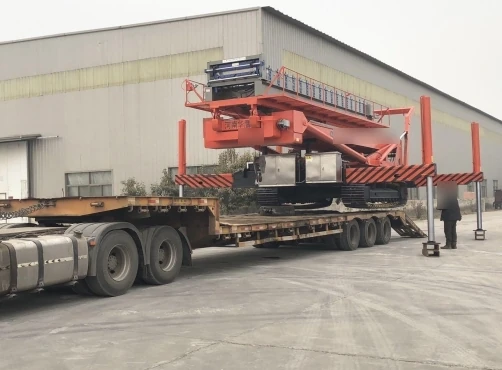
Reference photograph, cropped to exclude the tractor cab, with local privacy and identifier masking. Support legs are visible; this is not evidence of a road-ready state, verified configuration, performance or an ARCLIFT project.
Match the machine information to actual transport interfaces
Ask for the proposed carrier arrangement
Request deck geometry, rated capacities, loading arrangement, support locations, available interfaces and operating limitations from the proposed transport party. Their reviewer needs the prepared machine information for the same shipment revision. “A similar machine used this trailer” is a reference, not a match record. A useful response identifies the proposed carrier and the machine-state record assessed, then states the remaining inputs or the scope of acceptance.
Supply the support information for the stated cargo
Carrier, lifting and restraint reviews may require center-of-gravity information, support zones, ground-clearance limits, track contact information or allowable reactions. The exact needs depend on the method. Record what controlled information exists and which competent party interprets it. A visual balance point, track midpoint or geometric center is not a safe substitute for released center-of-gravity data. Similarly, a crawler track is not automatically an approved tie-down or lifting point.
Keep purpose-specific interfaces distinct
List only interfaces identified for the relevant purpose in the controlled equipment information. Keep lifting points, towing points, parking or braking provisions, transport locks and restraint interfaces distinct. Record access, orientation, compatible hardware boundary and any inspection or preparation requirement without inventing loads or angles. Restraint design, lifting plans and recovery methods belong to competent project parties working from the released data.
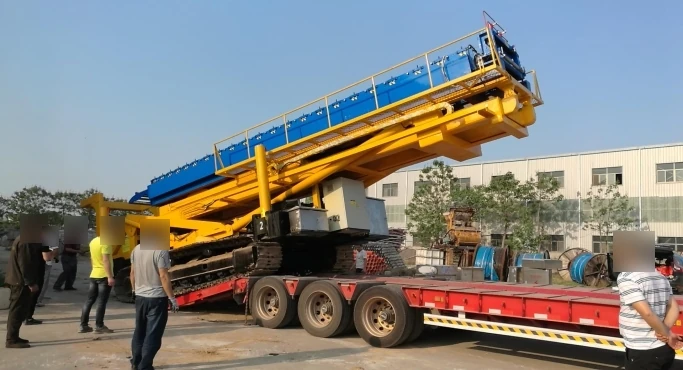
Reference photograph with local privacy and identifier masking. It records a loading-transition scene, not an approved loading method, verified configuration, performance or an ARCLIFT project.
Compare delivery groupings and their destination effects
Compare one load with separate vehicles or later batches
Consider a hypothetical platform shipment with the main unit and a removed optional section. The buyer is comparing carriage together, on separate vehicles or in different delivery batches. The main unit’s data may be identical across these proposals, while the cargo presented to each carrier and the items available at each site handover differ. Obtain item-specific data and the transport party’s proposed cargo arrangement for each option. This describes an enquiry comparison, not a loading or securing design.
The useful comparison is not simply whether the machine fits a carrier. It is whether each proposed carriage scope has enough data for its own review, and whether the delivery grouping matches what the site expects to receive. A later component arrival belongs in the receiving and assembly coordination as well as the transport enquiry. No complete-machine operating state follows from receiving the main unit alone.
Connect the external journey to the site route
Record origin and destination gates, road or port interfaces, bridges, overhead restrictions, width and turning constraints, gradients, surfaces, staging areas and the transition from public transport to controlled site movement. Assign legal and permit checks to the appropriate local specialist. The route condition observed during an early survey may not represent the delivery day, so define recheck triggers for construction changes, weather, congestion or access-control changes.
Use the building-entry survey for the connected destination geometry. The transport data should identify the state handed over to that review, without treating carrier arrival as permission to enter the building.
Recheck the changed carrier or route boundary
A replacement carrier may leave the machine’s confirmed mass unchanged while changing deck geometry, support locations, loading interfaces and the combined transport envelope. Create a change entry linking the old and new carrier records. Ask the affected owners which carrier-match, handling, restraint and route decisions remain valid. Preserve the earlier decision as history; do not copy its release onto the replacement vehicle.
A route change can have a different effect. The prepared machine record may still apply, but a new bridge, gate, transfer point or unloading location may require new evidence from the route or site owner. Record the trigger, affected documents, owner, open decision and closure reference. When an owner revalidates an existing conclusion, record that explicit response as well as any revised document. This makes the reopened scope visible without forcing every unchanged input through a new approval cycle.
| Proposed delivery grouping | Item-specific information to provide | Destination consequence to discuss |
|---|---|---|
| Main machine with all agreed fitted items | Prepared configuration, dimensions, mass and exclusions | Which exact arrangement is received? |
| Removed section on the same vehicle | Its own packaged data and identity | The carrier assesses the combined cargo, not just the machine |
| Option on another vehicle | Separate package and carrier references | Another receiving/route boundary may need review |
| Option in a later batch | Package scope and expected arrival | The first handover does not contain the final complete arrangement |
| Replacement carrier | Continuing machine data plus new carrier geometry/interfaces | Which transport decisions need a new answer? |
| Changed unloading location | Revised site boundary and access context | Which earlier receiving assumptions no longer describe the proposal? |
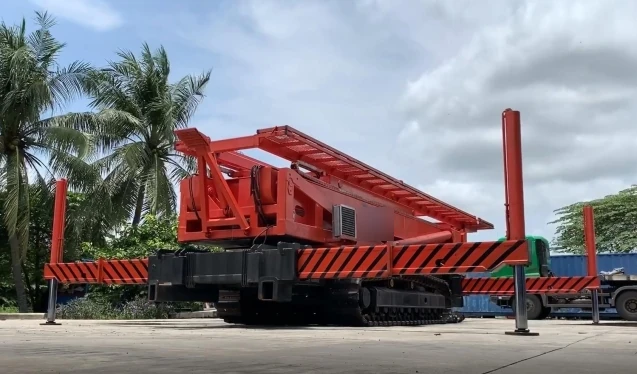
Reference photograph with local identifier masking. Folded equipment is stationary on deployed supports; this does not verify its transport or travel state, configuration, performance or an ARCLIFT project.
Issue a shipment brief that the next reviewer can use
Follow the objects through the handovers
List the planned states from the preparation point to destination release. Include on-site travel, folding or dismantling if applicable, loading, intermediate transfer, storage, unloading and reassembly only where they belong to the shipment. Record where custody and decision authority change. A buyer should be able to follow one equipment identifier through the chain and see where an attachment, package or separate component joins or leaves it.
The loading-transition reference photograph shows a transition between surfaces. It cannot confirm the final restraint arrangement or the condition received at destination. Equally, a receiving photograph of folded equipment on deployed supports cannot establish how it was secured during carriage. Each record needs a time, place, equipment identifier and state, plus the decision it supports. For the buyer, this prevents a preparation photograph from being reused as proof of dispatch or a delivery photograph from closing a damage question about an unseen component. Loading and unloading methods remain separate equipment-specific and site records.
The crawler ceiling-platform acceptance guide addresses the later configuration and destination records. Receiving all packages and accepting the assembled platform remain different decisions.
Use a concise index without hiding separate decisions
One enormous file can become stale and difficult to control; many disconnected sheets can hide conflicting revisions. A practical package uses an index that points to controlled specialist records and shows their status. Include enough data for reviewers to identify gaps, while keeping technical calculations and regulated documents with their owners. Copying values into multiple uncontrolled forms creates false confidence rather than redundancy.
For intermodal moves, identify the cargo transport unit, packing party, carrier, transfer points and receiver. The IMO overview of the 2014 IMO/ILO/UNECE CTU Code describes a non-mandatory global code of practice for packing and handling cargo transport units for sea and land transport. This is context for coordinating the chain, not local law, equipment-specific approval, a container-fit calculation or a restraint design.
Prepare the machine, cargo and destination inputs together
- Machine-state record identifying installed and removed items, with prepared length, width and height tied to controlled drawings or measurements.
- Carrier data describing deck geometry, loading interfaces and the transport party’s document revision, separately from machine data.
- Origin and destination access records covering route boundaries, transfer locations and the party responsible for current restrictions.
- Ground or floor information for loading, temporary holding and receipt areas, with unresolved support questions assigned to the site reviewer.
- Equipment documentation identifying the applicable restraint, support and handling interfaces, without treating them as interchangeable.
- Custody and loose-item register linking package identifiers, receiving owners, observed condition and the next required decision.
- Separate dimensions and mass information for removed options and packaged accessories, identifying what the main machine data excludes.
- Proposed grouping of those items by vehicle or delivery batch, matched to each carrier and destination handover.
When the proposed arrangement may not fit
This package may not fit a shipment whose machine identity, prepared state or companion-cargo scope remains undefined. A confirmed main-unit dimension cannot close a missing option-package or carrier question. The package organizes information for the named parties; it does not select a carrier, design restraint, approve loading or authorize a later operating state. Obtain the configuration-specific records and resolve the particular missing boundary before relying on the delivery proposal.
Start the transport enquiry with the actual shipment grouping
Send ARCLIFT the proposed shipment scope, identifying the prepared main machine, fitted/removed items, separate packages and delivery grouping. Include the destination, receiving site, route and floor questions, task-height context and the transport handover expected by the project. ARCLIFT can coordinate preliminary equipment information as an integrated equipment supplier and technical selection partner. Final project-specific carrier, handling, restraint and site decisions remain with their appointed owners. Editorial reference images do not identify your shipment or prove a released transport state.
FAQ
Can a public product specification be used to book transport?
It can support an early enquiry, but booking and method decisions should use controlled data for the exact machine, installed configuration and prepared transport state, with unresolved values clearly held open.
Does the equipment supplier approve the carrier and restraint plan?
Not automatically. The supplier may provide controlled machine and interface information, while competent transport and restraint parties assess the carrier, route, loading arrangement and applicable rules under the project responsibility matrix.
When should the transport data package be revised?
Revise or revalidate it when the machine state, attachments, dimensions, mass information, carrier, route, handling method, transfer point, destination condition or responsible roles change.
Is this package the same as a destination receipt plan?
No. The transport package coordinates information and releases across the movement chain. The receipt plan governs identity, condition, discrepancy, storage and release evidence after the destination handoff.