
A receiving point and a panel-staging service are different parts of a project. The former may deliver to an agreed receiver while nobody has quoted the space, custody or later handling for panels that wait after receipt. The buyer’s useful output is a boundary map showing what happens commercially beyond the agreed handover, with the separate service either expressly included or visibly left to procure.
The panel-handover guide already compares direct receipt with an intermediate stage. This page holds receipt constant and compares two services after it: provision of a location alone versus an expressly proposed custody service. A crawler forming lift carries a compatible former; it should not be assumed to provide either service or approve roof staging.
Contents
- Define the panel after the agreed receipt boundary
- Separate staging space from custody and later handling
- Compare two services after the same receipt boundary
- Request the missing post-handover service
- FAQ
Define the panel after the agreed receipt boundary
Identify the boundary already agreed
Refer to the actual handover definition rather than inventing another transfer point. State the product condition and panel identity used at that boundary. The staging enquiry should make clear that it concerns a panel already in the named receiver’s custody, not material still emerging from the former. If that earlier boundary is unresolved, return it to the handover discussion first. This distinction prevents a service described as storage from being used to hide an unanswered outlet-support question or an assumed transfer of responsibility that the parties have never defined.
Describe why the panel might wait
Ask the project planner whether installation and receipt are expected to coincide or whether an expressly defined waiting condition is part of the purchase. Name the actual programme dependency rather than assuming that output will always continue or that a buffer is always needed. A hypothetical delayed installation decision can reveal an unpriced staging need, but it does not establish that a particular roof area can accommodate it. Procurement should request the service around the stated waiting condition and let the responsible project parties assess the physical arrangement.
Keep panel destination visible during the wait
The staging question should retain the product reference and intended roof zone or later destination. Two panels with similar appearance may belong to different requirements. Ask the project owner how the service proposal will retain that association, without prescribing labels or a handling procedure. The buyer needs to know whether the requested service includes custody records and a later handover boundary. A provider may offer equipment only, while the project expects continued material responsibility. Identify that difference before treating the staging purchase as complete.

Reference photograph showing a suspended blue machine module, not a coil. It does not verify a staging arrangement, panel support or a supplied handling service.
Separate staging space from custody and later handling
Ask who defines the proposed holding location
HSE’s materials-storage guidance discusses coordination between clients, contractors, suppliers and trades in Great Britain. It supports identifying the parties behind a storage proposal. It does not establish roof suitability, contractual custody or an included service for these panels; those remain questions for the actual project and offers.
Name the project party that will provide or assess the location information. A box marked staging on a roof drawing does not establish capacity, access or suitability. Ask which actual product, period and conditions the proposed location is expected to address, and which records the responsible reviewers need. The buyer can identify a required service without deciding support design or roof loads. If no location has been proposed, keep it open rather than drawing a convenient space merely to make the material-flow diagram appear connected.
Describe custody as an actual service question
Ask whether the provider proposes responsibility for the panel during the named waiting period or merely supplies an item used by others. State which record or confirmation the parties would use to define that commercial scope. This is a request for an attributable agreement, not a universal rule about when ownership or risk transfers. The receiver, staging custodian and later installer may be separate parties. Procurement should show their boundaries clearly without relying on a department name to imply a complete material service or a legal conclusion about an unknown contract.
Keep onward handling separately defined
A post-handover staging proposal needs to say where its service ends and which separate party addresses the next movement or installation interface. The staging provider may exclude that later task. Ask what information the next provider expects and whether the staging offer includes any equipment beyond the holding function. This article does not describe how to move panels or select handling equipment. It helps the buyer identify an unpurchased function that could otherwise disappear between a former quotation, a receiving arrangement and a later installation contract.

Reference photograph showing a suspended steel coil beside vehicle-mounted apparatus. It does not verify an included material service or approved handling operation.
Compare two services after the same receipt boundary
Work through a hypothetical custody-service purchase
Imagine a project has already agreed one receiving boundary and separately decided it needs a post-receipt holding service. Both hypothetical offers below start from that same identified received-panel condition. Offer A provides a proposed holding location only; the buyer retains the material-custody question. Offer B proposes a named custodian for a defined period, with product-to-destination association and an expressly stated next-receiver boundary. Neither offer approves the physical location. The buying question is whether the required custody and information service is actually included after receipt, rather than whether the project should choose direct installation or an intermediate stage.
Use a post-receipt service card
| Post-receipt service field | Holding-location-only offer | Express custody-service offer |
|---|---|---|
| Starting condition | Same agreed received panel and boundary | Same agreed received panel and boundary |
| Purchased subject | Actual location provision and its limits | Named custodian and expressly described service |
| Period | State what location period is offered | State custody period and change assumptions |
| Destination association | Ask who retains the product-to-zone information | Identify the actual included information record |
| Exception | Unresolved panel destination remains a buyer question | State who receives that question and what record is supplied |
| Next receiver | Outside location-only provision unless stated | Name actual end boundary and excluded onward tasks |
The trade-off is the service bought beyond an already fixed receipt point. A location-only offer can be appropriate when another actual party provides custody. A named custodian is useful only when its described service matches the buyer’s need; its title alone supplies no technical or financial advantage.
Test one destination exception against both offers
Suppose one received panel’s intended destination remains unresolved while the other received panels have their assigned zones. This is the single hypothetical exception being compared, not a handling instruction. Ask A who is providing the missing custody and destination-information response outside its location offer. Ask B what its actual service records and which appointed project party receives the unresolved product question. Neither provider should be assumed to choose the panel’s roof destination or authorise onward movement. The useful output is a named, priced service boundary for the exception, rather than an undefined promise to look after the panels until needed.
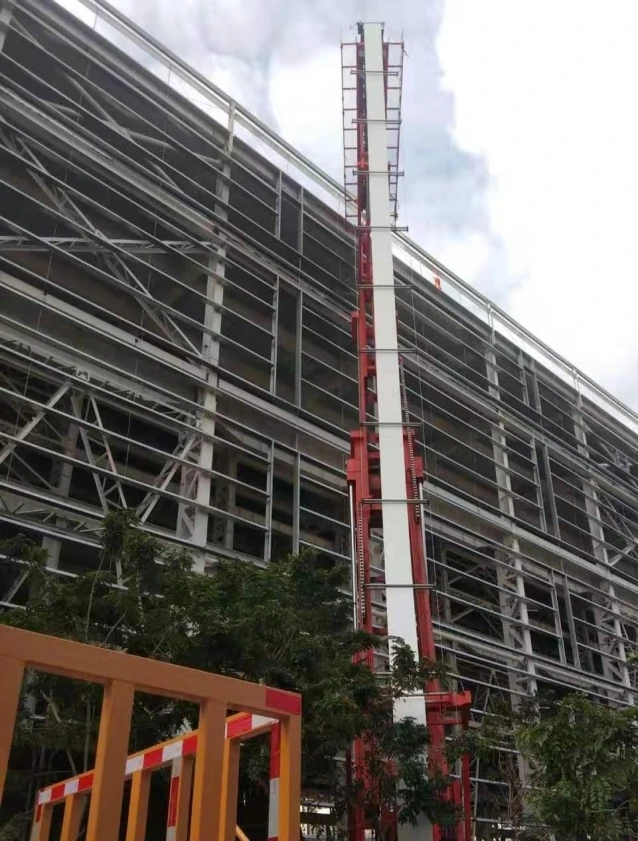
Reference photograph showing a long sheet beside a building and elevated apparatus. It does not verify panel storage suitability, support spacing or a measured length.
Request the missing post-handover service
Include six post-receipt inputs
- Identify the agreed receipt boundary, panel definition and condition from which the staging request begins.
- State the actual waiting need, proposed period and programme dependency without assuming continuous production.
- Name the intended roof zone or later destination and the party defining any proposed holding location.
- Ask for custody, records and onward-service boundaries in the actual provider’s reply.
- Include outlet height, site access and ground or floor information where they affect the separate equipment interfaces.
- State destination documentation, transport context and power questions applicable to any supplied staging-related equipment.
The request should ask whether the buyer needs location provision only or a separately described custody service after the same receipt point. Keep the destination exception and next-receiver boundary explicit rather than asking the former supplier to take responsibility for every later activity through a general turnkey label.
Reconcile custody scope before comparing the service price
Hold the product, starting receipt boundary and required period constant. Then ask each actual provider which location, custody and information functions its amount addresses. The price-scope guide helps retain unpriced services without inserting guessed allowances. If the location offer leaves custody elsewhere, name that actual separate provision before treating it as the same purchase as B. If the custody offer excludes onward service, keep that exclusion. The concrete result is a post-receipt service comparison, leaving the already agreed handover and the physical suitability of the proposed location to their own responsible reviews.
Recognise a staging concept that may not fit
A concept may not fit when the intended location cannot be assessed, custody is unassigned or onward handling is assumed outside every offer. This guide supplies no roof storage approval, support spacing, stack arrangement, panel limit or handling procedure. It also cannot turn a receiving area into a holding facility by changing its name. The responsible project and equipment parties must address the actual location and services before the buyer relies on a post-handover staging arrangement.
Discuss the expressly excluded staging function
Send the post-receipt service enquiry to ARCLIFT with the fixed receiver, requested period and location-only versus custody-service questions. Include site roof zone, outlet height, destination and transport context. Identify the unresolved-destination exception and next-receiver boundary. Ask which equipment interfaces can be coordinated and which service needs a separate actual provider. Final project-specific commitments need the parties’ response. ARCLIFT is a technical selection and supply partner, and these editorial photographs establish no panel-storage suitability or included custody service.
FAQ
Does provision of a location include custody?
Do not assume it. Ask the actual offer to identify its purchased subject and limits. A location-only service can leave custody and destination-information functions with another party, which needs its own actual provision.
Does a named custodian choose a panel’s destination?
No such authority is established. Ask what the actual service records and which appointed project party receives an unresolved destination question. Keep the product decision separate from custody and any later handling service.
How should the next-receiver boundary be described?
Ask the actual parties to name the service end condition and any expressly included records, with onward work excluded or separately defined. This article sets no legal transfer rule or panel-movement method.
Can an assumed production rate define staging space?
This article provides neither a rate nor a space calculation. The project must define the waiting need and obtain the responsible technical response for its actual panels, location and work programme.