
Name the person who owns the panel after the shear before you pick the lift. If that person stands at the eave and can stop the line, a roof-level outlet is worth screening: ARC-T18 at 18.5m, or ARC-T25 and ARC-C25 at 25m, with ARC-RF8 when the line is in the same purchase. If nobody owns the panel, the catalog height will not create a handover. Support length, exclusion, and wind are measure on site. Loads stay confirm on RFQ.
Contents
- Four boundaries and who stands there
- Direct receipt or a pause
- What fails when the zone is a blank
- The sketch to attach
Follow one panel across four hands
The panel is not finished at the shear. Someone supports it, someone aims it, someone takes it, and someone keeps people out from under the outlet. Write four names. The same crew can be more than one name. “The roofers” is not a name.
Shear to first support
The first support is a roller table, a person, or nothing. Write which. If it is a person, say so. That choice may be the reason to move the outlet or to keep the former on the ground.
Support to the roof edge
Direction, the face that may touch a rest, and the place the panel is allowed to stop. The long-panel guide is the selection context. This page is the receiving context.
Edge to the fixing crew
The words they use, and what they do if the panel arrives twisted. A radio plan is part of the zone. A height class is not.
Fixing crew to the finished bay
Where offcuts go, and who may walk under the outlet while a panel is moving. Draw the exclusion before you draw the machine.

Reference photograph. It does not show a handover.
Zone table
| Boundary | What you write | Catalog figure nearby | If you have not measured it |
|---|---|---|---|
| Outlet height | Eave or ridge datum | 18.5m ARC-T18, 25m ARC-T25 or ARC-C25 | Measure on site |
| First support | Table, person, or none | None | Do not leave it as “normal” |
| Run-out length | Metres you need clear | None | Measure on site |
| Exclusion under the outlet | Who is barred | None | Draw it, even roughly |
| Wind stop | Who looks and who shouts | None | Your rule, not a number from this site |
| Coating face | Which face may touch a rest | ARC-RF8 only if that line is in the buy | Architect to confirm |
| Deck instead of a former | People receiving sheets by hand | ARC-F25 25m class and the other ARC-F screens | Load confirm on RFQ |
| Chassis or carrier | How the lift arrived | Truck or crawler, not the zone itself | Confirm on RFQ |
Direct receipt
The panel runs toward the crew and is taken as it arrives. You need the outlet aimed at them, a support for the middle, and a stop if they are not ready. This is the picture people imagine. It needs the clearest stop rule.
A pause
The panel is cut, rested, and moved by a second crew. You need a rest that will not crease the coating. The lift might be simpler. The roof crew might not be. Write the pause if that is the truth.
The middle of a long panel
The middle sags. Name the support there, not only at the ends. A 25m class does not stiffen the sheet.
Night and rain
Say whether panels may rest overnight and who covers them. “Panels are not left out” and “panels may rest until the next shift, covered by the roof contractor” are both usable sentences. Pick one.
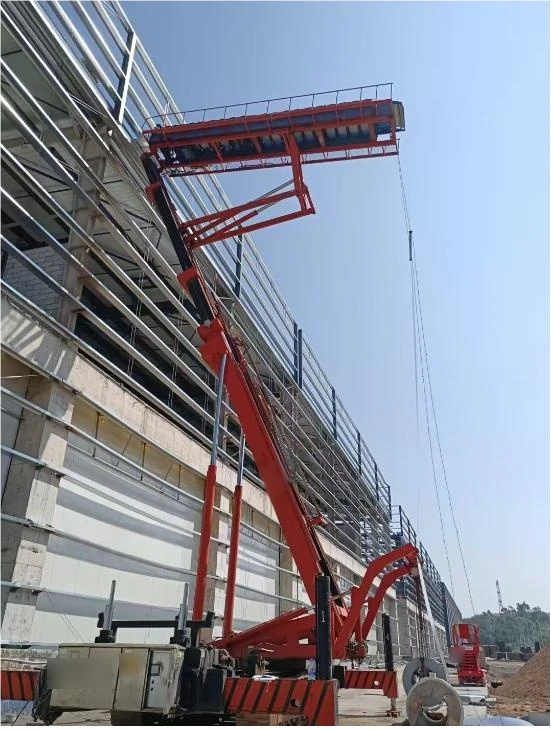
Reference photograph. It cannot confirm the outlet.
The trade-off is a short carry against a crowded edge
Putting the former at the eave shortens the carry and crowds the edge with the machine, the run-out, and the crew. Leaving the former on the ground clears the edge and lengthens the carry. The constraint is the same either way: a support and an owner at every step.
Three names
The person at the shear, the person at the edge, and the person who can stop both. Add the signal: radio, horn, or eye contact, and what happens when it fails.
Offcuts and oil
Name where offcuts land. A pile under the outlet becomes the exclusion you forgot. If the former sheds oil, say which way it falls and whether the finished face can pass through it.
A change of direction
A hip or a step is a new handover. Mark it. Say whether the former moves, the crew moves, or the panel is paused and turned. Unknown next to that bay is easier to quote than a bay you described as a copy of the first.
The first panel of the day
Treat the first panel as a rehearsal. Say who watches it, how long the crew may stop, and what gets written down before the second panel starts. A zone that only works after everyone has learned it by surprise is a hope. Put the rehearsal in the RFQ so the run-out and the rest are sized for the slow pass. If the first panel is scrap by plan, say that, so nobody draws the scrap path as the production path.
Name who removes a cover and who checks the face before the panel is fixed. Those two names are small, and they stop the zone from being redrawn by whoever happens to be holding the sheet. Say where the checked panel waits if the fixer is not ready. A rest in the wrong place marks the weather side. If you do not know the coating rule yet, write unknown and do not let a supplier assume either face is sacrificial.
Walk the exclusion with the site manager and mark the doors that stay open for other trades. A handover drawn as if the bay were empty will fail on the morning the electricians are still on the slab. Note that conflict now. The lift quotation will not invent a traffic plan. The sketch can, in one sentence: who waits, who passes, and who has the stop. Add the same sentence to the line enquiry so the lift quote and the former quote do not aim the run-out at two different crews. If the bay changes direction at a hip, give that hip its own four names or say the same crew walks around it. A copied exclusion from the first bay will put people under the outlet exactly where the panel turns. Write the hand-off as a time of day as well as a place. Morning handover on a wet sheet is a different zone from afternoon handover on a dry one, even when the machine has not moved. You do not need a weather model from this page. You need the sentence your crew will actually use when the sheet is slick. Write that sentence on the sketch, next to the names.

Reference photograph. It is not a handling method.
Failure modes
The elevated handover may not fit when nobody will own the panel after the shear, when the edge is a public way you cannot close, or when the only support is a person you are not willing to put there. It may not fit when the specification demands a splice the crew did not plan. Change the panel schedule or change the outlet. Do not hope the zone appears on delivery day.
Zone inputs
- Work height and the outlet the package must serve
- Roof geometry the panel crosses, including slope and parapet
- Profile, coating face, thickness, and former mass if it travels with the lift
- Wind stop and the name of the person who calls it
- Ground at the setup and at the rest table
- Access for the crew, not only for the machine
- Outrigger or track footprint beside the exclusion
- Destination country
- Chassis or carrier, so the zone sketch is not mistaken for a vehicle
- Transport of the panel if it is paused and moved again
- Voltage only if the stop is tied to the controls
- Documents: the sketch, the profile, and the stop rule
Send the zone with the machine enquiry
Send the work height, the site edge, the destination, the transport of the lift, the handover zone, and the floor or ground at the rest. The signed schedule is project-specific. Editorial images do not draw your exclusion.
Attach the sketch to request a quote and name ARC-T18, ARC-T25, or ARC-C25, plus ARC-RF8 if the line is included. WhatsApp +86 15515922444 or leelogly120@gmail.com can take the same four names. The HSE work-at-height guidance is a Great Britain reference for the people at that edge. It does not draw the zone.
Is the run-out included with the lift?
Only if the quotation says so. Ask for it as its own line.
Can the crew take panels straight from the shear?
Only if you have described the support, the stop, and the exclusion.
Which machine page should I open?
The truck or crawler page that matches how you move between pads. The zone sketch is the same attachment either way.
What if the first panel is scrap on purpose?
Say that. Otherwise the scrap path gets drawn as the production path.