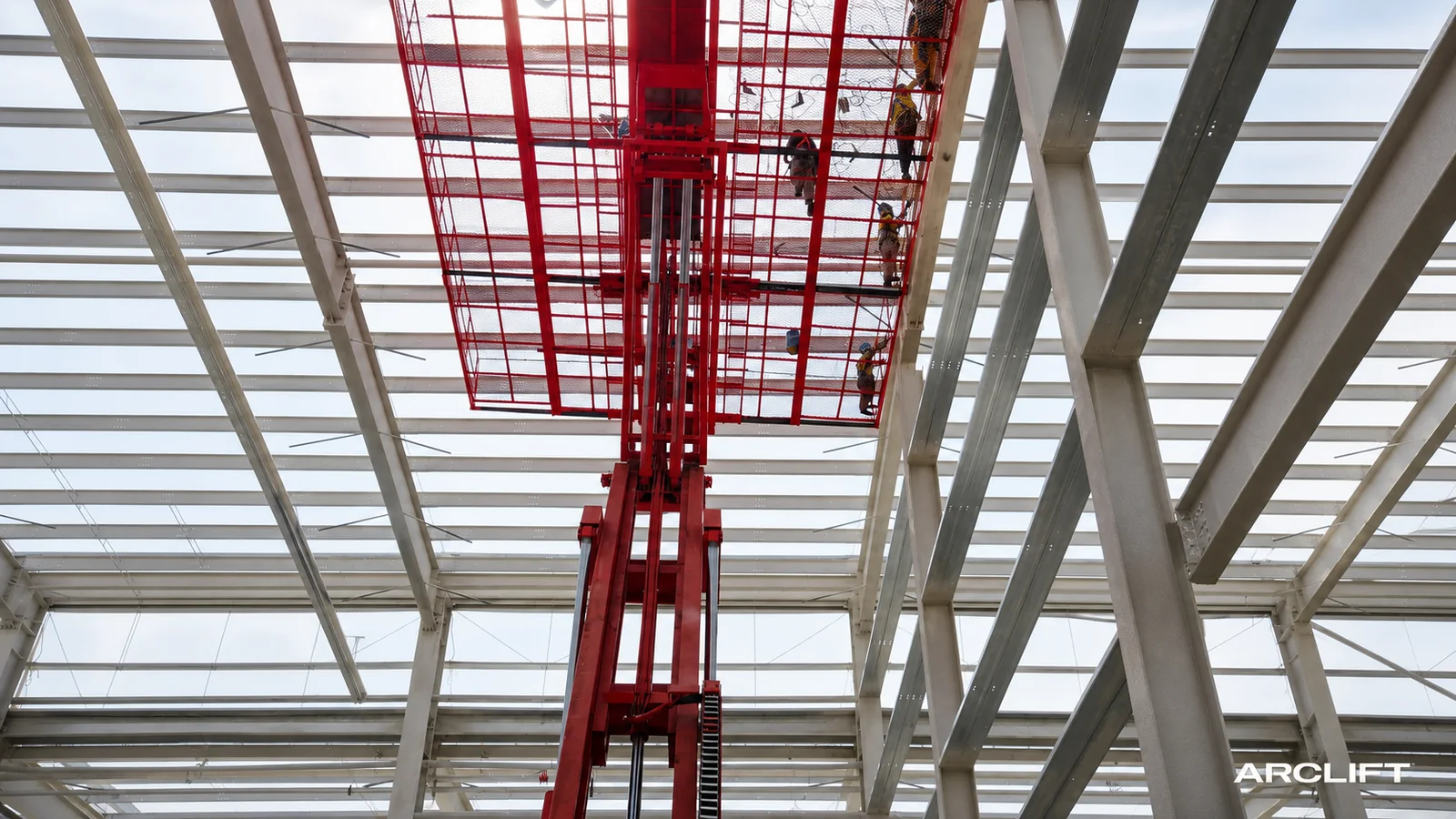
An airport-terminal ceiling access review should freeze the physical route as a controlled evidence package before equipment selection proceeds. The route begins at the project-defined delivery or transfer point and ends at the authorized work-face handoff. Between those points, the record should divide the path into named segments, identify openings, turns, floor transitions, overhead constraints and operational interfaces, and show who owns each unresolved item. It does not grant access, disclose a security plan, approve a work method or prove that a platform fits. Those decisions remain with the terminal operator, competent project roles and equipment reviewers.
The broader airport terminal maintenance access planning guide covers permissions, phasing and operator coordination. The overhead clearance survey covers the work-zone geometry in more depth. This page owns only the route-survey artifact that connects the delivery point to that controlled work face.
Contents
- Define the route and authority boundary
- Survey the physical path as controlled segments
- Coordinate interfaces without publishing sensitive data
- Release the route-survey package and hold points
- FAQ
Define the route and authority boundary
The buyer’s first question is not “Which platform can enter the terminal?” It is “Do the authorized reviewers have a complete, current and traceable description of the path the proposed equipment would need to follow?” That distinction stops a catalogue dimension or a photograph from being mistaken for route approval.
Fix the start and end points
Name the route start in the controlled project record: delivery bay, transfer area, building entrance or another operator-approved handoff. Name the destination as a defined work-face staging boundary, not simply “the ceiling.” If equipment must be transferred, reconfigured or handed between responsible teams, treat each transition as its own interface.
The public article deliberately contains no real terminal plan, route, checkpoint, room, gate, schedule or access-control detail. Those records can be operationally sensitive. Store them only in the project system approved by the terminal operator and share the minimum information each reviewer needs.
Separate route evidence from permission
A measured opening does not authorize passage through it. A clear corridor during one visit does not reserve it for a later work window. An operator-approved time window does not prove floor, clearance or machine compatibility. The route record should keep physical evidence, operational permission and equipment decision as separate status fields.
The FAA airport terminal planning circular page provides general U.S. terminal-planning context and explicitly notes that the circular does not create new requirements. It does not authorize maintenance access or select equipment. Other jurisdictions and individual operators require their own current review.
Assign a route owner and segment owners
One project role should control the route register and its revision. Each segment also needs an evidence owner: for example, the party who can release opening geometry, floor information, overhead-service status, temporary works information or an operational window. Anonymous labels such as “airport team” make escalation difficult.
The record should identify who can accept a segment, who can place it on hold and who approves a change. Names and contact details belong in the private project record, not in public copy or a generic website form.
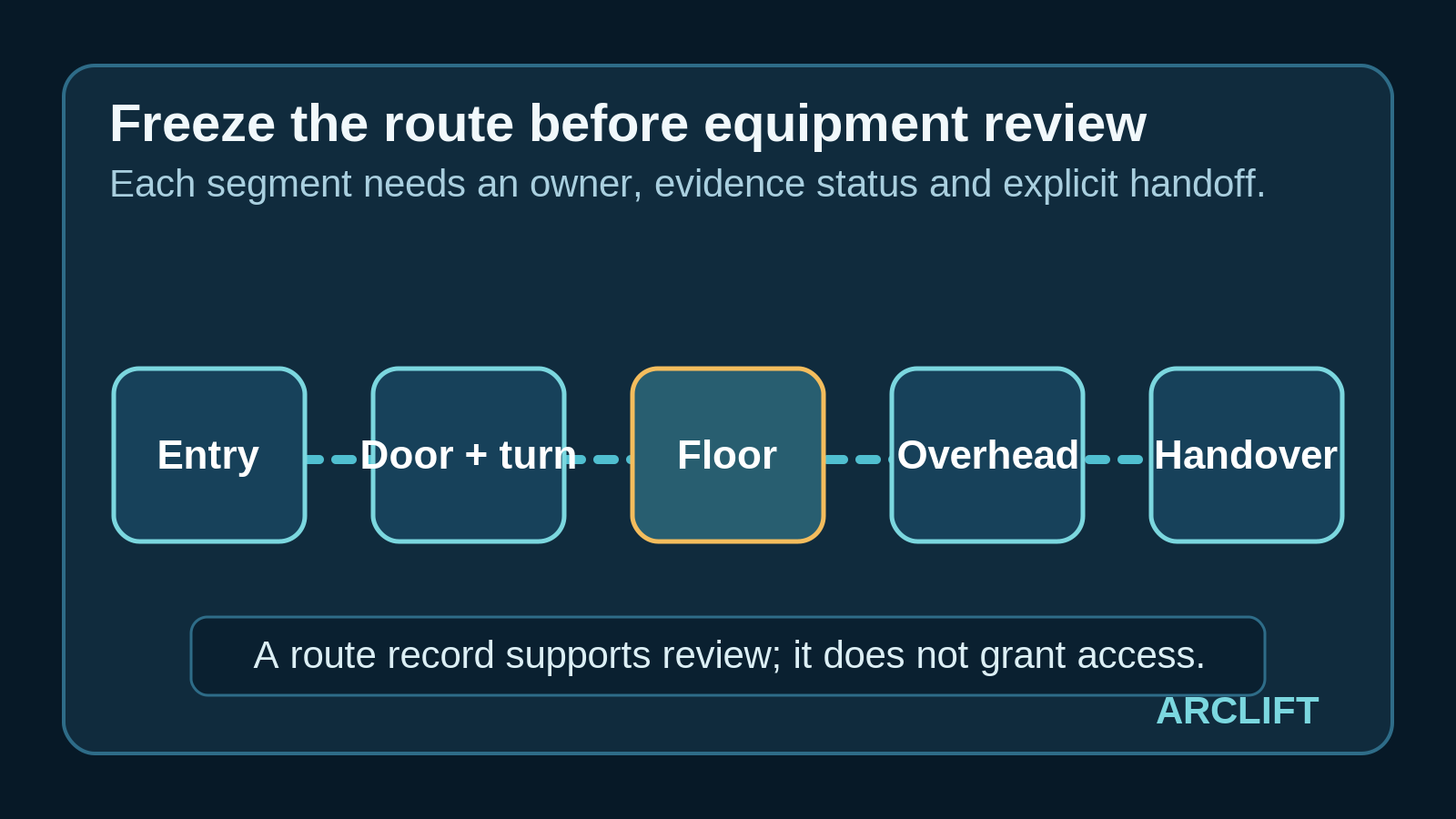
AI-assisted editorial diagram; not evidence of ARCLIFT equipment, configuration, project, capability or result. It is a generic route-control concept, not an airport map, measured survey or access authorization.
Survey the physical path as controlled segments
Divide the path where conditions or ownership change. A useful segment might run from an external handoff to an entrance, from an entrance through a corridor, or from a staging boundary to the work zone. The labels should be project-specific in the private record but anonymised in any external summary.
Record openings, turns and transitions
For each doorway, threshold, turn, ramp, lift, bridge or level change, record the controlled geometry, measurement method, date, obstruction state and owner. Note whether doors, barriers or removable elements are assumed open or removed, and identify who can authorize that state. Do not deduct an informal clearance allowance or treat a nominal opening label as an as-surveyed dimension.
Turning review needs more than a width. It may depend on equipment state, steering behaviour, overhang, swept envelope, floor edge, nearby fixtures and the sequence accepted by the competent planner. The route survey should deliver geometry and constraints; the equipment specialist determines the relevant envelope and whether further verification is required.
Separate floor route data from structural acceptance
Record surface type, gradients, transitions, covers, joints, edge conditions, voids, temporary protection and known restricted areas for each segment. Link controlled floor drawings or assessments where the project authorizes them. Do not infer structural capacity from appearance, building type or a previous equipment movement.
The indoor aerial platform ground-pressure guide explains why machine state, contact condition, route and floor evidence must be reviewed together. The route register should mark structural acceptance as a separate owner decision rather than hiding it behind a “floor OK” tick box.
Capture overhead and side constraints
Record ceilings, beams, signs, lighting, sprinklers, ducts, cable routes, sensors, temporary works and other relevant services without publishing sensitive layout information. Identify whether each record is from a controlled drawing, current survey or operator confirmation, and note changes expected during the work window.
The OSHA aerial-lifts fact sheet identifies U.S. work-zone concerns that include inadequate ceiling height, floor obstructions, overhead objects and nearby people. It is useful as a hazard prompt, not a complete risk assessment, operating procedure, route approval or global legal rule.
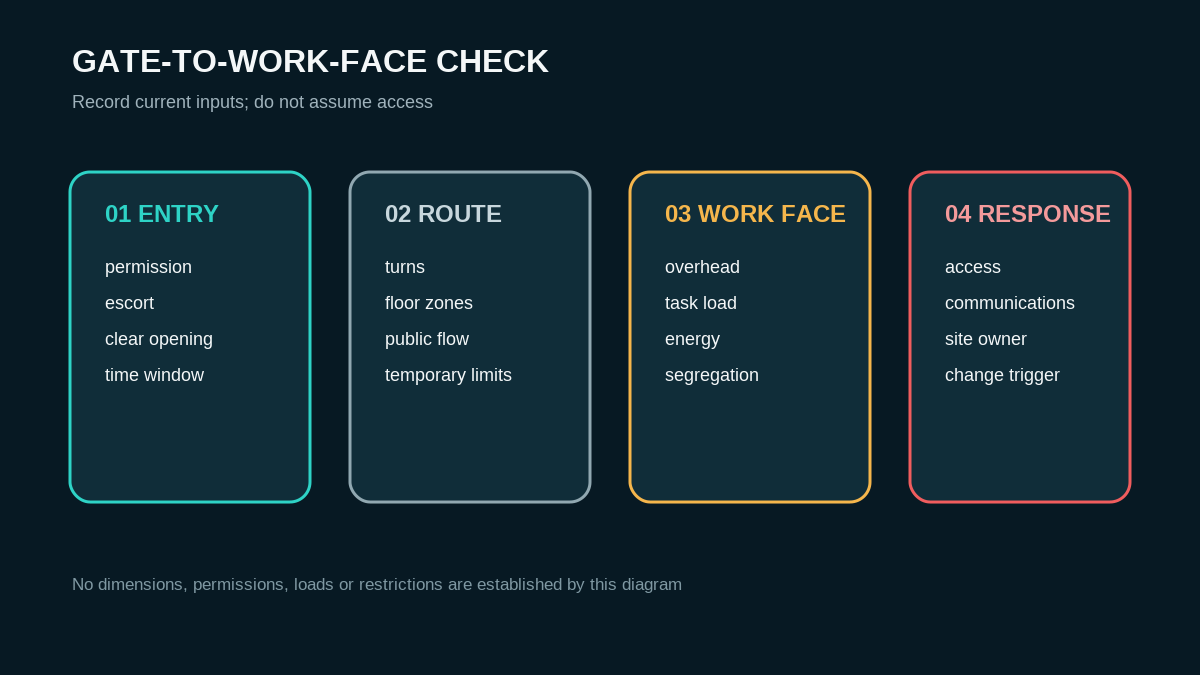
AI-assisted editorial diagram; not evidence of ARCLIFT equipment, configuration, project, capability or result. It does not show a real terminal, approved work zone, secure boundary or released route.
Coordinate interfaces without publishing sensitive data
Terminal routes can cross public flow, tenant activity, cleaning operations, baggage or service interfaces, emergency egress and building-maintenance zones. The route register should show the existence and owner of each interface while keeping site identities, schedules and controlled-access detail inside the authorized project channel.
Align the route with the work window
A physical survey and an operational window must use compatible assumptions. Record which doors, corridors, barriers, tenant areas and service zones are expected to be available in that window, then ask the operator to confirm the current state. If the route relies on temporary removal, isolation or traffic control, identify the responsible plan rather than describing an unapproved procedure.
The active FAA AC 150/5370-2G page is adjacent U.S. guidance for operational interfaces during airport construction. Ceiling maintenance may fall outside that scope, so the article uses it only to reinforce the need to identify interface ownership—not as maintenance authorization or destination advice.
Control temporary and moving conditions
Portable displays, furniture, queued passengers, cleaning equipment, temporary partitions and concurrent works can change a route after the survey. Record which conditions are fixed, time-dependent or explicitly excluded. A photograph can support a dated observation, but it cannot establish that the route will remain clear.
Use change triggers rather than promising a permanently valid survey. A revised work window, construction change, service relocation, floor-protection change, proposed machine change or altered transport state should return affected segments to their owners. The route controller then issues a new revision or maintains the hold.
Protect security and privacy by design
Collect only what the technical decision needs. Redact names, badges, contact details, access codes, camera views, checkpoint arrangements, tenant information and identifiable traveller data. Do not upload restricted drawings or access instructions to public analytics, public repositories or general inquiry forms.
This privacy boundary is also practical engineering control: a concise, permissioned evidence pack is easier to keep current than uncontrolled copies. The terminal operator determines classification, access and retention requirements. The technical team should record the source and approval status without expanding distribution.
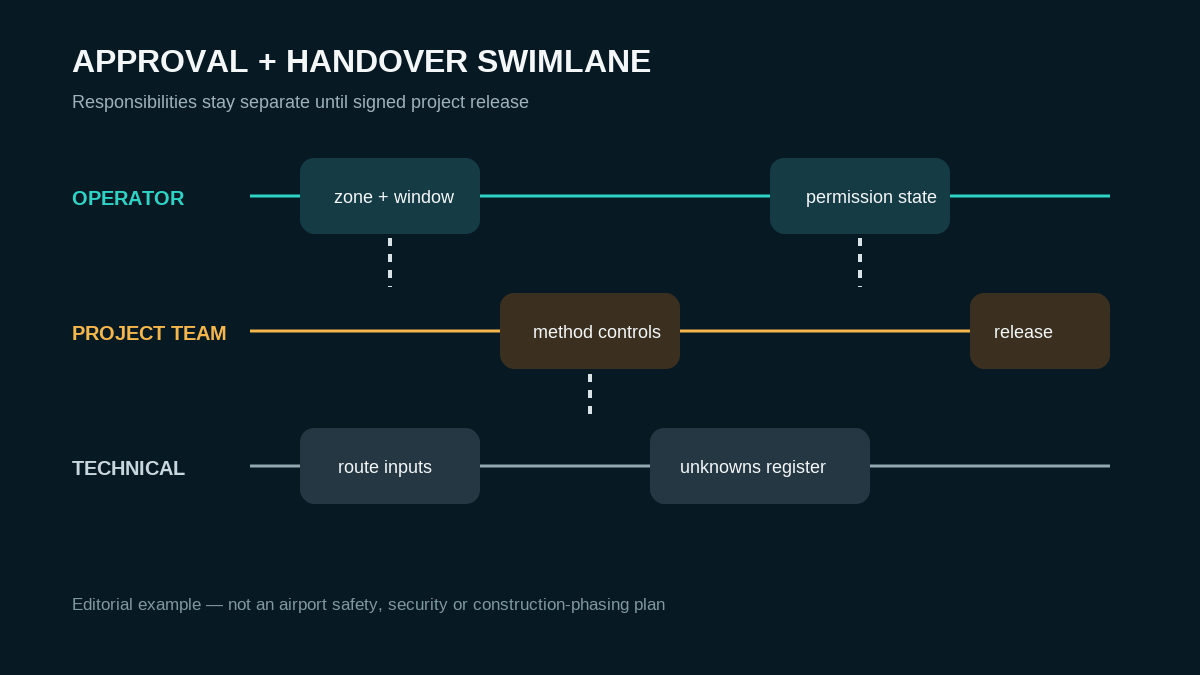
AI-assisted editorial diagram; not evidence of ARCLIFT equipment, configuration, project, capability or result. It is not a terminal procedure, security workflow, permit or signed responsibility assignment.
Release the package and hold points
The route survey is not fit for equipment review when the start or destination is vague, segments are missing, measurements lack a source, temporary states are assumed, floor acceptance has no owner, overhead records are stale, operational interfaces are unresolved or access authority is confused with physical clearance. A neat route drawing does not cure those gaps.
Use a route-release checklist
- Confirm the operator-approved route start and work-face handoff boundary.
- Divide the site access route where geometry, condition, ownership or permission changes.
- Record each opening, turn, floor transition and slope with source and date.
- Identify the proposed equipment transport state used for later envelope review.
- Link floor records and assign structural compliance review to a competent owner.
- Record overhead height, outreach and side constraints without publishing restricted layouts.
- Separate physical route clearance, operational availability and access authorization.
- Name the owner, documentation status and hold condition for every route segment.
- Record temporary zone conditions and the work window on which they depend.
- Record the destination terminal requirement without exposing security-sensitive information.
- Define site, route and transport change triggers and issue a controlled survey revision.
Define the handover record
The released package can include an anonymised route index, controlled segment sheets, measurement records, source list, status register, floor and overhead interfaces, operational-window reference, assumptions-and-unknowns list, privacy classification and signed handover note. Equipment reviewers should receive only the data required for their scope, while the route controller retains the master record.
The UK HSE MEWP selection guidance states that selection should consider the task and risks in the intended environment. It is UK guidance, not a model recommendation, site authorization or proof that this route package is complete.
Request a bounded route and equipment review
Provide an anonymised route-segment index, controlled opening and turn data, floor and overhead evidence status, proposed transport state, work-window reference, segment owners, privacy classification, change triggers and unresolved holds through the operator-approved project channel. Ask the final terminal and competent equipment reviewers to confirm the scope, missing evidence and signed release authority. ARCLIFT can coordinate preliminary selection inputs as an integrated equipment supplier and technical selection and supply partner, but cannot grant terminal access, approve the route or replace project-specific safety and engineering decisions. Every image on this page is an editorial visual, not a site record or suitability result.
FAQ
Does a route survey authorize equipment to enter a terminal?
No. It organizes physical and interface information for review. The terminal operator and other competent project roles retain access, security, operational, safety and work-method authority.
Should the public RFQ include the terminal route drawing?
Usually not. Share the minimum technical information through the operator-approved controlled channel. Restricted layouts, access details, personal information and operational schedules should remain protected according to project rules.
Is doorway width enough to confirm route fit?
No. Openings, height, turns, swept envelope, equipment state, thresholds, gradients, floor conditions, side obstructions and temporary states may all affect review. Competent parties must assess the complete path.
When should the route survey be repeated or revised?
Review affected segments after changes to the route, work window, temporary works, floor protection, overhead services, operational interfaces, proposed equipment or transport state. The route owner decides whether new evidence and release are required.