Create a measured clearance register that describes overhead conditions for each route, setup, elevated task and withdrawal state before configuration or method review. Record the obstruction, measured elevation and offset, service status, data source, date, work state and reviewer. The register does not select equipment, calculate reach or load, approve electrical separation, prove clearance, or replace a site method and rescue plan.
Contents
- Define every zone and work state
- Measure current overhead conditions
- Escalate unknown hazards and missing records
- Use the clearance register without overstating it
- Answer practical survey questions
Define every zone and work state
Record the transport state
Trace the approved route from unloading or staging to the work area. At each opening, turn, gradient and floor transition, record the overhead item that controls clear passage. Door closers, signs, lights, sprinklers, ducts, cable trays, beams and temporary works can create a lower point than the nominal ceiling.
Use clear measured dimensions rather than plan labels. Record the configuration reference as unknown until exact approved information is available; do not draw an assumed ARC-F outline. The ceiling-platform project-data guide explains the broader selection inputs, while this register stays narrowly focused on overhead geometry and status.
Record the setup state
Setup may change the occupied volume. Access panels, guard components, stabilising arrangements, work platforms or other configuration elements may move between transport and task states, but no specific function or movement should be assumed. Request the exact approved setup information for the candidate configuration.
Measure overhead items around the full setup area, not only above the centreline. Include columns, bracing, services, adjacent equipment, doors and movable installations. Record who controls each item and whether its state can change during the work window.
Record the elevated task and withdrawal states
Describe the worker position, task face, tools, materials and likely hand movement around the task. The register should show where the worker and task items may approach structure or services, but it must not invent a platform or worker envelope. Connect each measurement to a labelled work state.
Withdrawal deserves its own check. A route that appears open for approach may become restricted after tools, temporary barriers, nearby equipment or service states change. Record the path back to the safe handover point and the trigger for a new survey.
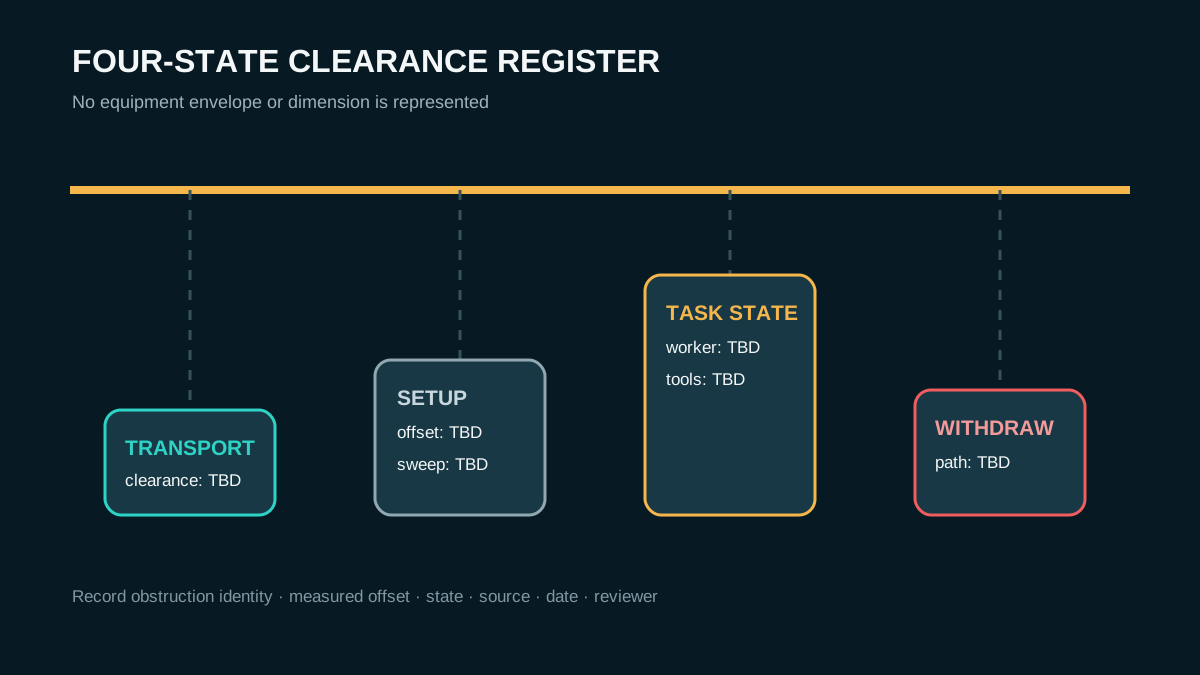
AI-assisted editorial diagram; not evidence of ARCLIFT equipment, configuration, project, capability or result. Tap to open the full-size editorial diagram. These conceptual states are not a load chart, operating envelope, clearance calculation or approved drawing.
Measure current overhead conditions
Build an obstruction inventory
Give every obstruction a stable anonymised ID, type, location and owner. Typical categories include structure, fixed building service, electrical line, moving service, temporary installation, stored item and task-generated obstruction. Photograph or sketch only when the source and publication authority allow it.
Do not infer status from appearance. A cable can be live, isolated, abandoned or unidentified; a duct or rail can move; a panel can hide another service. Record unknown status explicitly and route it to the responsible owner. The purpose is to make uncertainty visible, not to turn the register into a declaration of safety.
Record offsets, elevations and measurement sources
Use a defined coordinate or reference system and state the instrument, method, date and responsible survey role. Record both vertical and horizontal relationships because a single floor-to-ceiling height cannot describe a three-dimensional route or work face. Attach the floor level and work state to every entry.
Include measurement uncertainty and access limitations where the project process requires them. If an item could not be reached, observed or identified, mark the field unknown. Never substitute a convenient value from a marketing drawing, editorial diagram or archival product page.
Control drawing revisions and site changes
Compare current measurements with available as-built or design records, but do not assume a drawing is current merely because it is labelled as-built. Record the drawing number, revision, date and owner in the secure record, then note any field conflict.
Re-survey after ceiling work, temporary installations, service movement, floor-level changes, route changes or task changes. In a live building, the register should identify its valid work window. The stadium planning guide shows why event, changeover and isolated states should remain separate in venue environments.
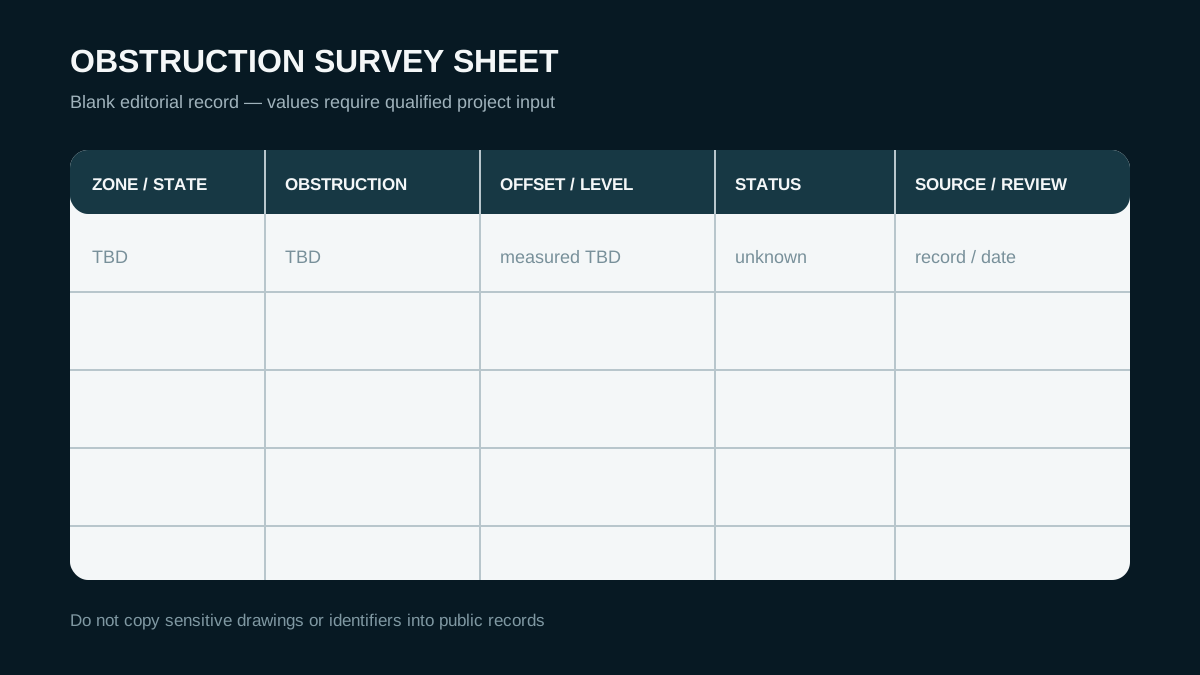
AI-assisted editorial diagram; not evidence of ARCLIFT equipment, configuration, project, capability or result. Tap to open the full-size editorial diagram. This blank example does not provide measurements; qualified project personnel must verify dimensions, status and source records.
Escalate unknown hazards and missing records
Route electrical-line status to its owner
U.S. OSHA’s Aerial Lifts eTool identifies ceilings, overhead objects and power lines among work-zone considerations in U.S. occupational-safety context. Its guidance is a survey prompt only. It does not establish an electrical approach distance for this project, classify an ARC-F reference, decide legal applicability or clear a route.
Record the line or service owner, status, applicable jurisdiction and responsible competent review. Do not use a generic distance or assume insulation, de-energisation or protection. If status or the required separation is unknown, the method remains on hold.
Capture moving services and changing states
Overhead doors, cranes, curtains, hoists, screens, lighting rigs, conveyors and maintenance systems can occupy different positions. Record every state that may coincide with transport, setup, task or withdrawal. Name the owner who can isolate or control movement.
The trade-off is additional coordination: a static snapshot is simpler, but it can miss the condition that actually controls the work. A useful register identifies the allowed state, evidence of that state and what happens when the item cannot be controlled.
Escalate missing as-built data
When records are absent or conflict with the site, do not fill the gap with assumptions. Request a qualified survey, opening-up work or owner confirmation appropriate to the risk. Record the unresolved item, action owner and release condition.
Secure handling matters. Detailed service drawings, electrical status, security installations and site identifiers must not appear in public content or open forms. Use anonymised references and share only the minimum necessary extract through the controlled project channel.
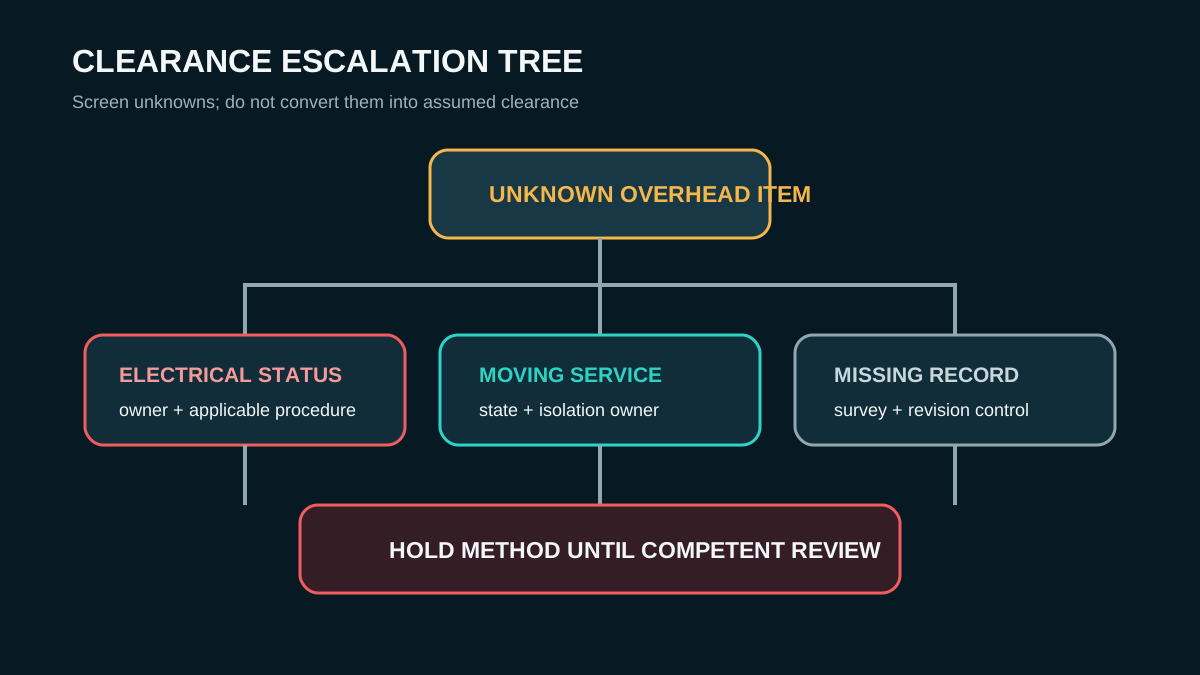
AI-assisted editorial diagram; not evidence of ARCLIFT equipment, configuration, project, capability or result. Tap to open the full-size editorial diagram. This screening aid is not an electrical procedure or clearance approval; applicable jurisdiction, utility and site controls govern the task.
Use the register without overstating it
Hand off to configuration review
The register becomes useful when a reviewer can compare its measured states with exact approved configuration information. That review may need transport dimensions, setup envelope, task envelope, permitted movements, load state and stated restrictions. This article provides none of those values.
The under-ceiling platform buyer guide can place clearance beside floor, task, power and rescue inputs. Keep the register as one input, not a selection conclusion. Any mismatch should return to the project team as an open interface.
Redesign the method when the path is not fit
The current method may not fit when an obstruction cannot be identified or controlled, a required separation is unresolved, the route depends on an unavailable service state, measurements conflict, the worker position cannot be reviewed, or withdrawal is blocked. Record the reason rather than forcing a smaller assumed envelope.
Possible project responses include another route, a different work window, removal or isolation by the responsible owner, enabling work, another access method or a revised task. Those choices require site authority and competent review.
Keep approval with the responsible reviewers
A surveyor records conditions; that act does not approve equipment fit. A supplier can organise questions; it does not approve structure, electrical separation, work method or rescue. The site owner or employer and competent reviewers retain their respective decisions.
Do not publish “fits under,” “zero-clearance,” “safe near live services,” generic clearance dimensions or an assumption that a drawing establishes the current site. Editorial images on this page are explanation tools only.
Issue a measured clearance register
- Site and destination jurisdiction, anonymised zone ID, work owner, survey date and document revision
- Work-zone height, ceiling geometry, task position and horizontal outreach relationship
- Access and transport route, openings, turns, floor levels, gradients and temporary restrictions
- Transport, setup, elevated task and withdrawal states, each with a clear state definition
- Obstruction ID, type, owner, measured elevation, horizontal offset and measurement source
- Structure, services, electrical lines, moving items, temporary works and stored obstructions
- Floor reference, support-path status and connection between level data and each measurement
- Electrical status owner, applicable review, isolation record and unresolved separation question
- Exact configuration information requested, its source/date and all unknown envelope fields
- Site access, communications, rescue route, emergency interface and stop-work trigger
- Redacted drawings, secure transfer record, sensitive-data owner and publication boundary
Send only the clearance register for review
Send only the measured clearance register through a secure project channel to ARCLIFT as an integrated equipment supplier. Include the site zone, height and ceiling records, access and transport route, floor reference, work states, obstruction status, destination context and unresolved interfaces. This request does not promise suitability, fit, approval, quotation, configuration, availability, result or response time. Final decisions require project-specific signed information from the responsible site and competent reviewers.
This article is editorial survey guidance, not a configuration schedule, electrical assessment, operating instruction, site approval or rescue plan. Its AI-assisted editorial diagrams cannot establish an equipment envelope, service status, clearance, capability or result.
FAQ
Why record more than ceiling height?
Ceiling height is one vertical value. A route and task are three-dimensional and state-dependent; beams, services, offsets, turns, worker position and withdrawal can control the method.
Which work states need measurement?
At minimum, record transport, setup, elevated task and withdrawal states wherever their occupied volumes or surrounding conditions differ. Add states when the project method requires them.
How are electrical lines handled?
Identify the line owner and status, keep the source jurisdiction visible, and route the required separation and method to the responsible competent review. Never assume status or use a generic distance.
Does a register prove fit?
No. It records project inputs for comparison with exact approved configuration information. Equipment fit, site approval and the work method remain separate decisions.