A forming-lift purchase may arrive as a lifting assembly, a separately supplied roll former and an interface package on different dates. Plan receipt around those actual objects: what belongs to the order, where each item can wait, and what the later installation team will still need. The useful result is an expected-item map connected to receiving and storage conditions. Counting all delivered packages does not establish that the combined equipment is ready.
The practical goal is a clear handover from transport to storage and then to the responsible installation team. This guide explains that procurement boundary for equipment intended to raise a compatible roof-panel roll-forming machine. It supplies no unloading, lifting, packing or assembly procedure. Those activities require the applicable equipment instructions and an approved local arrangement.
For the earlier shipping decision, see the 40HQ container fit review. For the later integration decision, use the commissioning readiness guide. Delivery receipt sits between them and answers a different question: what was actually handed over?
Contents
- Know what the shipment is supposed to contain
- Record condition without assuming completeness
- Keep stored items connected to their destination use
- Hand over only the scope that is ready
- FAQ
Know what the shipment is supposed to contain
Distinguish the equipment from its carrier
A crawler lift travelling on a lowboy remains crawler equipment carried by another vehicle. It is not thereby a truck-mounted lifting system. Similarly, a machine module carried separately is not the complete production arrangement. Identify the delivered object and its transport state on the expected-item list. This avoids assigning the carrier’s documents to the equipment or treating one photograph of an arriving load as evidence that every contractual item is present.
Map a split arrival to the purchase
Consider an explicitly hypothetical purchase: the lift assembly arrives first, a buyer-sourced former follows, and an agreed interface package is dispatched separately. Start with the final supply scope, then ask each provider to connect its packages to the equipment or connection they serve. This is an illustration of a receiving problem, not an ARCLIFT delivery case. An optional former pictured in an earlier quotation may have been excluded from the order, while a small package might contain an important connection item.
Give the receiving team an expected identifier, provider, stated contents or function, arrival batch and intended holding location. Keep “outside this order” distinct from “still needed by the project.” That distinction lets procurement address an actual shortage without treating every separately supplied machine as a missing ARCLIFT item.
Identify separately supplied equipment early
The roll-forming machine, coil equipment, carrier or electrical connection materials may be supplied by different parties. A separate arrival does not automatically indicate a shortage against ARCLIFT’s scope, but it may still prevent the combined arrangement from being ready. Show both facts: whether the contracted delivery is complete and whether the broader project has the equipment required for its next activity. This distinction helps buyers raise the right query with the right provider.
Match delivery timing to the receiving space
The lift’s arrival date does not have to be the date when the former and installation resources are available. Ask what waiting period the proposed schedule creates, which areas can hold the items and whether the relevant storage conditions can be provided there. If the delivery location cannot accommodate the proposed package or its waiting conditions, compare a revised delivery window or receiving arrangement with the transport and equipment providers. This is a commercial planning question before dispatch, not a storage technique.
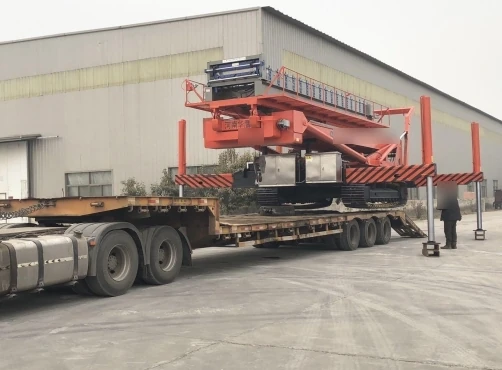
Local reference photograph of crawler equipment at a loading transition; it does not provide an approved loading or unloading method, show rated lifting points or establish shipment condition.
Record condition without assuming completeness
Separate package condition from equipment condition
An undamaged outer package cannot prove the condition of every component inside it. Conversely, a marked or damaged package does not identify the affected equipment without further assessment. Record observations at the level actually visible, tied to item identity and time. The responsible team can then decide the appropriate inspection or disposition. Avoid vague entries such as “all fine” when the record covers only external appearance and some contents have not been checked.
Preserve observations before the context changes
Useful records show the item identifier, the relevant area and enough context to locate the observation. When the equipment moves or packaging is handled, that context can become harder to reconstruct. Establish who records and retains observations under the approved receiving arrangement. This is a recordkeeping requirement, not an instruction to enter an unsafe area or open packaging without authorization. Personnel safety and the agreed local method govern what can be inspected and when.
Give discrepancies different destinations
A missing item, a condition concern and a drawing mismatch need different answers. Procurement may resolve whether an accessory belongs to the order; a technical specialist may assess a suspected damaged connection; the document owner may resolve conflicting revisions. Record who owns each issue and which next activity depends on its resolution. An open commercial question should not be disguised as an engineering rejection, and an engineering concern should not be closed merely because the delivery paperwork has been signed.
A shortage asks where an agreed item is; a mismatch asks whether the object received is the intended item. If a replacement follows, identify the issue it is meant to resolve and the supplier’s intended role for both objects. Keep the original item’s identity and location visible if it remains onsite or arrives later. The second receipt does not turn the first item into an accepted spare or authorize a substitution. One clear discrepancy entry can connect the two arrivals without repeating the entire receipt process.
Treat cargo guidance as context, not a site method
The IMO/ILO/UNECE CTU Code publication describes guidance for packing and securing cargo transport units. That scope is relevant when discussing what shipment information the transport parties should supply. It does not make a generic receipt article an unloading plan, confirm the condition of a delivered machine or establish compliance for every destination. Equipment-specific and local requirements still need their responsible owners.
Keep stored items connected to their destination use
Keep the waiting modules findable
In the split-arrival example, the lift may be in one holding area while the interface package waits elsewhere for the former. The installation team needs the current location of both, including any accessory bag travelling with another batch. Preserve the supplier’s identifiers when the site adds its own storage labels. A receiving photograph can show that an item arrived; it cannot tell a later team where that item is now.
Obtain equipment-specific storage information
Do not infer storage requirements from whether the equipment normally works outdoors. Shipping protection, exposed connections, separately packed components and the expected waiting period can create different requirements. Ask the relevant supplier for applicable storage and preservation information, including the circumstances that require further review. This guide gives no generic oil, moisture, temperature or inspection interval values. If suitable storage cannot be provided, raise that constraint before accepting the proposed delivery timing as workable.
Use a decision table to control the handover
The table below distinguishes common receipt situations. It assigns a question to resolve rather than prescribing a field action. The trade-off is between making space and resources available promptly and preserving reliable information about identity, condition and custody. Moving an uncertain item into the general assembly flow can make the original discrepancy much harder to understand.
| Receipt situation | What the record can establish | What remains unresolved | Next responsible discussion |
|---|---|---|---|
| Main assembly arrives, accessories are in another shipment | Identity and observed condition of this arrival | Completeness for the proposed installation | Logistics schedule and installation dependency |
| Outer package has a condition concern | The observed package condition and time | Internal equipment condition and technical consequence | Receiving team and relevant technical provider |
| Module identifier differs from expected list | A documented identity mismatch | Whether it is the ordered or an approved substitute item | Supplier and project configuration owner |
| Replacement arrives while the original remains onsite | Two identifiable arrivals linked to one discrepancy | Intended role and disposition of each object | Supplier clarification and the owner of the open issue |
| Items are moved into temporary storage | New location and custody if recorded | Suitability of protection and later readiness | Storage owner and equipment provider |
| Delivered items match the list | Receipt against the identified list | Installed fit, controls and site suitability | Responsible installation and integration team |

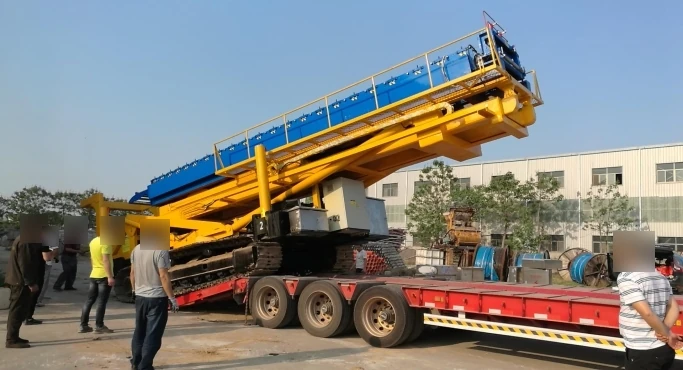
Local reference photograph of a separate blue machine module; it does not identify the contents of a particular shipment or establish an approved handling arrangement.
Keep split deliveries paired at the installation boundary
Return to the hypothetical lift, former and interface package. An accessory bag received with the lift may be intended for the separately shipped former. The expected-item map should show that association rather than assigning every loose item to the main assembly’s arrival batch. Ask the provider to identify the relevant connection and its supplied items; matching colour or hole patterns cannot establish a pairing.
If the former arrives but the agreed interface package does not, the former’s receipt can be complete while the combined installation still depends on that package. If a package arrives bearing another reference, the question changes from “where is it?” to “is this the intended item?” Pass that precise distinction to procurement and the installation team. The mounting-interface guide handles the later connection review; this page preserves the objects and observations needed to begin it.
Hand over only the scope that is ready
Identify the next activity precisely
This receipt approach may not fit an unidentified used machine, a shipment with undocumented substitutions or equipment whose required instructions are unavailable. Resolve identity and responsible technical ownership first. A receiving record cannot establish mounting compatibility, load capability, safe operation, destination approval or permission for personnel to work on the equipment. It should describe only the observations and decisions actually supported.
Separate receipt from installation readiness
“Received,” “available for agreed inspection” and “ready for the specified installation activity” are different statuses. The project should define who can assign each one and what supporting information is required. A shipment can be commercially complete while an unresolved site floor condition prevents installation planning. Conversely, one independent item may be ready for its authorized next activity while another remains under review. Avoid a single green status that hides these boundaries.
Prepare the destination receipt brief
- Identify the destination, receiving contact and expected arrival arrangement.
- Match transport packages and modules to the agreed supply scope.
- Describe the access route and approved receiving location.
- Assign ground or floor information to the responsible site reviewer.
- Identify separately supplied forming and coil feed equipment.
- Retain mounting, power and control documentation with the correct revision.
- Link the later outlet height and roof geometry inputs to the installation team.
- Identify applicable storage instructions and the person responsible for custody.
- Record missing items, condition concerns and document conflicts separately, linking replacement arrivals without erasing the original object’s location or status.
- Name the party authorized to release each defined next activity.
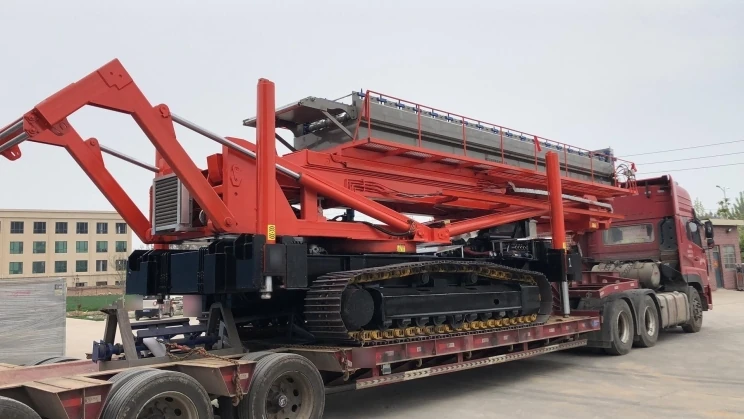
Local reference photograph of crawler equipment on a carrier; it does not prove road readiness, securement adequacy or the condition of a specific delivered unit.
Ask for a delivery scope that supports the project
Send an ARCLIFT delivery-scope enquiry identifying the lift, former and separately supplied interface items. Include destination, transport route, receiving space, expected waiting period and known storage constraints, with the outlet-height, roof-zone and floor inputs for later installation. Ask which expected items and delivery documents the proposed supply includes. ARCLIFT supports equipment selection and supply coordination; final receipt and installation decisions remain with the appointed project parties. The crawler lift reference is product orientation. Editorial photographs illustrate equipment contexts and do not document this shipment or its acceptance.
FAQ
Does signing a delivery receipt approve the installed system?
No. The record should state its actual scope. Arrival, visible condition, contractual completeness, installation readiness and permission to operate are different decisions with different supporting requirements.
What if the forming machine arrives from another supplier?
Record that supply boundary and its dependency on the lift installation. Match the machine identity and current interface information before treating the combined arrangement as ready for review.
Can the equipment wait outdoors because it is used outside?
Do not infer storage suitability from its working environment. Obtain the applicable equipment and component storage instructions and have the responsible team assess the proposed location and waiting conditions.
Should a damaged package be recorded as damaged equipment?
Record the observation accurately and keep the affected item traceable. The appropriate inspection and technical disposition should determine what the package condition means for the equipment and its next activity.