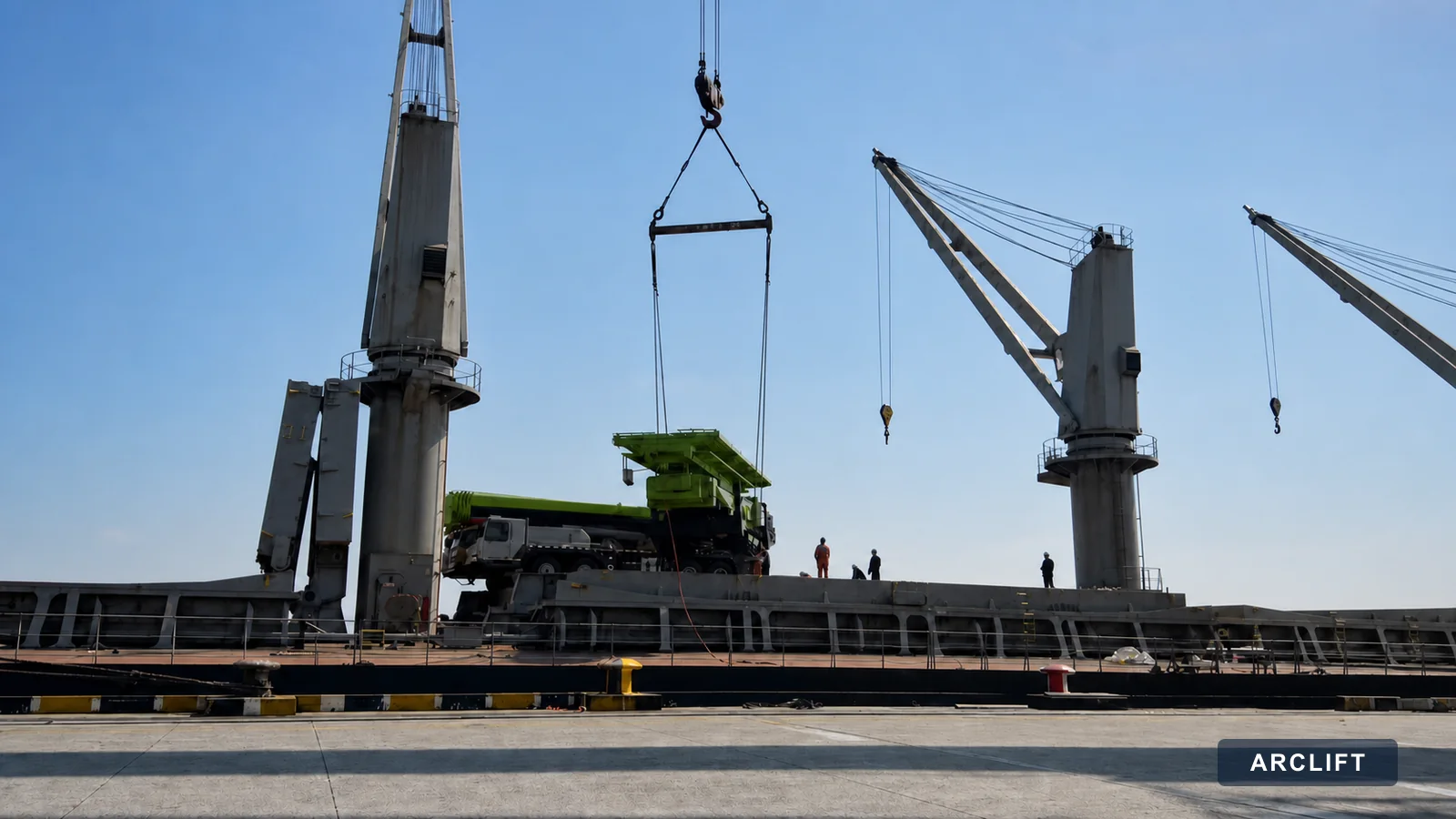
Treat 40HQ as a logistics design route, not a promise that every complete truck-mounted roll-forming lift will fit one container. The route is credible only after the actual configuration has a module list, measured packing envelopes, masses, lifting points, container-door checks, lashing details, chassis-interface plan, reassembly procedure, and named responsibilities at destination. Start with the largest indivisible module, not the container’s headline internal volume.
Define the logistics question before the container
The buyer’s real decision is whether a transport-oriented configuration can arrive in a form that local teams can unload, integrate, inspect, and commission. Container selection is only one part of that question. A machine may fit dimensionally but still be impractical because a module cannot pass the door, its center of gravity is unsuitable for the planned lift, the receiving site lacks handling equipment, or the chassis interface has not been agreed.
“40HQ” is therefore a project constraint used to shape the equipment and packing plan. It should never appear as an unconditional quantity or fit statement. The ARC-T25HQ transport-oriented configuration provides a useful discussion reference, but the purchase decision must use the packing list and drawings issued for the quoted configuration.
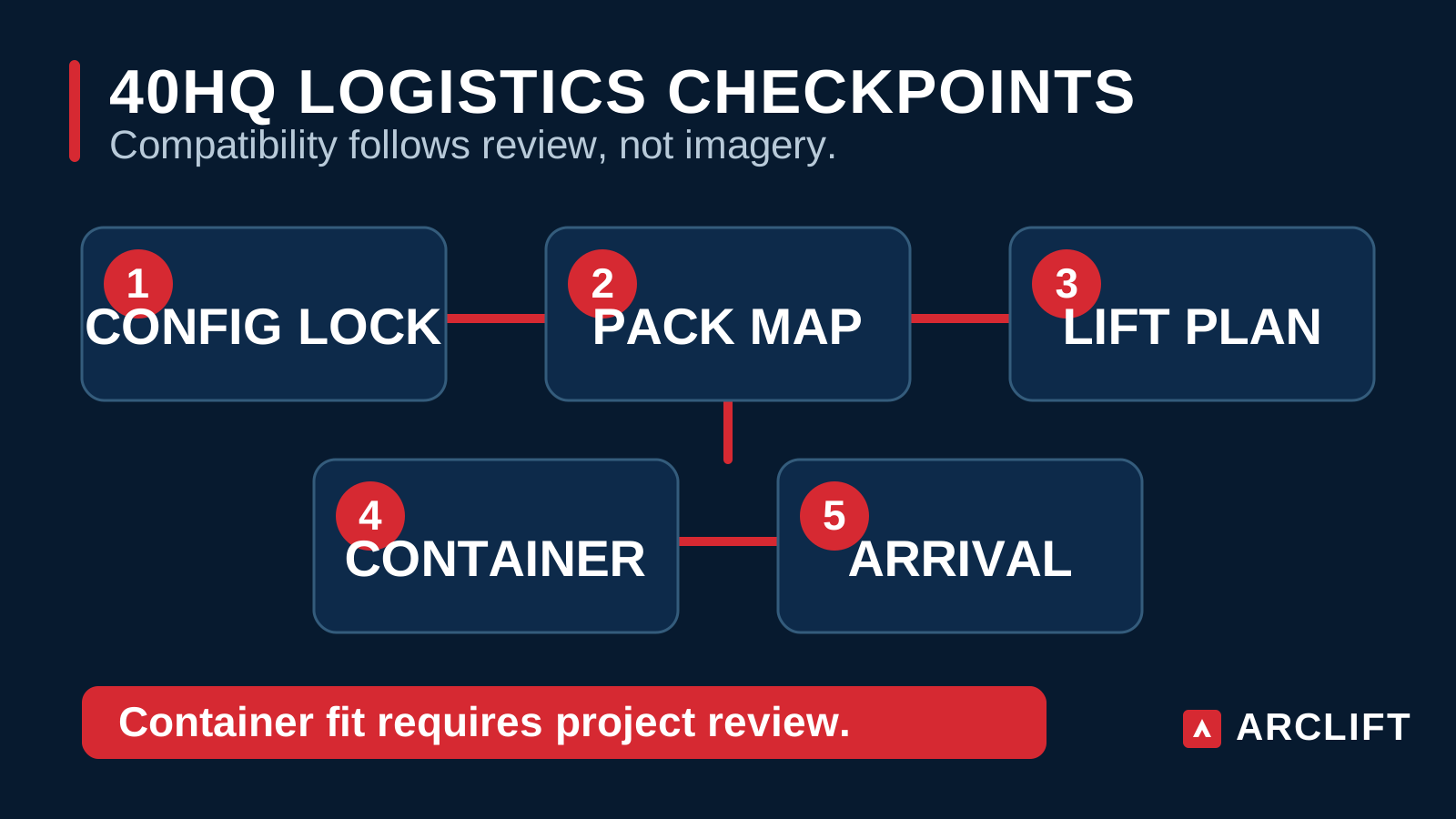
Editorial diagram. It does not prove that a complete machine, a specific module set, or a selected chassis fits a 40HQ container.
Lock the modules and interfaces
Freeze the configuration boundary before planning the container. List what is included in the equipment package and what is supplied locally: lifting structure, roll-forming line, controls, power components, support devices, walkways, guards, tooling, hoses, cables, fasteners, service items, and chassis-related parts. If optional equipment remains undecided, the packing study is not final.
For every transport module, record length, width, height, mass, lifting points, center-of-gravity information, support points, orientation limits, removable projections, and protected interfaces. The largest dimension does not always govern. Door clearance, forklift pocket position, crane access, packing-frame geometry, and the sequence of loading or unloading can be more restrictive.
Container condition and handling route matter. Confirm the specified container type, door opening, internal obstacles, floor load limits, acceptable point loads, lashing arrangements, moisture protection, and inspection process. Then map the route from packing area to port, through terminal handling, to the destination unloading site. The plan should identify where lifting equipment is required and whether each location can use the intended lifting points.
Local chassis integration deserves its own work package. Define the chassis model or interface envelope, frame data, wheelbase, axle arrangement, permissible loads, mounting zones, power take-off or auxiliary-power arrangement, electrical interfaces, controls, stabilizer geometry, and local road requirements. The party responsible for interface drawings, installation, inspection, and documentation must be explicit.
Editorial diagram. Tap to open the full-size editorial diagram. It presents review stages and cannot verify container fit, module mass, chassis compatibility, or commissioning readiness.
Where modularity helps—and where work moves
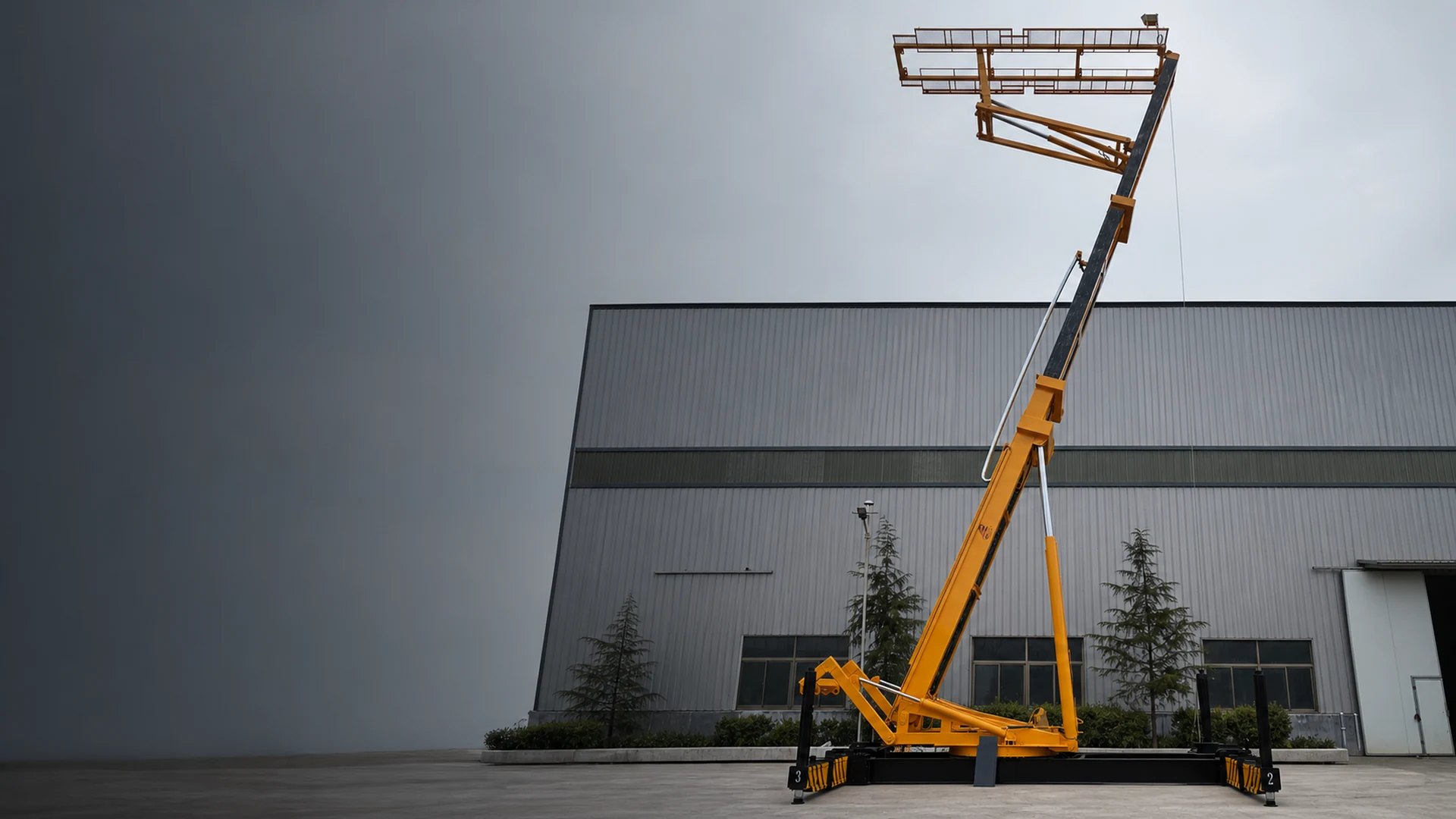
The editorial visuals illustrate the kinds of operations a logistics plan must address: lifting, temporary support, weather protection, controlled orientation, and transfer between transport modes. They do not establish the packing arrangement for the buyer’s configuration. Even a visually similar assembly may use different boom sections, line modules, frames, controls, or local chassis parts.
More disassembly can make the packing envelope easier to manage, but it transfers work to destination. Every separated hydraulic, electrical, structural, or control interface must be protected, identified, reconnected, inspected, and tested. Additional modules may also increase lifting operations and create more opportunities for packing damage or assembly error.
Less disassembly can simplify destination work, yet larger modules place greater demands on door clearance, internal support, weight distribution, lifting equipment, and inland transport. The correct balance depends on the receiving team, available cranes or forklifts, work area, technical support, and the time allowed for controlled assembly and checks.
A locally sourced chassis can reduce the need to transport a complete vehicle and may better match destination road rules. The trade-off is interface risk. Frame dimensions, mounting method, stability assumptions, axle distribution, power connection, and inspection responsibility must be coordinated before equipment is built around that route.
Documentation is part of the physical plan. Module identification, packing list, center-of-gravity data, lifting instructions, connection drawings, fastener schedule, hose and cable identification, preservation requirements, assembly sequence, inspection points, and commissioning checklist should match the delivered package. A generic manual cannot resolve a configuration-specific interface.
Packing frames and temporary supports also need a destination plan. Identify which items remain until assembly is complete, which may be removed during unloading, how restrained modules are transferred, and who confirms that a temporary support is no longer required.
AI-assisted editorial composite. It illustrates a logistics context only and does not prove container fit, shipment condition, delivery scope, or destination acceptance.
Routes that should stay off the shortlist
A 40HQ route may not fit when any essential module exceeds a verified handling envelope, when the container floor or lashing plan cannot accept the load arrangement, or when safe loading and unloading resources are unavailable. It may also be unsuitable where inland height, width, axle, or road restrictions make the container or receiving vehicle route impractical.
The route is not ready if the destination chassis is still a generic idea. Proceeding without interface data can shift structural, stability, control, and documentation questions to the assembly site, where correction is harder. The same applies when no qualified party owns reassembly, inspection, functional testing, and local review.
Do not use a port image, product-page label, or preliminary layout as evidence that the selected equipment fits. Do not assume that all accessories can share the same container, that packing frames can be discarded before commissioning, or that every module may be lifted from any convenient point.
If the complete machine must arrive road-ready, or if local assembly resources are limited, a different transport route may be more suitable. Compare roll-on/roll-off, flat-rack, break-bulk, multiple-container, or locally integrated options through a qualified logistics study. ARCLIFT can organize equipment data, but carriers, ports, lift planners, chassis specialists, and local authorities retain their own responsibilities.
Documents needed before booking freight
- Freeze the equipment scope, options, tooling, accessories, spare parts, controls, and locally supplied items.
- List every module with packed dimensions, mass, orientation, support points, lifting points, and center-of-gravity information.
- Confirm 40HQ door clearance, internal clearances, floor limits, point-load controls, lashing method, and moisture protection.
- Provide the loading sequence, unloading sequence, crane or forklift data, sling arrangement, spreader needs, and working area.
- Map port, inland transport, access width, overhead clearance, turning restrictions, storage location, and final assembly zone.
- Supply destination chassis drawings, frame material, wheelbase, axle data, mounting zones, stabilizer space, and power interfaces.
- State destination road, registration, dimension, axle, emissions, lighting, documentation, and inspection requirements.
- Define who supplies the chassis, performs integration, supervises reassembly, inspects connections, and conducts functional checks.
- Confirm available voltage, frequency, phase, temporary power, cable connections, control settings, and commissioning instruments.
- Record preservation period, storage conditions, corrosion protection, packaging disposal, and damage-reporting procedure.
- Request a configuration-specific packing list, module drawings, connection schedule, assembly steps, and acceptance checklist.
Before freezing this plan, compare the transport assumptions with the broader crawler-versus-truck selection guide. If the chassis or inter-site transfer logic remains weak, the architecture decision should be reopened.
Request a packing-route review
Send ARCLIFT the target configuration, largest permitted transport envelope, container requirement, destination route, lifting resources, chassis data, assembly site, available power, local documentation needs, and division of responsibilities. As an equipment solutions supplier, ARCLIFT can coordinate the technical questions needed for a project-specific packing and interface review.
This article is not a packing certificate, transport instruction, chassis approval, or container-fit confirmation. The AI-assisted editorial composite, representative configuration images, and editorial diagram are explanatory visuals only. They cannot prove model identity, module dimensions, mass, performance, packing quantity, or destination suitability. Final values must come from the signed configuration, packing drawings, logistics review, and local acceptance process.