Truck-Mounted Roll Forming Lifts
ARC-T25HQ Truck-Mounted Roll Forming Lift
Catalog model — packing routeView historical reference
A vehicle-mounted lifting system that carries a compatible roof-panel roll former close to the installation level. The lifting arm positions the forming equipment, with the truck, stabilisers and machine layout selected together.

- Vehicle-mounted equipment layout
- Elevated forming-machine platform
- Folding and telescoping lift structure
- Optional coil-handling arrangement
Archive reference
Historical class and current specification
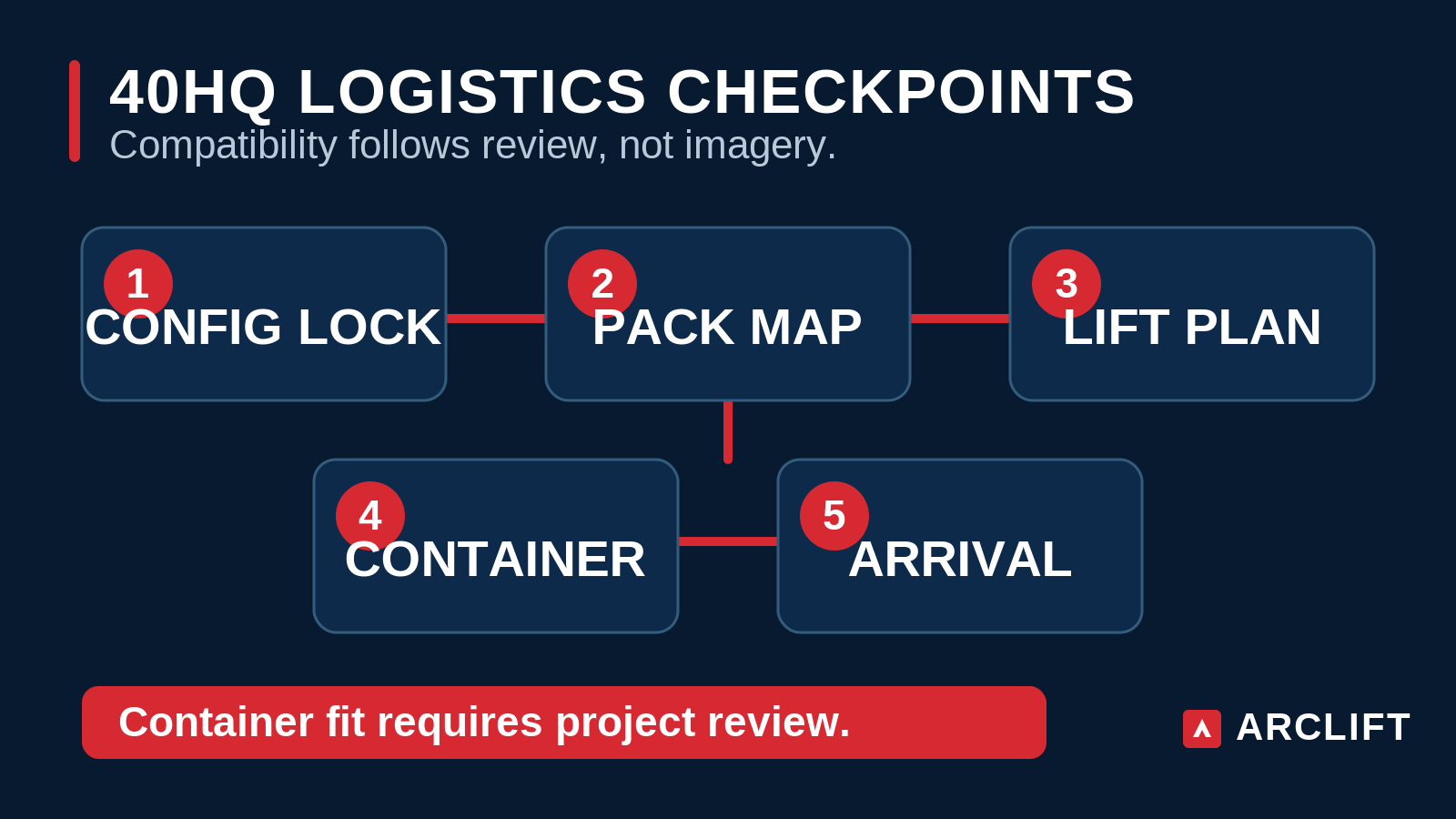
A catalog model for 40HQ packing-route discussion. Packing confirmation remains project-specific. 40HQ packing route — confirm on RFQ. Current height, load, dimensions and options are established by the signed technical schedule, approved drawings, approved load chart and approved packing plan.
| Reference field | Published orientation |
|---|---|
| Catalog height classCatalog reference — confirm on RFQ | Catalog reference — confirm on RFQ; 25m class; project-specific confirmation required |
Equipment background
ARC-T25HQ selection notes
Keep ARC-T25HQ as a 40HQ packing-study route only
ARC-T25HQ exists to decide whether a modular packing study should be opened for a defined project. It is a 40HQ packing-study route only, not evidence that any configuration fits a container, ships in a fixed quantity, or lowers freight cost. ARCLIFT acts as an integrated equipment supplier and can coordinate the information needed for the study.
The archived 25m class does not release a packing plan. Start with the selected module breakdown, then test it against the container, handling, destination assembly, chassis, and route constraints.
Define every packing and integration variable
The configuration review changes with module dimensions and mass, centre of gravity, lifting points, container-door clearance, internal limits, floor basis, blocking, and lashing. Destination road and chassis rules, travel and working envelopes, outriggers and ground data, transport route, panel run-out, and approval documents remain separate project inputs.
Send:
- Module dimensions and mass with centre of gravity and lifting points
- Container-door clearance, internal envelope, floor limits, and owner requirements
- Blocking, lashing, lifting, unloading, and destination assembly resources
- Destination road and chassis rules plus the proposed interface drawing
- Travel and working envelopes, outriggers and ground basis, and transport route
- Panel run-out, work-zone information, customs needs, and approval documents
Stop before freight booking
This planning route may not fit if the module breakdown is unsettled, masses or lifting points are unissued, container limits conflict with the package, or destination assembly and chassis interfaces remain unresolved. Do not use this page for a booking, lift plan, or tender commitment.
Release only configuration-matched packing data
The signed technical schedule and approved drawings control the final configuration. The approved packing list, lifting-point drawing, lashing plan, load chart, and chassis interface must match it. Ask ARCLIFT to review the packing inputs as a technical selection and supply partner; carrier acceptance and destination approvals remain external gates.
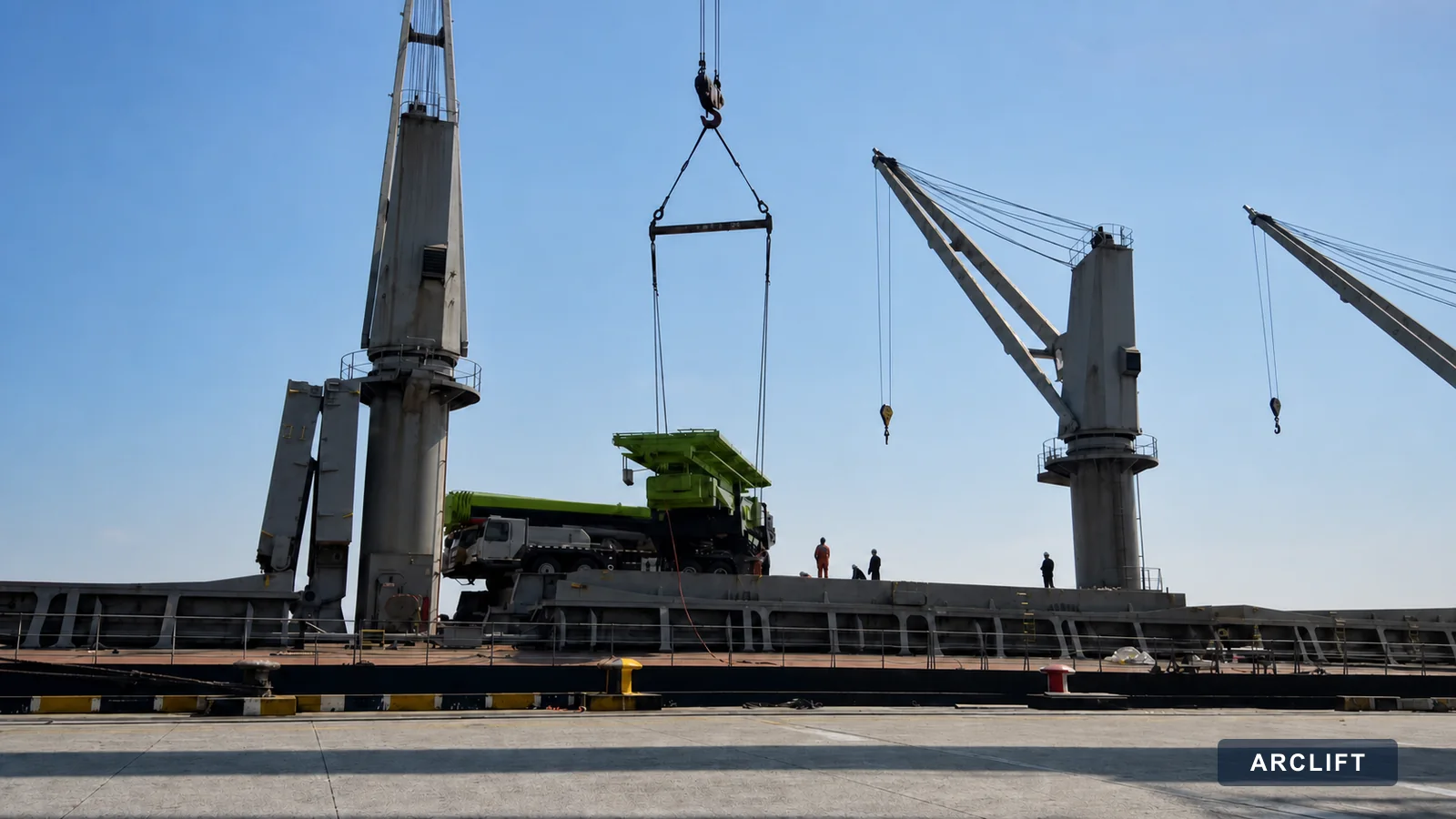
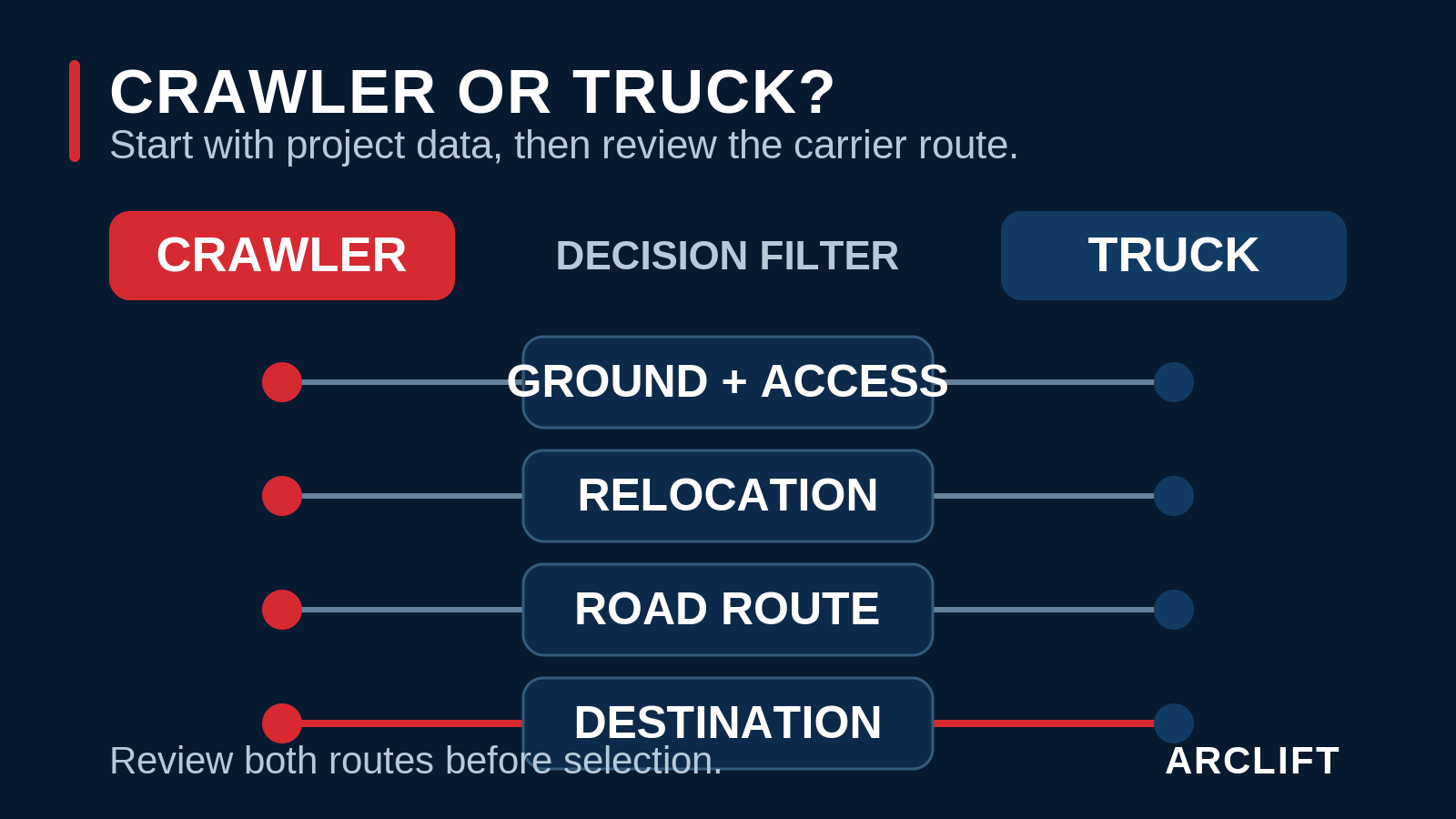
Image disclosure: Representative editorial image — not model-specific evidence. The port raster is an AI-assisted editorial composite and the diagrams explain packing checkpoints only; they do not prove container fit, shipment, or ARC-T25HQ performance.
Project inputs
Tell us about your application
- Destination chassis and axle data
- Road-route and registration constraints
- Work zones and setup geometry
Workflows to assess
Match the system to the site
Route, permits and site entry
Packing and handling route where applicable
Questions and documents
Questions and specification documents
Does ARC-T25HQ automatically fit a 40HQ container?
No. 40HQ is a planning route, not a fit guarantee. Module dimensions, module mass, container-door clearance, internal envelope, floor limits, lifting points and lashing must be confirmed per project.
What destination information is required?
Provide the destination chassis interface, axle and frame data, local registration route, unloading equipment, assembly area, route restrictions, available lifting capacity and competent assembly resources.
Which documents authorize packing and shipment?
The signed technical schedule, approved drawings, approved load chart, packing list, lifting plan and approved packing data control the shipment. Website diagrams are only editorial planning aids.
Documents to request and validate
- Signed technical schedule
- Approved drawings
- Approved chassis interface schedule
Request the available documents for the proposed configuration.
Technical guides for this equipment family
Practical guidance on the machine, worksite and transport questions.
- Truck Chassis Integration Review for Roll-Forming Lines
Review truck chassis integration for mobile roll-forming lines, including interfaces, payload allocation, stability inputs, utilities, and verification records.
- 40HQ Planning for Truck-Mounted Roll-Forming Lifts
Review 40HQ shipping for roll-forming lifts by comparing complete vehicles, equipment modules, local chassis supply, packing boundaries and destination work.
- Truck-Mounted Roll-Forming Payload Allocation Review
Review truck-mounted roll-forming lift mass inputs by separating chassis, installed equipment, coils and accessories across road, arrival and working states.
- Roll-Forming Lift Documents: Read and Compare Offers
Read roll-forming lift documents by their purpose, configuration and issue status, then compare quotation scope, interface evidence and unresolved deliverables.
Optional equipment planning illustrations
These AI-assisted editorial visuals explain planning relationships and are not model-specific evidence.