
A roll-forming lift height is useful only when the offer explains what is being measured. The panel outlet, the deck supporting the former and a personnel working-height description are different references. Two quotations can display the same height label while leaving different parts of the purchase unresolved. Ask the supplier to identify the measurement points and configuration before shortlisting on a number.
The equipment raises a compatible roof-panel roll former toward the roof receiving level. This guide reads the equipment offer; the roof-zone survey guide establishes the project’s measured geometry. Bring those two answers together without treating a model name, photograph or familiar height convention as a substitute for a labelled configuration drawing.
Contents
- Identify what the offered height measures
- Read the conditions attached to the label
- Compare height statements without false equivalence
- Request a drawing that answers the purchase question
- FAQ
Identify what the offered height measures
Locate the upper measurement point
Ask whether the stated point is the former’s cutter, panel outlet, equipment platform or another explicitly identified location. The former sits on a supporting arrangement; its outlet is not automatically at the deck surface. A drawing should identify the actual point used by the quotation.
A verbal answer such as “maximum height” still leaves the important question open. Maximum height of what? Request the point on the supplied configuration rather than suggesting a convenient definition. The buyer needs to compare the offer’s stated measurement with the particular point required by the roof-forming task.
Locate the lower reference
Ask where the measurement begins: the equipment’s specified ground/support reference or another stated datum. The answer should belong to the same drawing and configuration as the upper point. A height quoted from one reference cannot be compared with a building elevation from another without connecting them.
This does not require the buyer to calculate a conversion. Ask the equipment party to label its reference and the project survey party to identify the corresponding site information. Where that connection is missing, retain it as the next question rather than silently subtracting unrelated levels.
Keep personnel terminology outside the forming duty
A personnel working-height description concerns a different equipment use from positioning a roof-panel former. Do not apply an assumed person-reach allowance to obtain a forming outlet height. Equally, a forming-lift figure cannot establish where people may work or what a separate deck configuration permits.
The forming-lift architecture comparison explains crawler and truck bases for the main equipment duty. Choosing a base does not settle the measurement point. Ask the same datum questions of each candidate and use its own configuration information.

Reference photograph of a suspended blue machine module, not a steel coil. It does not verify the module mass, attachment, supply inclusion or an approved handling method.
Read the conditions attached to the label
Identify the assembly represented
A quoted height may be associated with a particular former, mounting arrangement or other installed equipment. Request those identities beside the drawing. If the buyer supplies its own former, the relationship between that machine’s outlet and the proposed lifting arrangement still needs an equipment-specific answer.
Do not carry a label from one machine illustration onto another former merely because both produce roof panels. The mounting-interface guide develops the separate physical connection. Here the question is whether the offer identifies the assembly whose measurement is being quoted.
Read height and load conditions together
A height statement without the applicable lifted-load scope can be incomplete for shortlisting. Ask which load and arrangement the supplier’s statement covers and whether any stage-specific conditions need separate explanation. Do not turn a headline height into a claim that every load is covered throughout that range.
The capacity-statement guide explains how to request that scope. It provides no load curve or rating. Keep the quoted height and load references connected to the same proposed assembly so one attractive label cannot be borrowed from a different configuration.
Distinguish a highest point from a useful arrangement
An upper measurement does not describe every position between the equipment and the roof receiver. Orientation, horizontal relationship, the surrounding building and the proposed stand position still matter. A height label answers only the particular measurement it defines.
This is why an equipment drawing should accompany the statement. Ask which depicted arrangement is represented and what project geometry is still needed. A candidate can remain under discussion while an outlet relationship is unresolved; it should not be described as selected solely because its headline number looks sufficient.

Reference photograph of a suspended coil beside vehicle-mounted apparatus. It does not verify coil mass, option availability, permissible lifting conditions or an approved transfer method.
Compare height statements without false equivalence
Test a same-label comparison
Consider two explicitly hypothetical offers showing the same numerical height label. Offer A identifies a cutter/outlet point relative to its stated support reference. Offer B identifies an equipment-platform point but does not show the former’s outlet. No numeric product rating is asserted by this example.
The two labels cannot yet answer the same roof question. Ask B for its outlet relationship, and ask A whether the depicted assembly is the one proposed. The trade-off is between a familiar headline comparison and a comparison that actually addresses the required physical point. The appropriate response is a clarified drawing, not an assumed correction factor.
| Offer wording | Meaning still to establish | Buyer question |
|---|---|---|
| Lift height | Upper and lower measurement points | Which labelled dimension does this phrase refer to? |
| Platform height | The identified supporting deck and applicable assembly | Where is the former outlet relative to that deck? |
| Cutter or outlet height | Exact output reference and stated support condition | Does this describe the former and arrangement being quoted? |
| Working height | Equipment duty and the source’s definition | Is this a personnel descriptor rather than a forming-outlet measurement? |
| Maximum height | Applicable arrangement and associated conditions | Which configuration and load statement accompany this value? |
| Model-name suffix | Whether any measurement is actually established | Can the supplier provide an order-specific labelled drawing instead? |
Read a photograph as context rather than a scale
A photograph can show a former near building steelwork or a panel beside a façade. Perspective does not identify the equipment’s measurement datum. The visible roof cannot supply a reliable machine height, and a long panel cannot establish the elevation or reach available in another arrangement.
Use the image to explain the object whose location matters: the former outlet and roof receiving relationship. Then request the relevant drawing. A useful image can clarify a question while remaining insufficient to answer it. Repeating a height guess in an enquiry would only make that uncertainty less visible.
Ask for consistent wording across the offer
The quotation, drawing and supporting description should use compatible terms for the same point. If one says platform and another says outlet, ask the issuing party to explain whether they refer to different measurements or an inconsistent label. Do not choose whichever wording appears more favourable.
Great Britain’s HSE supply-chain information distinguishes equipment roles and accompanying product information. It provides context for asking the appropriate supplier for attributable configuration information. It does not define ARCLIFT height terminology, certify a drawing or establish destination requirements outside its jurisdiction.
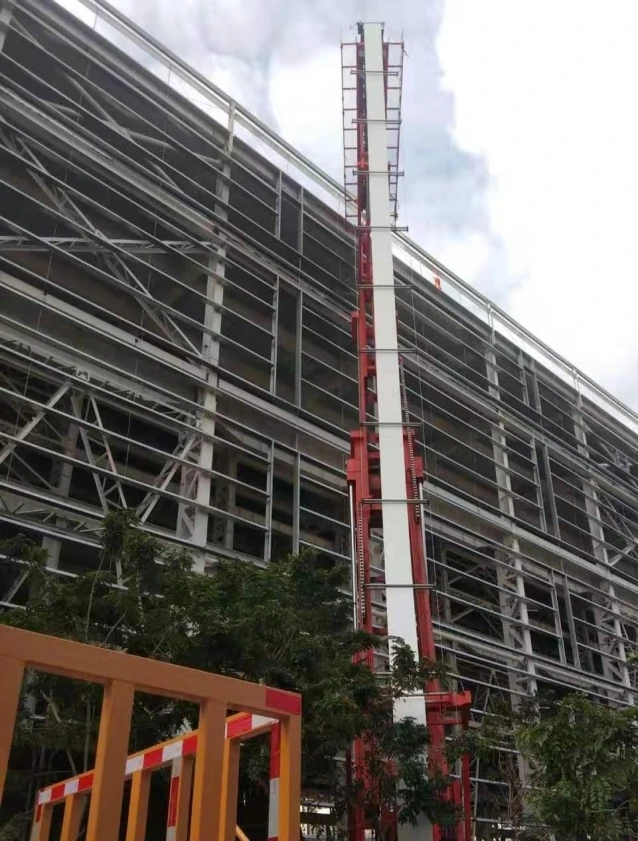
Reference photograph of a panel beside a building. It does not verify panel length, output height, active production or a permitted receiving arrangement.
Request a drawing that answers the purchase question
State the required point in ordinary language
Describe where the panel needs to emerge relative to the roof’s first receiving point. Attach the available project reference without translating it into a preferred model rating. Ask the provider to identify the corresponding outlet and support references on its proposed equipment arrangement.
If the project has only a general building height, state that limitation. The next step is to obtain the relevant receiving and ground relationship through the survey process. A supplier cannot resolve an unknown project point simply by supplying a larger quoted height.
Separate an information gap from an unsuitable candidate
An offer with an unexplained height label is unresolved, rather than automatically unsuitable. A clarified drawing may answer the project relationship or reveal a mismatch needing another proposal. Those are different outcomes and should remain distinguishable in the shortlist.
For a hypothetical buyer, the preferred candidate initially appears to have a lower headline label. After clarification, it describes the required outlet point, while another candidate’s apparently greater label remains a personnel description. The useful finding is that the original labels were incomparable. This example does not show that either machine is adequate or that lower labels imply better fit.
Prepare a focused datum request
- Identify the former, proposed base and lifting arrangement in the quotation.
- State which outlet-height point the roof task requires and attach its project reference.
- Link roof receiving geometry to the proposed ground location through the survey record.
- Identify material/panel requirements whose position must be shown, without deriving capacity.
- Provide destination and transport context so carriage and work states remain separate.
- Mark known access and floor or ground constraints relevant to the proposed stand area.
- Ask for the support or outrigger reference represented in the quoted measurement.
- Request power/control and documentation identities where they distinguish the proposed assembly.
- Name the associated load statement and ask which configuration its conditions cover.
Use clarification to request the next decision
Ask the response to identify the upper point, lower reference, applicable assembly and any remaining project geometry needed. This is a compact request the buyer can compare across offers. It avoids demanding a complete technical dossier when the immediate obstacle is an undefined measurement.
For a crawler forming-lift proposal, use the same request you would use for a truck configuration. The base architecture changes the equipment discussion, while the need to understand what a quoted dimension means remains. Keep unresolved height interpretation separate from ground acceptance, installation or operation.
Recognise a label that cannot support shortlisting
The stated offer may not fit a defensible shortlist when no one can identify its measurement points, the proposed former differs from the reference assembly, or the required outlet relationship remains undefined. A current labelled response is needed. This guide supplies no height conversion, human-reach allowance, model rating or permission to use an arrangement.
Request an explicit height reference
Ask ARCLIFT to clarify a forming-lift height statement. Send the offer wording, proposed former, required roof receiving point, site ground reference, destination and transport context. Highlight whether the missing answer concerns outlet height, equipment platform or another datum. ARCLIFT can coordinate the equipment-side question as a technical selection partner. Final project-specific configuration and site decisions require the appointed reviewers. Editorial photographs cannot establish the dimension or prove a candidate’s suitability.
FAQ
Can I use the model suffix as the lifting height?
A suffix is a reference name unless an attributable current specification defines its meaning. Request the proposed configuration and labelled measurement. Do not derive a present outlet height or capacity from an archive filename or familiar model format.
Is equipment-platform height the same as outlet height?
They identify different points. Their relationship depends on the former and its supporting arrangement. Ask the provider to show both where relevant; do not assume an offset or apply one from another machine.
Does enough height establish roof-level forming suitability?
No. The label concerns a defined measurement. The actual arrangement must address the receiver relationship, surrounding geometry, equipment scope, load conditions and site inputs. Height interpretation is an early comparison step.
What should I do when the quotation and drawing use different terms?
Ask the issuing party to reconcile the points and identify which statement applies to the proposed assembly. Preserve the unresolved wording in the comparison until clarified. Choosing the more attractive term would create an unsupported equipment claim.