
A roll-forming lift tender can invite useful alternatives and still require a comparable base offer. The difficulty begins when a bidder’s attractive option quietly replaces the task used by everyone else. The buyer needs a response sheet that separates the required task, base proposal and changed alternative, including what the project would have to provide if the alternative were adopted.
The equipment positions a compatible roof-panel roll former near the receiving level. The first-RFQ guide starts that enquiry. This article works at the next comparison stage: several tender responses exist, and procurement needs to understand their actual endpoints without inventing prices or choosing contract terms.
Contents
- Establish the task every base offer must answer
- Give alternatives a separate comparison space
- Reconcile two hypothetical tender replies
- Send a response sheet that reveals changed obligations
- FAQ
Establish the task every base offer must answer
Fix the production question before the preferred machine
Describe the panel requirement, former ownership, named roof receiver and destination supply endpoint. Identify what the bidder is actually expected to price. A lift-only tender around an owned former differs from a proposed new line-and-lift package. Do not let the first bidder’s machine name become the task definition for the remaining bidders. Where the project permits different base architectures, make that permission explicit while retaining the same required receiver and completion boundary for their base responses.
Distinguish a requirement from a provisional input
A surveyed receiving location, estimated ground condition and unselected chassis do not have the same status. Identify which facts are established and which still need a response. A bidder can state assumptions against provisional inputs, but the buyer must see what would change if those inputs are resolved differently. This is not a reason to demand a final engineering answer from incomplete data. It is a way to keep the tender comparison honest about what its base offer can currently establish.
Define the commercial endpoint in physical terms
State whether the requested package ends at equipment dispatch, an identified transport handoff or another actual agreed supply boundary. Name the assemblies and requested services at that endpoint. Avoid terms such as complete system unless the tender explains what completion includes. The purchase-scope guide develops broader cost comparison. The tender response sheet should preserve the endpoint so an option excluding a former, carrier or local integration does not appear equivalent merely because it uses the same family label.

Reference photograph showing a suspended blue machine module beside red lifting equipment. It does not verify mounting compatibility in a bidder’s proposed alternative.
Give alternatives a separate comparison space
Require a recognizable base response
Ask each bidder to identify the arrangement offered against the stated task, its inclusions and its unresolved dependencies. If the bidder cannot provide that base scope, the response should say so rather than place an alternative amount in the base column. Procurement can still consider the alternative on its own merits. Keeping the distinction visible prevents a proposal with another receiver or another former from being ranked as though it answered the unchanged task used by the other offers.
Describe the alternative by the difference it makes
An alternative should say what changes: base architecture, forming machine, receiver location, locally sourced vehicle, feed-side equipment or completion service. Ask for the corresponding physical and scope consequences. A different product code without those differences is not enough. One option might retain the roof task while moving local integration outside the supply; another might depend on a changed site position. They need different project responses even when both are described as cost-saving alternatives in a tender discussion.
Keep the project obligation next to the option
Ask what the buyer or its appointed providers must supply for each alternative, and which assumptions still need confirmation. Do not assign guessed values to that work to make the option look complete. Great Britain’s HSE equipment supply-role guidance distinguishes roles and accompanying information. This gives context for asking who covers an equipment boundary; it does not determine tender law, contract terms or destination-specific duties for the proposed purchase.

Reference photograph showing a suspended steel coil beside vehicle-mounted apparatus. It does not verify a complete vehicle or destination delivery package.
Reconcile two hypothetical tender replies
Keep two identifiable base bids unchanged
Consider an explicitly hypothetical tender with replies A and B, each identifying its own base package against the same roof task and receiver. Both also list options, but A describes an option amount as additional to its base, while B describes a revised package amount that replaces its base. No actual amount, ARCLIFT offer or tender rule is represented. The buyer’s immediate problem is that identically headed option cells describe unlike commercial relationships.
Separate incremental, replacement and dependent options
Ask each bidder to state whether the option cell is an addition, deduction or complete replacement proposal, using its actual offer terms. Do not add a replacement package to the original base or assume an incremental item can be purchased independently. Suppose A also identifies option A2 as dependent on A1, while B identifies B1 and B2 as alternative complete packages. Preserve those relationships. They are provider-stated conditions in this example, not universal rules for evaluating equipment tenders.
Return the clarification to the unchanged task
The trade-off is between a visually simple option column and a comparison that preserves what each amount actually buys. Request a clarified response retaining base A and base B, identifying each option’s pricing basis, included scope and dependencies. If an option changes an endpoint or local obligation, record that difference alongside it; do not silently revise the base task. The resulting decision can be that one proposed combination is not described by the actual bid, even though every individual cell is populated. A full table is not the same as a purchasable combination.
| Response cell | Hypothetical stated relationship | Clarification needed before comparison |
|---|---|---|
| Base A | Identified package for the common task | Preserve its offer reference and scope unchanged |
| A1 | Additional item against Base A | Confirm the supplied difference and incremental basis |
| A2 | Requires A1 according to the bidder | Confirm the actual combined scope; do not treat A2 as standalone |
| Base B | Different identified package for the same task | Preserve B’s separate actual base reference |
| B1 | Revised complete package replacing Base B | Confirm replacement basis; do not add it to the original base |
| B2 | Alternative to B1 according to the bidder | Do not construct B1 plus B2 without an actual proposal |
| Clarified comparison | Common task remains unchanged | Identify which actual combination and local obligations each response covers |
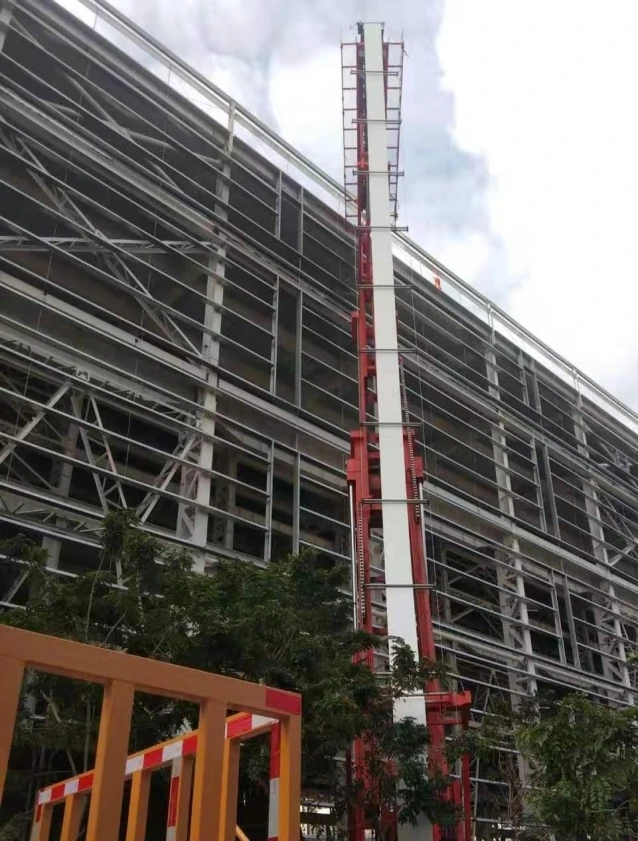
Reference photograph showing a long sheet beside a building facade and elevated apparatus. It does not verify included options or a current equipment supply commitment.
Send a response sheet that reveals changed obligations
Ask for answers that can be reconciled line by line
Use the response sheet to compare the purchase, not to dictate an equipment design. Keep bidder-specific information under the bidder’s own proposal reference. The truck-mounted forming-lift route and crawler route can both be discussed where the tender permits them. Each still needs its actual scope and relationship to the common task. A useful clarification identifies the changed object, location or provider and the next project decision, rather than simply returning a revised headline figure.
- State the required roof task, panel material requirement and named receiver used by all base replies.
- Identify the outlet height reference and candidate ground information without disguising estimates as confirmed facts.
- Separate former ownership and machine-to-lift integration from the choice of base architecture.
- State site access, destination and transport handoff as part of the common comparison boundary.
- Ask each option to identify its incremental or replacement basis, dependencies, changed local work and actual provider.
- Preserve base replies, dependent or mutually exclusive option relationships and outstanding clarification as distinct entries.
Recognize an alternative that has become another project
A proposal may not fit the base comparison when it changes the receiver, omits required equipment or assumes local completion outside the stated endpoint. That does not automatically make it worthless; it makes it a separate option requiring an explicit project decision. This guide sets no tender scoring, contract condition, legal duty or final selection rule. Technical adequacy, commercial terms and destination obligations need their own qualified review of the actual offers, not a worksheet assembled from generic product descriptions.
Request a clarified base and alternative scope
Discuss the tender scope with ARCLIFT. Send the common roof-zone task, height reference, site and destination, plus the transport and former-supply boundaries. Highlight which proposed option changes that task and what local work it introduces. ARCLIFT can address an attributable equipment proposal in its selection-and-supply role. Final project-specific offers require their actual conditions and scope; editorial photographs illustrate reference equipment rather than a priced tender package or an accepted alternative.
FAQ
Must all bidders offer the same architecture?
That depends on what the actual tender permits. Different architectures can be considered against a common task if the response preserves the required receiver, panel requirement and supply endpoint. The buyer should make permitted differences explicit and request their consequences. This page does not determine the tender’s commercial rules or establish that any particular architecture can meet the task.
Can a cheaper alternative replace the base response?
The buyer needs to recognize that it is an alternative and what it changes. If no base response is available, say that clearly in the comparison rather than implying equivalence. An apparently lower amount cannot be evaluated fairly while necessary local equipment or work remains undefined. Obtain the actual scope and project response before drawing a value conclusion.
How should unpriced local work be treated?
Keep the activity, expected provider and unresolved commercial position visible. Do not insert invented costs or assume that a local party will provide it. The comparison can identify an incomplete option and request the missing response. That is a more useful result than presenting a false completed total for a package whose endpoint has not yet been agreed.
Does the response sheet approve a changed receiver?
No. It identifies that the bidder proposes another physical task and who must consider it. The project, equipment and roof-work parties need to assess the actual alternative. Keep any resulting decision and revised scope attributable, so a clarification cannot silently become permission to buy or operate a different arrangement from the one originally tendered.