
Comparing the cost scope of ground and roof-level roll forming requires the same finished-panel task on both sides. A ground line produces panels at its outlet before their onward transfer. A lifted compatible former changes where the panel emerges and the interfaces that must be supplied. Neither equipment price describes the complete route to the intended roof receiver by itself.
This guide builds a commercial scope comparison without amounts or claimed savings. The roof-level forming overview explains the physical concept. Here the buyer’s output is a common requirement brief and a list of actual inclusions, local obligations and unanswered commercial questions for each route.
Contents
- Define the same panel output for both routes
- Compare the equipment and work beyond forming
- Work through a hypothetical scope difference
- Request complete commercial alternatives
- FAQ
Define the same panel output for both routes
Fix the panel task before comparing equipment
Identify the profile, material basis, lengths required as project inputs, roof zones and expected receiving locations. Ask both alternatives to address that same task. A proposal for shorter panels or a different roof zone can be a separate option, but it should not silently replace the baseline used for another quotation.
Also distinguish production from installation. The completed panel may arrive at an initial roof receiver before it reaches its final location. Your cost-scope brief should state where the compared supply ends. A route ending at ground production cannot be priced as equivalent to one expected to deliver a panel to a defined receiving interface without explaining the additional work.
Identify the forming line in each alternative
State whether an existing former is used in both routes or whether new equipment is requested. If one proposal assumes the buyer’s line and the other includes a new line, the machine purchase is a separate difference to reconcile. Do not attribute that cost-scope difference to roof-level positioning alone.
For lifted use, the actual former-to-lift arrangement remains a technical question. The forming-line specification guide develops the installed assembly and production requirement. A commercial comparison can request its scope without declaring that a buyer-owned ground machine is compatible with the proposed lift.
Preserve the work window and project boundaries
Describe when the roof receiver, ground production area and material routes are expected to be available. A comparison that assumes unrestricted space for one route and an occupied site for the other uses different tasks. Keep the construction stage visible and identify any alternate arrangement a bidder proposes.
The commercial enquiry does not dictate the installation sequence. It asks the responsible providers to describe their actual scope and assumptions against the same project conditions. Where the project has not settled those conditions, retain the uncertainty rather than inserting a convenient laydown area or temporary work window.

Reference photograph showing a suspended blue machine module. It does not verify its identity, compatibility, attachment points or an approved lifting method.
Compare the equipment and work beyond forming
Follow each route from incoming material to receiver
For ground forming, identify the line location, coil or feed arrangement, emerging-panel support and the onward transfer boundary. For elevated forming, identify the line and lifting assembly, feed concept, immediate outlet interface and roof receiving boundary. Both routes need the actual material and receiving work described.
Do not assume a lift includes the uncoiler, coil-handling equipment or roof-side support. Do not assume a ground-forming price includes the finished-panel transfer. Those may be separate scopes provided by other parties. Ask who supplies each item and what information is required for a defined commercial response.
Use inclusions and exclusions rather than assumed savings
The following table contains no prices. Enter actual provider responses and identify buyer-supplied items. A category may be unnecessary for one defined route, but that should be explained by the actual arrangement rather than presumed from a product label.
| Common task category | Ground-forming scope to obtain | Roof-level scope to obtain | Commercial difference to clarify |
|---|---|---|---|
| Required panel production | Identified former and material basis | Identified former and lift pairing | Owned versus supplied line |
| Incoming material | Coil delivery, support and feed boundary | Coil delivery and proposed feed boundary | Included equipment and local work |
| Machine position | Ground line location and services | Lifting assembly, base and integration | Actual purchased assemblies |
| Outgoing panel | Ground outlet and onward handling scope | Elevated outlet and receiving interface | Separate support and transfer provision |
| Destination logistics | Line and other equipment movements | Lift, line, base and other movements | Delivery, collection and local resources |
| Site coordination | Required space and receiving availability | Support area, material space and receiver | Assumptions outside supplier prices |
| Handover and support | Defined information and service scope | Defined combined-equipment scope | Which later activities are included |
Retain separate handling questions
Elevating the former does not establish that no other lifting resource is required. Coils, machine modules, accessories or other tasks can remain outside the forming-lift scope. Ask which separate material-handling questions the proposal leaves with the project. The actual responsible parties determine the arrangements; this article specifies no lifting or panel-support method.
The HSE lifting-operations planning guidance provides Great Britain planning and resource context. It does not select a production route or establish a cost, capacity or handling design. Use it as background for assigning a defined question to a competent provider, rather than assuming handling is included.
Work through a hypothetical scope difference
A ground-line proposal ending at its outlet
Imagine a contractor comparing two concepts for the same main-hall panels and receiver. Proposal A uses its existing ground line and prices no forming-machine purchase. Its written scope ends at the ground outlet, while onward transfer remains with a separately appointed project provider. This hypothetical offer is not a complete answer to the receiver until that provider’s scope has been obtained.
The buyer should request the actual transfer and receiving boundary and associated commercial response. It should also identify the space those providers assume. No estimated handling amount is inserted here, and the example does not establish that the ground route is technically suitable. It shows the scope still needed before making a commercial comparison.
A lifted-line proposal with excluded roof-side work
Proposal B investigates the contractor’s former on a lifting assembly and identifies its base and integration scope. It leaves the immediate receiving arrangement and site services outside the equipment price. Bringing the outlet nearer the roof has changed the interface; it has not made the excluded roof-side work disappear.
Ask for the relevant project providers’ scope and retain the actual local obligations beside B’s equipment amount. If the existing former cannot be paired with the proposed lift, a new-line alternative would be a changed purchase, not an unpriced assumption. The existing-former guide helps decide how to investigate that question.

Reference photograph showing a suspended coil beside vehicle-mounted apparatus. It does not verify an approved handling method, included coil equipment or the scope of this purchase.
Compare the full task, including the exception
Suppose an adjoining roof zone uses another receiving position and is outside B’s initial proposal. Keep that remaining work in the comparison. Either request a separate scope for it or identify an alternative production route covering that area. Comparing A’s whole-roof scope with B’s main-hall-only scope would hide a purchase difference.
The trade-off concerns the equipment and work actually required for each complete alternative. One can have a smaller initial equipment purchase while leaving more local scope; another can include more assemblies while still depending on unresolved receiving work. Neither pattern proves lower total cost or faster production.
Keep unavailable evidence out of the commercial conclusion
Do not turn a claim of fewer movements into a labour saving without actual project evidence. Do not infer eliminated cranes, reduced crew, less damage or an investment return from the elevated concept. The responsible buyer can evaluate its actual amounts and resources after the scopes are defined.
The equipment quotation guide develops the comparison of actual supplied-package prices. This production-route page has a broader endpoint: the same panel task reaching the same defined receiver, with equipment and project obligations visible on both routes.
Request complete commercial alternatives
Issue one output brief with permitted alternatives
State the baseline panel requirement and receiving boundary. Identify the owned equipment, fixed site constraints and unknowns. Ask each provider to describe included equipment, work, local dependencies and any proposed departure from the baseline. An alternative can be valuable when its changed receiver, panel task or machine scope is explicit.
Use the crawler forming-lift family for an elevated crawler enquiry or identify the truck-mounted route separately. Architecture is a supply choice within the concept; it does not by itself complete the commercial route. The final response needs the actual base, transport and integration scope.
Prepare the common output brief
- Define the panel profile, material and lengths as requirements for both alternatives.
- Identify the former owned or required and any permitted new-line option.
- Show outlet height and roof receiving geometry for every included zone.
- Describe site access and the ground or floor areas available to each route.
- State the destination, carrier or chassis expectations and transport handover.
- Identify coil/feed equipment and separate panel-handling scopes still to be priced.
- Describe power connections and the local service boundaries expected from other parties.
- Separate supplier inclusions, buyer-provided resources and unresolved documentation.
Ask for the difference that changes the decision
If one response ends at the ground outlet and another ends at an elevated outlet, ask what remains between each endpoint and the common receiver. If one uses the owned line and another supplies a new one, isolate that equipment difference. A focused reconciliation is more useful than asking for another total while leaving the boundaries unchanged.
Recognize a comparison with unequal output scope
The comparison may not fit when the panel task, roof coverage, receiver or forming machine differs without an explicit alternative. This article provides no price, saving, productivity gain, crew reduction or recommendation to eliminate handling equipment. Commercial completeness does not establish engineering suitability or permission to use either route.
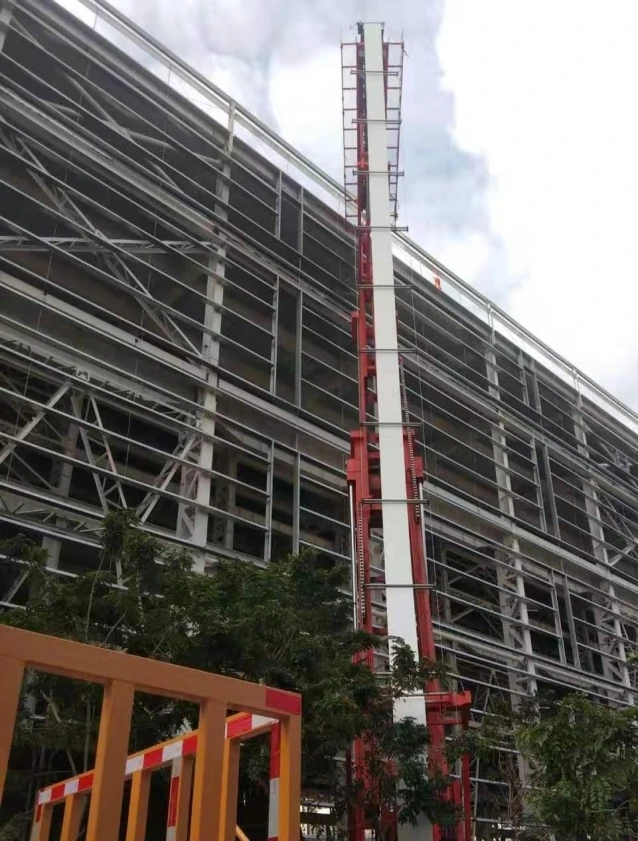
Reference photograph showing a panel beside elevated apparatus and building steelwork. It does not verify panel length, quality, production status or an approved receiving method.
Request scope for the same roof-panel task
Ask ARCLIFT for an elevated-forming scope discussion, attaching the common output brief and your separately proposed ground route. Include the former, height and roof-zone references, site access, destination, transport boundary and local receiving work. Ask which equipment and interfaces the actual proposal covers. Final project-specific comparisons require actual provider responses. These editorial images do not demonstrate savings, performance or an approved production method.
FAQ
Does an elevated former remove the finished-panel transfer task?
It changes where the panel emerges and what the receiving interface must address. The complete material route still needs definition; no general conclusion about eliminated equipment follows.
Can I compare the lift price with the cost of a ground line?
Only after clarifying which machine, integration, feed, handling and receiving scopes each amount covers. A lift and a forming line perform different functions within the route.
What if one alternative serves only part of the roof?
Keep the remaining panel work visible and obtain its separate scope. A partial route should not be presented as commercially equivalent to a whole-task alternative.
Does the worksheet show which route saves money?
No. It identifies the actual amounts and obligations the buyer needs to obtain. It supplies no assumed costs, returns or performance improvements.