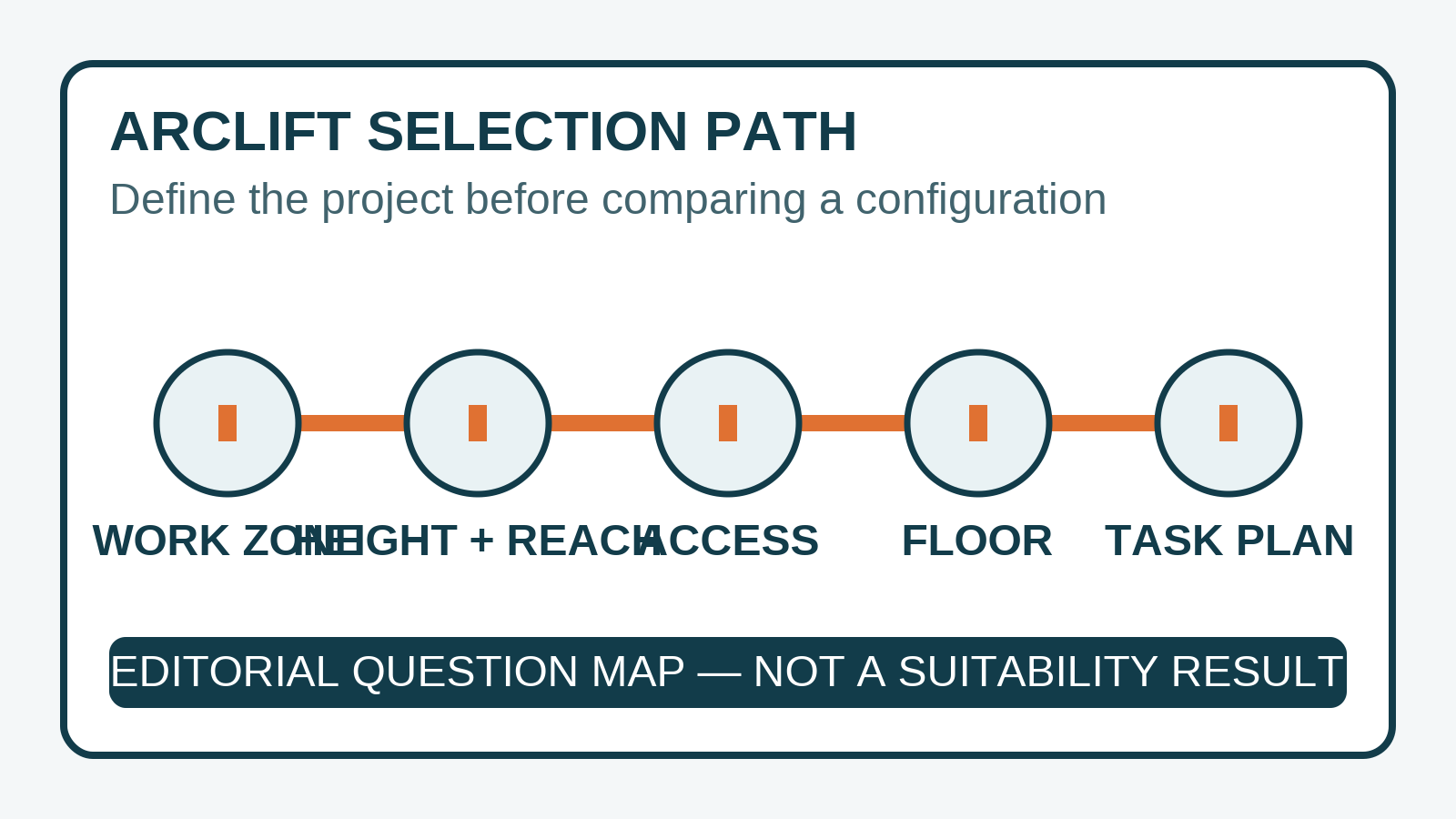
A pick-and-carry crane and a spider lift can both appear mobile and compact, but those surface similarities do not make them substitutes. Start with the work: is the primary task to lift and carry a load, or to position people for work at height? Then document the site, interfaces, responsible parties and equipment-specific evidence. This guide keeps those two decision paths separate. It does not select a model, authorize personnel lifting, approve a suspended-load operation or establish that either category fits a project.
Contents
- Separate material handling from personnel access
- Map the route and work zone
- Compare evidence, not labels
- Set review holds and request the right data
- FAQ
Separate material handling from personnel access
The first useful comparison is not brand against brand or specification against specification. It is task boundary against task boundary. A buyer who skips this step may compare reach, footprint or mobility while overlooking the basic purpose for which the equipment and work method must be reviewed.
For a personnel-access comparison among compact methods, use the separate crawler platform, spider lift and scaffolding guide. That page does not answer a material-handling question and should not be treated as a crane comparison.
Define the load-handling task
In U.S. construction context, OSHA’s crane-and-derrick scope describes equipment used to hoist, lower and horizontally move a suspended load. That definition is useful here only as a boundary marker. It does not classify a particular machine outside that context, approve a lifting method or replace local rules.
For a proposed pick-and-carry task, record the load identity, controlled mass record, center-of-gravity information, lifting points, attachment or rigging concept, pickup state, travel state, set-down state and every handoff. Record who owns lift planning, equipment selection, rigging, route review, exclusion controls and final authorization. If these items do not exist, “pick and carry” is still a label rather than a reviewed operation.
Do not assume that compact dimensions make load travel simple. The route may change the machine state, load behavior, visibility, surface demand or separation from people. These are project questions that require the actual equipment instructions and a competent lift-planning process.
Define the personnel-access task
A spider lift is commonly discussed as a compact mobile elevating work platform used to position people, tools and permitted materials at a work location. The controlling question is therefore not how it carries a suspended load, but how occupants reach and perform a defined elevated task within the machine’s instructions and the site’s work-at-height plan.
The OSHA aerial-lift fact sheet distinguishes personnel elevation from crane use and tells users not to use an aerial lift as a crane. Treat that statement as U.S. safety context, not a complete global rule. For a real project, the equipment identity, permitted use, rated information, attachments, occupant and material load, operating state and destination requirements all need controlled confirmation.
The worker, tool and material load guide explains how to build a task-load schedule without inventing a platform rating. That schedule belongs in the access review because occupants, tools, consumables and handled components can change both the work method and the equipment decision.
Stop when one method is being asked to do both jobs
Some requests combine material transfer and personnel access in one sentence: carry a component across the site, raise workers, hold material beside them and then relocate. That description contains several operations with different interfaces. Split it into work packages before asking for equipment.
Do not infer that a crane may elevate personnel because it can lift a load. Do not infer that a spider lift may suspend, pick or carry a load because it can position workers with tools. If a project proposes an unusual attachment, lifting accessory, material-handling feature or personnel platform, obtain the exact controlled documentation and competent destination review before the concept proceeds.
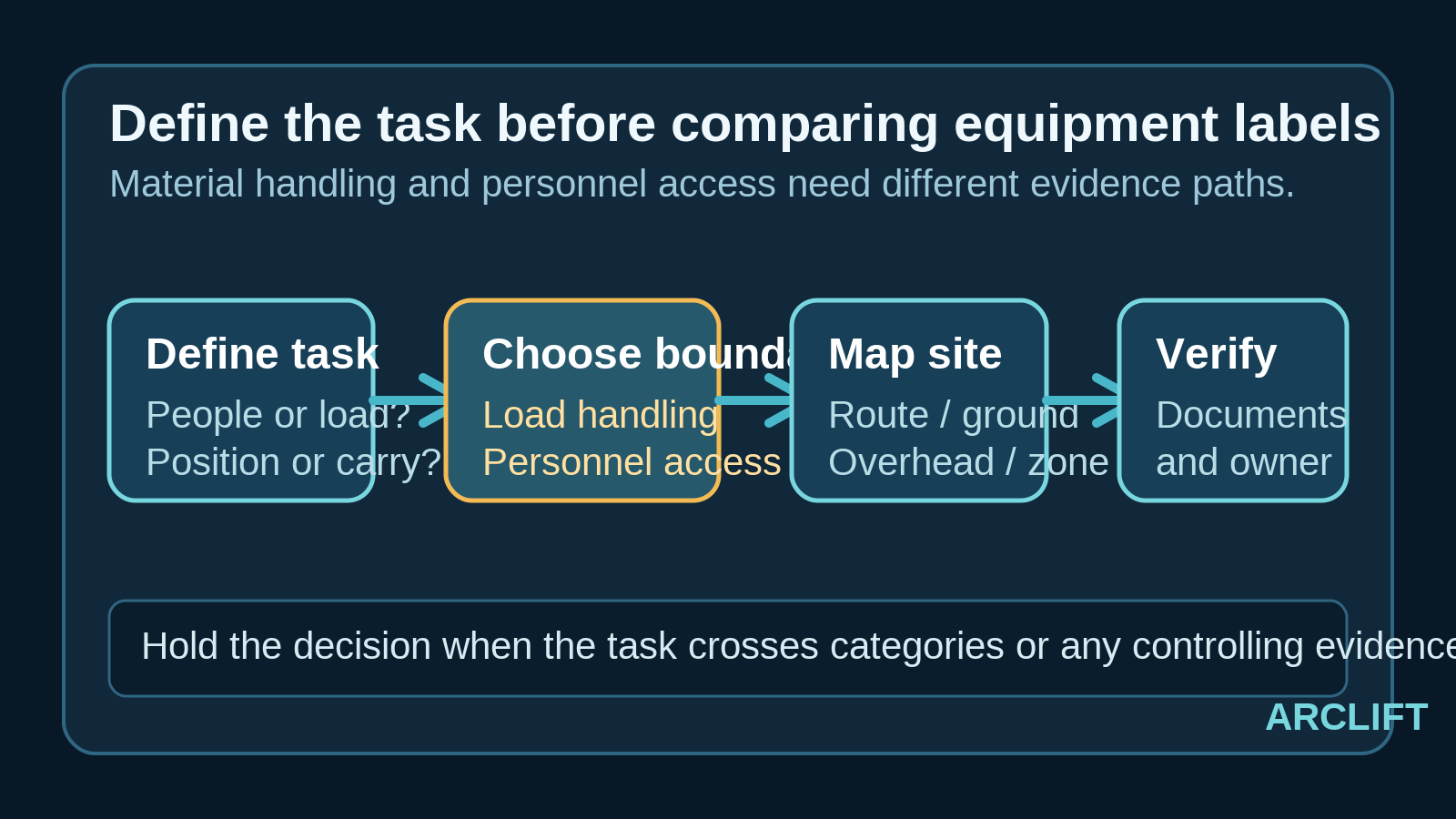
AI-assisted editorial diagram; not evidence of ARCLIFT equipment, configuration, project, capability or result. Tap to open the full-size diagram. It defines information paths and does not approve a crane, spider lift, attachment or work method.
Map the route and work zone
After the task is separated, map where the equipment and its load or occupants must go. A machine that can reach the work position on paper may still be blocked by delivery access, floor conditions, overhead geometry, occupied areas or an unworkable rescue interface.
Break the route into states
Record arrival, unloading, assembly or setup, travel to the work zone, working position, relocation and removal as separate states. For each state, identify equipment geometry, load or occupant state, visibility, turning need, slope, edge, opening, door, traffic interface and required separation.
A pick-and-carry route should not be reduced to a line on a plan. Load orientation, suspended movement, stopping points and set-down access may change along the route. A spider-lift route likewise needs the actual transport and travel configuration, not an elevated-work envelope copied into the access survey.
If the building route is the controlling issue, use a dedicated entry survey such as the large crawler platform building-entry guide and adapt only the data fields that apply. The survey output is an input package, not proof that a different machine category can follow the route.
Review ground and floor separately
Outdoor ground and indoor floor records need named owners. Ask for surface construction, condition, level changes, edges, covers, underground or concealed features, allowable loading information and the route-specific structural review. Do not convert a machine mass or contact area into a floor decision inside a sales comparison.
The equipment state matters. Transport, travel, setup and work may create different contacts and load distributions. A suspended load may also change the information needed for the pick-and-carry review. For personnel access, stabilizers, outriggers, tracks, wheels, protection mats or other interfaces must be confirmed from the actual configuration rather than inferred from a category name.
The indoor floor and route review sets out a controlled way to connect machine state, contact data, route drawings and a competent structural decision. Use it to request evidence; do not use the article to calculate an allowable condition.
Survey overhead and occupied-space conflicts
Ceilings, beams, services, doors, cranes, conveyors, cable trays, lighting and temporary works can affect both methods. The consequences differ: a load path needs clearance for the machine, rigging and load, while personnel access needs clearance for the platform, occupants, controls, tools and work movement.
Record fixed, movable, live and uncertain objects separately. State whether operations nearby continue, who owns isolation or coordination, and which survey revision applies. A nominal ceiling height does not represent the lowest obstruction or the space required to perform the task.
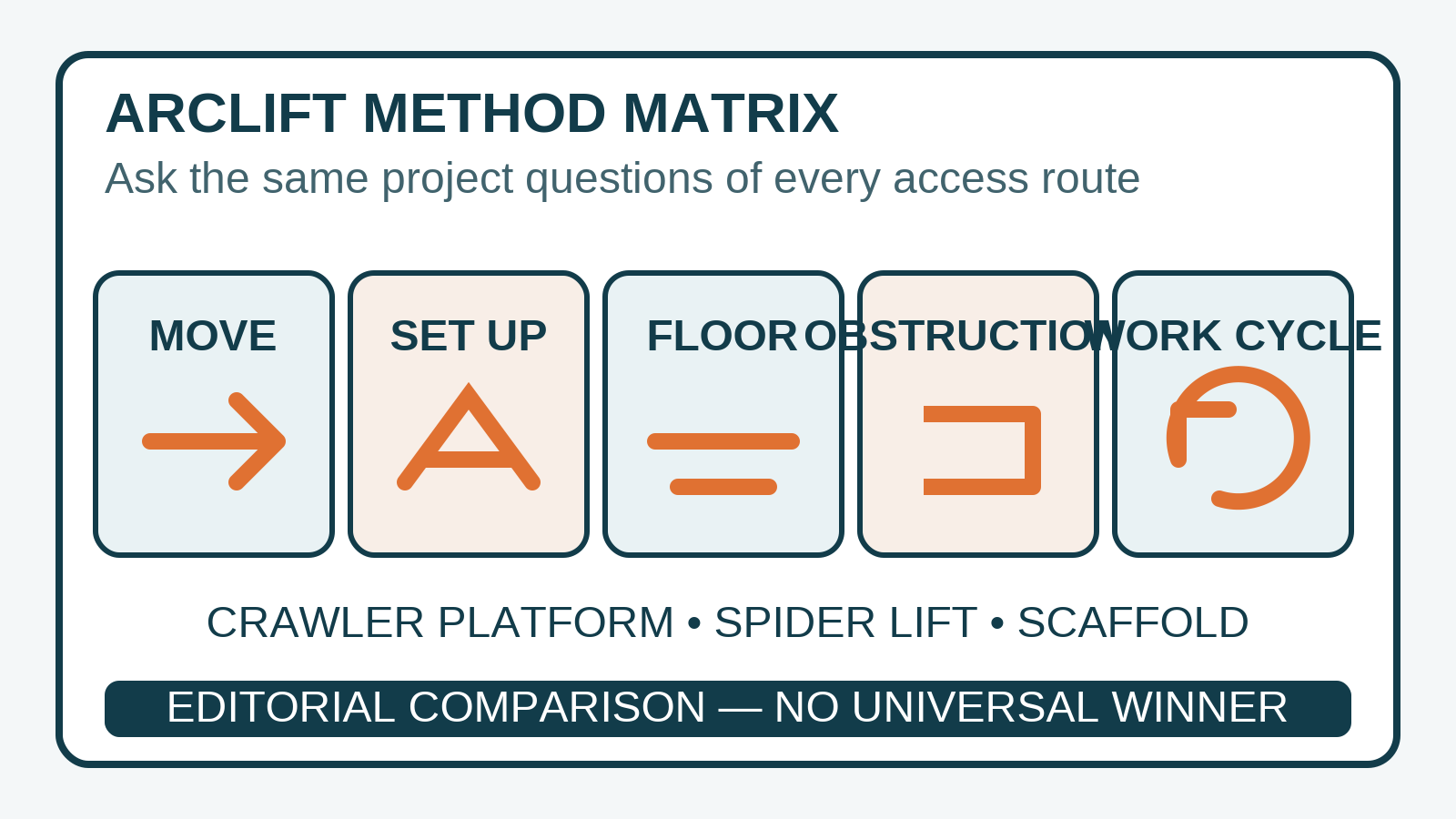
Editorial diagram. AI-assisted editorial diagram; not evidence of ARCLIFT equipment, configuration, project, capability or result. Tap to open the full-size diagram. The matrix prompts route, setup, floor and obstruction questions; it does not rank methods.
Compare evidence, not labels
A useful comparison names the decision, the evidence owner and the unresolved condition. It avoids generic tables that place unrelated specifications side by side and then announce a winner.
Request controlled equipment information
For either category, identify the exact equipment, configuration and document revision. Request the permitted-use statement, operating states, dimensions relevant to each route state, mass and contact information, load information, attachments, environmental limits, control arrangements, inspection status and emergency information as applicable.
The HSE MEWP selection guidance frames selection around the task and risks during use. The IPAF selection checklist adds practical prompts for height, outreach, task, materials, environment, terrain, access, training and supervision. These sources support disciplined questioning; neither selects a machine for this project.
Marketing names, photographs and archived range pages are not controlled equipment information. If a value changes with option, attachment, operating state or destination build, record that dependency rather than publishing a single number.
Assign responsibility at every interface
Name who defines the task, supplies equipment data, reviews the route, evaluates ground or floor, plans lifting, plans work at height, controls the work zone, verifies training or familiarization, prepares rescue arrangements and authorizes work. One commercial supplier label should not absorb responsibilities held by the employer, site owner, lift planner, structural specialist, equipment owner or local authority.
ARCLIFT may support the data request as an integrated equipment supplier or technical selection and supply partner. That role does not make ARCLIFT the lift planner, structural reviewer, employer, trainer, rescue planner, local legal adviser or site authorizing party.
Make the trade-off conditional
A compact access machine may fit a constrained route yet provide the wrong work interface. A crane concept may address load movement yet add a load-path, rigging and exclusion-zone problem. A broad platform may support a different work organization but create entry or floor constraints. None of these statements establishes a result; each points to evidence that can change the decision.
Compare methods by the total work package: task boundary, route states, support surface, overhead space, load or occupant interfaces, nearby operations, setup and removal, rescue or recovery, document control and decision ownership. If a trade-off cannot be tied to a verified project input, leave it open.
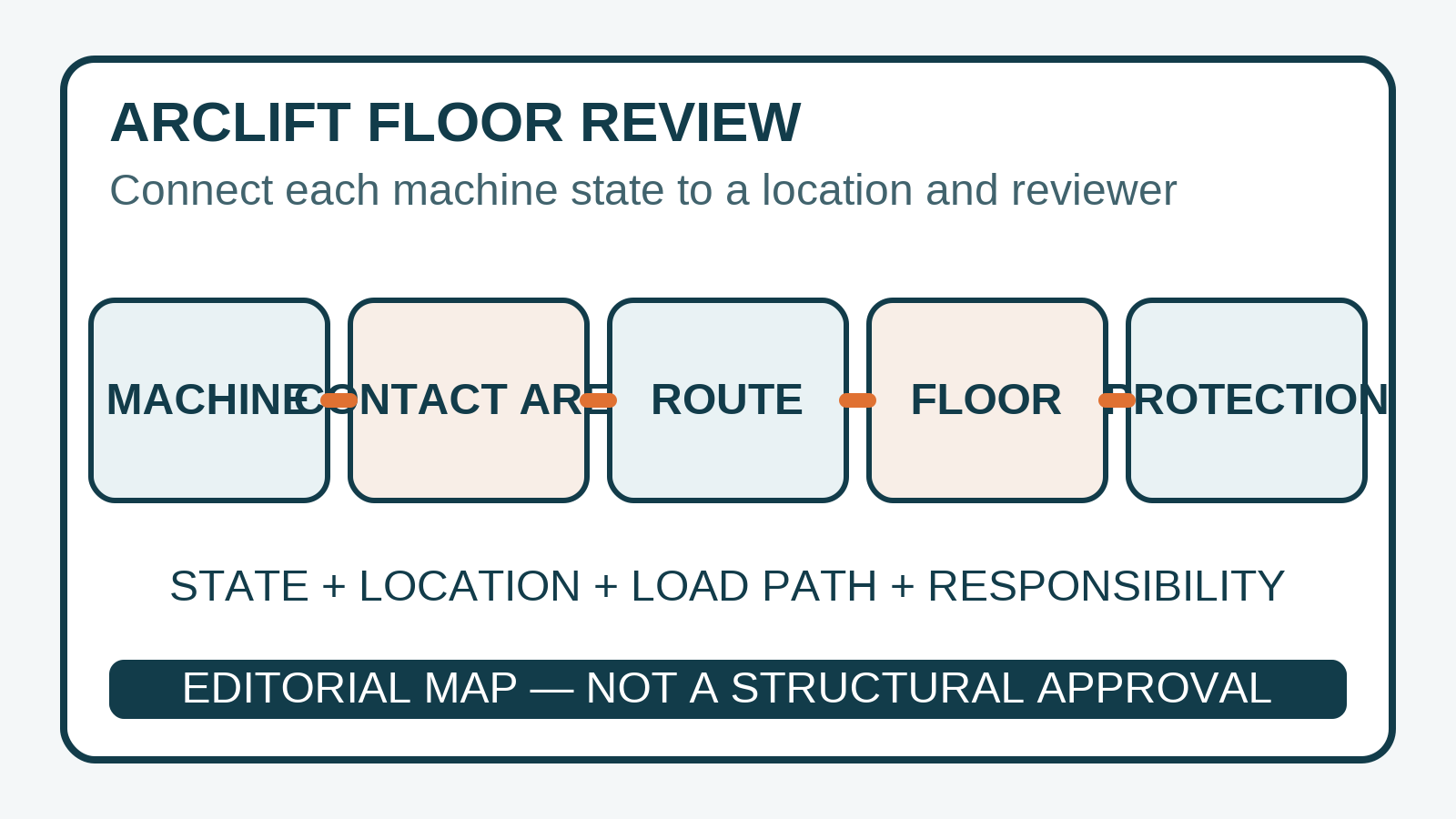
Editorial diagram. AI-assisted editorial diagram; not evidence of ARCLIFT equipment, configuration, project, capability or result. Tap to open the full-size diagram. It shows review layers and provides no pressure calculation, structural decision or equipment approval.
Set review holds and request the right data
The output of this comparison is a scoped information request and a list of holds. It is not a recommendation to buy, rent or operate either category.
Either category may not fit when its permitted task boundary, route state, support condition, work-zone interface or responsible-party structure conflicts with the project. A familiar label cannot override an unresolved interface.
Identify clear not-fit conditions
Hold the comparison when the task boundary is unclear, a personnel-access machine is expected to act as a crane, a crane is assumed to be a normal personnel-access method, or an unverified attachment is essential. Hold it when the route survey, floor or ground record, overhead survey, task-load breakdown, equipment instructions or responsible owner is missing.
Also stop when the proposed work depends on an operating state not confirmed by the exact instructions, when the work zone cannot separate people from the operation, or when rescue and recovery responsibilities are unresolved. A lower purchase price, familiar brand or smaller brochure dimension cannot close those gaps.
Use a one-page decision record
Create a table with one row per decision: task, load or occupants, pickup or work position, route, support, overhead, work zone, controls, rescue, destination review and authorization. Add columns for owner, required source, revision, status, assumption, hold point and closure record.
Use status values such as confirmed, provisional, missing and changed. A changed input should reopen affected decisions. Keep customer names, site identities, drawings and sensitive contacts in the controlled project channel, not in public forms or editorial material.
Send a bounded technical request
Provide anonymized task and site data, not a request for a universal winner. For load handling, include the controlled load package, route states and lift-planning owner. For personnel access, include work-zone geometry, occupant and material breakdown, route, support, overhead and rescue inputs. State the destination and identify who owns local review.
A preliminary package should include:
- Task statement, required height or outreach, category boundary and exact equipment identity if known.
- Load or task-load schedule with material, length and handling-state questions kept explicit.
- Access and transport route-state drawings, including slope, doors, turns, edges and traffic interfaces.
- Ground or floor records with contact-state and structural-review ownership.
- Roof, ceiling and work-zone geometry with overhead obstructions and controlled survey revision.
- Power and control questions tied to the exact operating state and current equipment documents.
- Outrigger, stabilizer, track or wheel interface questions where the actual configuration uses them.
- Destination requirements, documentation owner and local decision path.
- Rescue or recovery interface, change triggers, unresolved holds and required signed closure records.
Send that controlled package to ARCLIFT as a technical selection and supply partner. Include project-specific height, route, transport state, floor or ground, work-zone, task-load, destination and responsible-party inputs. ARCLIFT can organize configuration questions and the evidence needed for a preliminary review. The response does not establish equipment fit, personnel-lifting permission, suspended-load approval, site authorization, availability, quotation or outcome. Final decisions remain with the competent project parties using current equipment, signed closure documents and current site records. Every editorial visual and image in this article remains an explanatory aid, not project evidence.
FAQ
Is a pick-and-carry crane a type of spider lift?
No. The terms describe different primary task boundaries: material handling versus personnel access. A particular machine’s permitted uses must still come from its controlled documentation and the applicable project review.
Can a spider lift carry suspended materials?
Do not assume so. Confirm the permitted use, attachments, load conditions and operating instructions for the exact configuration. If the method requires crane-like handling, treat that as a separate hold requiring competent review.
Does a smaller footprint decide the comparison?
No. Footprint is one input among route geometry, machine state, support conditions, overhead space, work interface, load or occupant plan, nearby operations and rescue or recovery requirements.
What should be sent before asking for a recommendation?
Send a task-boundary statement, route-state survey, support-surface evidence, overhead map, load or occupant breakdown, destination, responsible-party map and list of open equipment-document questions. Do not send public links containing customer or site identity.
This article is a procurement and planning framework, not a lifting plan, work-at-height procedure, training document, structural review, legal opinion or authorization to operate.