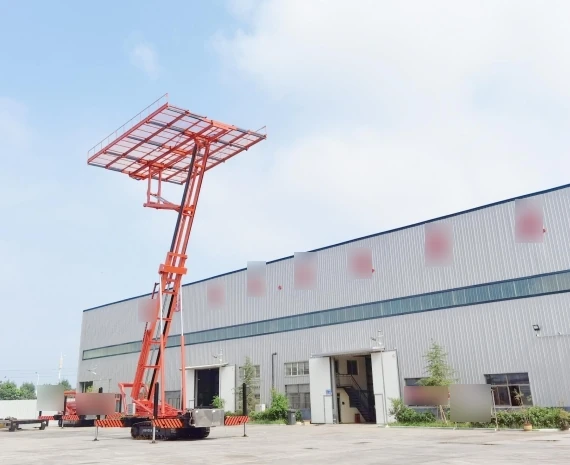
The useful comparison between a large-deck crawler platform and a basket lift is the work each proposal addresses. Adjacent people may need a shared work area, or a task may consist of separate points visited at different times. A project can also justify comparing a divided equipment scope, with one candidate proposed for the main work band and another for clearly named exceptions. Give all three approaches the same task list before comparing their price or apparent convenience.
Here, basket lift means an identified personnel-access candidate with a basket, not a single chassis, reach or movement capability. Crawler large-deck work platforms provide a broad deck for ceiling and wall tasks; they are distinct from lifts that elevate roof-panel formers. Neither platform area nor a product-family name proves task coverage, allowable load or performance.
Contents
- Establish one task list for every proposal
- Compare shared-deck, basket and divided scopes
- Follow material and site occupation through each scope
- Build a shortlist from comparable coverage
- FAQ
Establish one task list for every proposal
Separate the main work band from exceptions
Mark the repeating ceiling band or wall area, then list corners, recesses, end bays and scattered inspection points separately. Include the building stage for each. Work performed before services are complete may have a different access relationship from inspection after closure.
The ceiling and wall-platform project-data guide helps define those task rows. This comparison uses them to ask which offer addresses which work. It should neither let an exceptional corner disappear from the purchase nor assume that the equipment serving that corner must also serve the whole installation band.
Identify the interaction the task actually needs
Describe whether people must work at adjacent positions, share visibility or coordinate with material presented at a common face. Several people assigned to a job do not necessarily need simultaneous access on one deck. Conversely, a small fixing point can still require a material interface or another person’s involvement that the equipment proposal must account for.
Distinguish an essential task relationship from a preferred habit. That gives each provider room to explain a different arrangement while answering the same requirement. The buyer’s role is to describe the necessary interaction; the appropriate project specialists assess the proposed work method.
Identify the candidate, not only its category
For the deck proposal, establish whether it is a complete crawler platform or a working deck associated with a named host. For the basket proposal, identify the actual machine and configuration. For a divided scope, name both candidates and their assigned tasks. An unspecified small lift to be arranged later leaves the exception unanswered.
The ARC-F20 reference can help orient the large-deck discussion, but it does not establish current configuration values. Ask for the records needed to relate each candidate to the task. A photograph cannot prove host compatibility, access past a beam or the permitted use of an accessory.
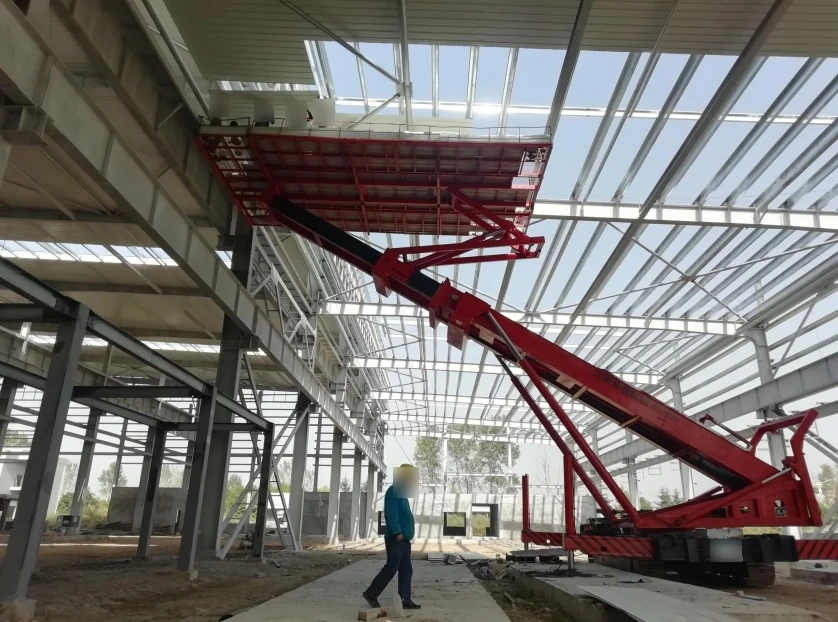
Reference photograph of a broad platform beneath a building roof. It does not establish working coverage, allowable occupancy, load or superiority over a basket lift for another task.
Compare shared-deck, basket and divided scopes
Investigate a shared deck for adjacent work
A shared-deck proposal deserves investigation when the task depends on adjacent working positions and a coordinated relationship to the same workface. Ask it to describe the proposed working area, the material presentation assumed and the positions covered. The possible value lies in the task arrangement, not in deck width alone.
Carry the proposal through the exceptions. Can the documented configuration be assessed at the recessed corner or later inspection point, or does it address only the main band? A broad deck does not by itself resolve an obstructed face. The reply should identify any uncovered task instead of using the main work area as evidence for the whole building.
Investigate a basket for separated task points
A basket proposal deserves investigation where the task is a sequence of separated positions and the required interactions can be described for that arrangement. Ask how the same tools and material reach those positions and which supporting equipment is assumed. A small-looking basket is not evidence of sufficient reach, clearance or load for a particular task.
If the repeating band includes coordinated work, ask the basket provider to respond to that requirement explicitly. Splitting a task into points must not silently remove a necessary interaction. The comparison concerns the proposed method and configuration together; it cannot be settled by counting the workface targets.
Investigate a divided scope for different work patterns
Consider a hypothetical project with one continuous installation band, several recessed corners and later inspection at scattered points. A divided proposal might assign the band to an identified deck candidate and the exceptions to an identified basket candidate. Ask whether each part addresses its assigned work and how the material and site interfaces connect.
The divided proposal may introduce another delivery, additional local coordination or a separate period of site occupation. It could also leave a gap where neither provider has addressed a material transfer. These are questions to price and assess, not reasons to assume the mixed scope is better or worse. Its task list must be as complete as the single-candidate offers.
Compare all three approaches against the same rows
| Task or interface | Shared-deck proposal | Basket proposal | Divided equipment scope |
|---|---|---|---|
| Main installation band | Explain the adjacent working arrangement | Explain how the same task and interactions are addressed | Name the candidate assigned to the band |
| Corners and recesses | Identify covered and unresolved positions | Identify the actual configuration proposed at each point | Assign each exception to a named candidate |
| Later inspection | Address the completed building condition | Address the same later viewing or tool approach | State the candidate and timing for follow-up access |
| Material presentation | Describe included functions and separate handling | Describe transfers and any supporting equipment | Identify shared, separate and omitted material interfaces |
| Site occupation | Describe the space needed for the proposed task | Describe the candidate and its supporting activity | State whether the candidates occupy the site together or separately |
This is a purchasing comparison, not a capability matrix. Fill its rows with configuration-specific responses. The proposal that describes the most familiar equipment is not necessarily the one that covers the most work, and the offer with the fewest unanswered rows still needs the relevant technical evidence.
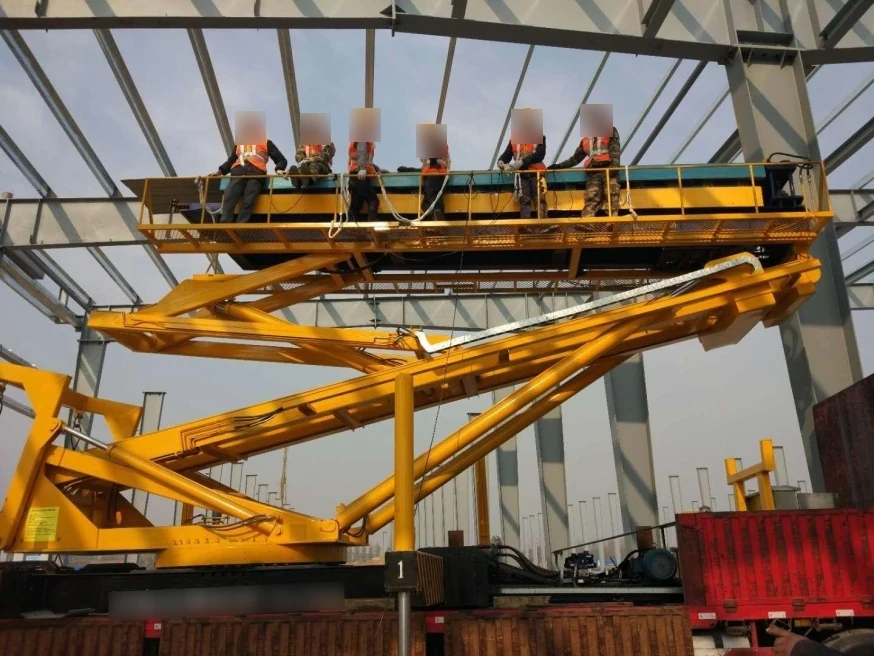
Reference photograph of a yellow platform with people visible. It cannot establish a permitted person count, coordinated work method, platform rating or comparable performance against a basket lift.
Follow material and site occupation through each scope
Keep material functions inside the comparison
Use the same panel dimensions, packaging, tools and presentation requirement for all candidates. Identify where items wait, how they are proposed to reach the workface and which functions belong to separate equipment. A proposal that omits material presentation should not be compared as though it includes the same scope as one that describes it.
For a deck, visible area does not establish permissible stock storage or load distribution. For a basket, do not assume that material may be attached to or suspended from it. Use the task-load guide to separate people, tools, material and accessories, then request the relevant configuration evidence.
Consider the supporting structure and available floor area
Compare each complete equipment arrangement against the worker position, beams, services and available support area. A smaller basket image does not describe the envelope of its supporting structure; a broad deck image does not establish usable access to every part of the workface. Both proposals need the actual building geometry.
Entry and floor questions can eliminate an apparently attractive concept before the main working area is considered. Use the building-entry survey and floor-review guide for those specialist inputs. Keep those unresolved conditions visible beside the comparison instead of allowing a favorable task score to conceal them.
Compare occupation through the project stages
Show the space required for equipment, material staging and shared access during the relevant task periods. A divided proposal used sequentially has a different coordination question from two candidates proposed at once. Ask which periods and arrangements are assumed; do not treat two equipment prices as the complete mixed-scope cost.
The work-zone layout guide develops the occupation detail. Here the buyer needs enough information to compare the offers on the same basis, including the later return for inspection. A main-band proposal that leaves follow-up site occupation undefined has not yet answered the whole task list.
Treat movement and timing as configuration questions
Describe the required sequence of positions without prescribing how the equipment moves between them. Applicable instructions establish permitted states, including what may be present during movement. Neither the crawler label nor the basket category establishes raised travel or movement with people and material aboard.
Britain’s HSE MEWP selection guidance concerns selecting equipment for work at height and managing associated risks. It does not rank these candidates or approve their movement states. Fewer proposed positions do not prove a faster or cheaper method; preparation, material interfaces and site availability also belong to any project-specific evaluation.
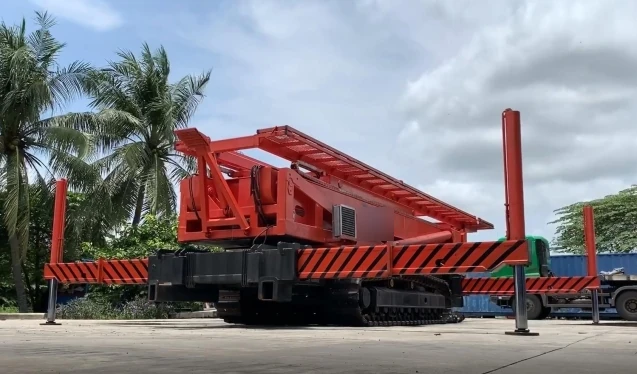
Reference photograph of a different crawler lifting apparatus in a folded support state. It does not show either broad platform above, prove their transport or support configuration, or establish permission to travel.
Build a shortlist from comparable coverage
Issue one input set with differences that matter
Ask the providers to use the same task and drawing revision, then supply the information that distinguishes the proposals:
- Main work band, exceptional positions and later inspection tasks at their respective building stages.
- Worker height, horizontal position, tool approach and necessary interaction with others.
- Ceiling or wall geometry, obstructions and the candidate positions to assess.
- Material dimensions, length, packaging, tools and simultaneous people-and-item requirements.
- Material-transfer functions included in each scope or supplied by another provider.
- Ground or floor records and the available support or outrigger areas.
- Entry, turning, withdrawal and shared-access constraints for every candidate.
- Wind exposure and other environmental inputs relevant to the work area.
- Destination, transport, unloading and any proposed container or assembly boundaries.
- Power, voltage, control and documentation needs for the actual configurations.
- Site coordination, emergency-access and rescue-planning responsibilities for the proposed periods.
These prompts prepare a comparison; they are not operating instructions. The result should show whether the candidates are being assessed against the same work and which inputs remain unavailable.
Compare total supply scope before preferring an offer
Ask for included equipment, options, delivery, integration, documentation and any proposed attendance or handover support. For a divided offer, identify which party coordinates the connection between scopes. For a single candidate, check that its quotation actually includes responses to the exceptions rather than assuming they are minor follow-up work.
If one proposal has better documentation, distinguish that evidence advantage from demonstrated physical superiority. Request the missing records from the other provider before drawing a technical conclusion. Keep a preference provisional where a material, floor or clearance question can still change the outcome.
Leave unresolved coverage visible
A deck or basket proposal may not fit when the required worker position, material interface or support conditions cannot be assessed. Another access concept may need investigation. Do not fill an unanswered row with a general family claim, a model suffix or an assumed body reach beyond the documented arrangement.
FAQ
Is a large deck automatically preferable for several workers?
No. Establish whether the task needs adjacent simultaneous positions and what else is present. The number of people assigned to the overall job does not establish either that task relationship or the configuration’s permitted occupancy.
Is a basket automatically better at recessed corners?
No. Assess the actual basket, supporting structure and proposed position against the corner geometry. A smaller platform appearance cannot establish reach or clearance for the required worker and tool approach.
Should the purchase use one machine for every task?
Compare that option with an explicitly divided scope where the work patterns differ. Both must account for the same main band, exceptions, later tasks and material interfaces. Neither has a presumed cost or time advantage.
What makes two quotations comparable?
The same task list and construction stages, named equipment configurations, stated material and site assumptions, and clear covered or outstanding positions. Compare the services and supporting equipment as well as the platform price.
Request coverage of the common task list
Ask ARCLIFT to clarify a large-deck proposal against your main work band, exceptional points and later inspection tasks. Include the basket or divided-scope boundaries you are comparing, and request a response identifying covered work, separate material functions and the site occupation assumed.
Supply the required height, floor information and destination transport boundaries for each candidate. This editorial comparison supports a shortlist; final selection depends on configuration-specific evidence and the competent site reviews.