
A useful roll-forming lift lead-time discussion identifies the decisions and inputs needed before a supplier can commit to a defined delivery boundary. Machine records, panel requirements, chassis selection, packing and destination work can affect different parts of that discussion. Ask which dependencies remain open rather than requesting one duration for an unidentified package.
The lift carries a compatible roof-panel roll former near the receiver. Its shipment date is different from the date when that combined arrangement is available for the intended site task. This guide maps pre-order dependencies without supplying production durations, promised dates or an installation sequence. The receipt guide handles what actually arrives later.
Contents
- Define which delivery event matters
- Follow the machine and chassis dependencies
- Connect shipment with destination completion
- Request a schedule response with visible assumptions
- FAQ
Define which delivery event matters
Separate dispatch, arrival and completed scope
A buyer can ask when equipment is expected to be dispatched, when a shipment may arrive or when specified local work may be complete. These are different questions with different responsible parties. Name the event and place before asking for a supplier date. Otherwise a factory-ready answer can be mistaken for availability at the roof workface.
Also identify the assemblies covered. An order can involve a lift, separately arriving former and local vehicle. The first item’s arrival is not the arrival of the whole proposed arrangement. Ask which dates refer to which objects and which local activities are outside the supplier’s commitment.
Identify the project need without making it a promise
State the project’s target event, such as when equipment access is needed for a named roofing package. Label that date as the buyer’s requirement. The provider’s response should explain the equipment scope, assumptions and outstanding inputs on which any proposed schedule depends. Repeating the buyer’s date in an offer does not establish a commitment unless the offer actually defines it that way.
Where the work window remains uncertain, explain the uncertainty. A provider can discuss dependencies or a requested supply route without pretending that the final programme is settled. The task is to find what would make a schedule response credible, not to force confidence into an early estimate.
Map parallel purchases without inventing a sequence
Some information and purchasing work may proceed independently; other decisions depend on a selected machine or vehicle. Ask the actual providers to identify those relationships. Do not assume that every item can be ordered in parallel or that all work must happen one item at a time. The map in this article is a procurement enquiry, not a manufacturing or installation programme.

Reference photograph of elevated apparatus, building steelwork and ground-level coils. It does not verify active production, current performance or the complete equipment arrangement being offered.
Follow the machine and chassis dependencies
Existing-former route: records before a defined pairing
For a buyer-owned former, identify its current arrangement, availability and applicable machine-side records. The lift provider needs to know which machine its proposal is intended to carry. If the outline is old or support information is missing, ask whether the gap affects initial screening, a firmer equipment proposal or later integration work.
This creates a practical chain of questions: what owned machine is available; what information describes it; which lift arrangement is proposed around it; and which integration scope remains to be agreed? Each answer narrows the next purchase decision. The existing-former guide develops the asset-retention question without promising a retrofit service.
New-line route: panel definition before an identified assembly
For a new forming line, the panel profile and actual material basis help define the machine being purchased. A provisional product mix can leave the forming arrangement and its lift interface unsettled. Ask which panel inputs must be agreed for the next stage of the supplier response and which choices remain possible alternatives.
The dependency is not simply tooling takes time. It concerns knowing what line and installed arrangement the offer describes. A generic line price followed by a separate lift price can leave that connection unresolved. The line-specification guide explains the detailed production inputs; the schedule discussion should identify their effect on commitments.
Destination-chassis route: candidate availability is one input
A local vehicle being readily available does not establish that it has been reviewed for the upper equipment. Identify the exact candidate and ask what information the equipment and local integration parties need. The truck-mounted forming-lift family describes the architecture; its family label does not settle vehicle inclusion or completed local integration.
Keep local procurement and integration appointments visible. If the candidate changes after an earlier review, ask which equipment and schedule assumptions must be revisited. The buyer should not preserve a date based on a different vehicle merely because the replacement is also called a truck chassis.
Connect shipment with destination completion
Use a dependency table tied to real objects
The table below identifies purchase questions rather than durations. Replace each unresolved dependency with the actual provider’s answer, including the equipment and event covered. An input being available does not prove the dependent activity is complete; it enables the responsible provider to explain what can be proposed next.
| Purchase path or event | Input to identify | Who needs to answer the dependency | Event still requiring its own scope |
|---|---|---|---|
| Lift around an owned former | Current machine records and availability | Machine owner and proposed equipment parties | Coordinated integration proposal |
| New line and lift | Panel/material basis and included line arrangement | Forming and lift supply parties | Agreed combined equipment scope |
| Destination chassis | Exact candidate and integration provider | Vehicle and upper-equipment parties | Defined completed-vehicle boundary |
| Packing study | Actual shipped assemblies and packed arrangement | Equipment and packing providers | Carrier booking and shipment acceptance |
| Destination arrival | Actual shipment and transport handover | Logistics and receiving parties | Receiving and storage readiness |
| Local completion | Available equipment, information and facilities | Appointed local and equipment parties | Agreed installation or handover event |
Hypothetical split-supply project
Imagine a contractor asks for equipment at a named roof zone by its project target date. The former will be buyer-owned, the lifting assembly is newly requested and the chassis would be sourced locally. The former’s current records are available, but the chassis candidate and local integration provider remain undecided. This is a hypothetical dependency example, not an ARCLIFT schedule.
Ask the lift provider which scope it can discuss now and which commitment depends on the vehicle input. Ask the buyer’s local parties for their candidate and completion scope. The target date stays visible as a project requirement. It should not be reported as a confirmed delivery date simply because one component provider has proposed an earlier dispatch.
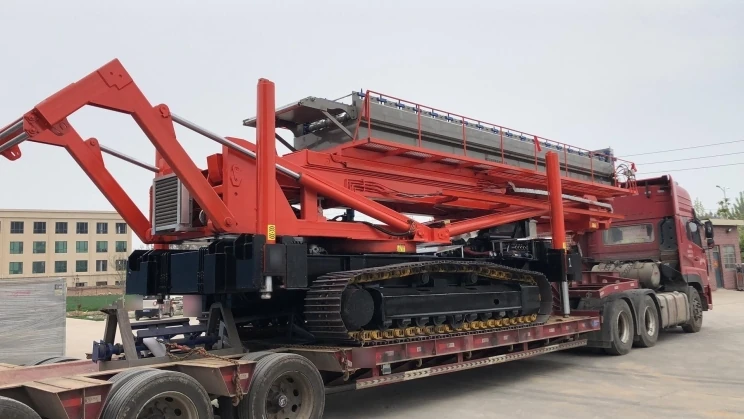
Reference photograph of crawler equipment on a separate carrier. It does not verify truck-mounted architecture, an approved transport arrangement or a completed ARCLIFT delivery.
Compare shipment choices with the work they leave behind
A more divided shipment can create additional receiving and local completion dependencies. A more assembled shipment still needs actual transport and destination review. The trade-off is the agreed arrival boundary and the work remaining there, not a presumption that one packing route is always faster.
The CTU Code publication provides packing and securing context. It does not establish booking availability, transit duration or container fit. Request those answers from the parties working on the actual shipment, using the actual package information.
Distinguish a changed input from a late activity
If the buyer changes the former, material requirement or vehicle, the proposal itself may need another response. That differs from a provider reporting a delay against an unchanged agreed scope. Keep the reason visible so the project can ask the right question: what decision changed, which information remains valid and which commitment needs revision?
The configuration-change guide explains the equipment consequences. Here the purchase map should identify the affected dependency without guessing how long the revision takes. A new date from one party cannot automatically reset every other provider’s commitment.
Request a schedule response with visible assumptions
Ask for named events and required buyer inputs
Request a response that identifies the proposed equipment, event, place and assumptions. Ask what the buyer must supply before a firmer commitment can be made and which local work remains outside the offer. If the supplier can only provide a preliminary response, retain that description when reporting to the project team.
The quotation-scope guide can help align commercial boundaries with these events. A schedule for supplied modules should not be compared with another provider’s completed-arrangement date without explaining the extra work. Both replies can be useful when their boundaries are explicit.
Prepare the procurement dependency brief
- Identify the former owned or required and the panel profile and material basis.
- Show the outlet height and roof receiving geometry for the target work zone.
- State the destination and distinguish dispatch, arrival and local completion requirements.
- Identify actual chassis or carrier candidates and transport handover expectations.
- Describe site access, ground or floor information and the receiving-space owner.
- Name local power and integration resources already appointed or still unknown.
- Ask which packing and configuration documentation must precede the requested commitments.
- Keep the project target date distinct from each provider’s actual proposed event.
Make the next action proportionate
If the blocker is an unidentified former, retrieve machine information. If it is an undecided local vehicle, obtain a candidate-specific response. If the packages are defined but no receiving location exists, address that destination dependency. A single focused action can advance the plan more than repeatedly asking every provider to shorten a date that has no common basis.
Recognize a date that cannot yet be relied on
The plan may not fit a fixed site commitment while the machine combination, vehicle, packing boundary or local completion provider remains undefined. This article states no manufacturing capacity, production duration, transit time or committed delivery. It also provides no assembly or operating sequence. Actual commitments require the specific parties and scope.

Reference photograph showing a suspended blue machine module. It does not verify its identity, compatibility, attachment points or an approved lifting method.
Ask which dependency controls the next commitment
Request a forming-lift procurement discussion with the equipment and dependency map. Include the former, height reference, roof zone, site access, destination, transport boundary and local completion expectations. Ask ARCLIFT to distinguish the scope it can propose from the inputs still needed for a project-specific schedule response. These editorial reference images do not establish stock, manufacturing throughput, dispatch status or a completed delivery.
FAQ
Is dispatch the same as site readiness?
No. Dispatch concerns the identified shipment. Arrival, receipt, local integration and the intended work task have their own scope and prerequisites.
Can I ask for a schedule before selecting a former?
Yes, for a bounded discussion of dependencies and needed inputs. Identify the unresolved choice so a preliminary answer is not reported as a final commitment for an actual combination.
Does a locally available chassis settle the vehicle route?
No. The exact candidate, integration scope and destination requirements still need their responsible responses. Availability is a useful input, not completed compatibility or integration.
Should the plan use one date for every provider?
Identify the actual events and dependencies first. Different providers may commit to different boundaries, and the project must understand how those commitments connect before reporting a complete schedule.