A used roll-forming lift listing needs an evidence review before it becomes a defined purchase. Start by establishing which equipment is for sale, which former and options belong with it, and whether the available records describe that actual arrangement. A photograph can show appearance; it cannot establish identity, condition, remaining life or permission to use the machine for your roof project.
The buyer’s immediate goal is a precise seller question list and a scope for independent condition and configuration review. This guide concerns pre-purchase evidence. The destination-receipt guide begins later, after an agreed shipment exists. Nothing here identifies used equipment offered by ARCLIFT.
Contents
- Identify the equipment behind the listing
- Connect history and manuals to the actual arrangement
- Define a useful independent review
- Decide which seller answers are needed next
- FAQ
Identify the equipment behind the listing
Separate the visible machine from the sale scope
Ask the seller to identify the lifting assembly, base, forming machine, feed equipment, loose items and supplied documents. Determine which visible objects are included and which are only background equipment. A separate carrier in a photograph may be excluded; a former shown on the lift may no longer be present. The price should refer to identified objects rather than the general scene.
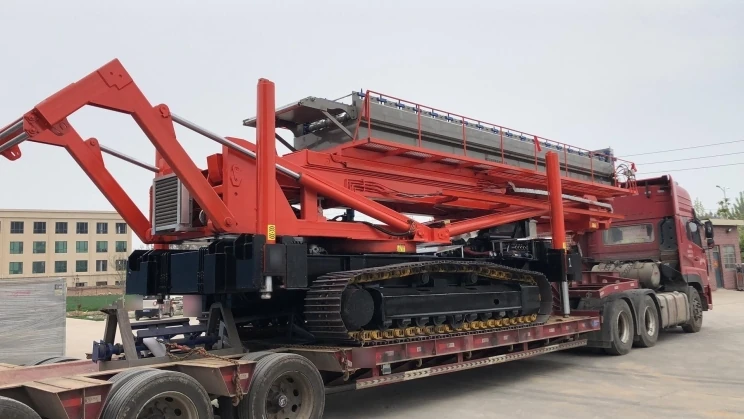
A crawler carried on a truck trailer remains crawler equipment. A truck-mounted lifting assembly requires an identified vehicle integration boundary. Use the forming-lift architecture comparison to keep these categories clear. Neither the seller’s label nor a similar appearance establishes that the advertised configuration matches the one pictured.
Request identity that connects across records
Ask for the equipment identifiers and corresponding applicable records through an appropriate private channel. The seller should be able to explain how the photographs, instruction set, maintenance history and proposed sale list refer to the same machine. Where an identifier is unreadable or a document covers a broader family, retain that specific uncertainty.
Do not infer a model from a filename, painted colour or a number resembling a height. Historical classes and model suffixes are not measurements or current capability statements. A missing identity link prevents a confident purchase comparison; a clean-looking exterior cannot replace it.
Distinguish an equipment description from a condition claim
“Folded,” “stored” and “recently painted” describe appearances or circumstances when supported by evidence. They do not mean inspected, maintained or ready for a journey. A folded crawler with supports extended is a stationary scene, not a travel-ready state. Ask the seller to identify the actual state and records supporting any additional claim.
The same discipline applies to footage of movement. It can show an event under the conditions actually recorded without establishing the machine’s complete history or suitability for another task. Do not turn an edited video into an implied condition assessment.
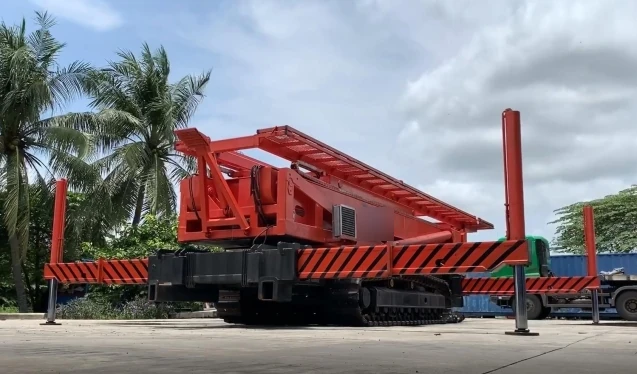
Reference photograph of folded crawler equipment with supports deployed. It does not verify a travel-ready state, condition assessment or suitability for another project.
Connect history and manuals to the actual arrangement
Ask about alterations, not only age
An age statement does not describe the equipment’s configuration or use history. Ask what assemblies have been changed, what known alterations are documented and which records apply afterward. A replacement cabinet, former or feed arrangement can affect the information needed for the proposed combination even if the main lifting structure looks familiar.
Distinguish seller-reported facts from supporting records and unresolved questions. A declaration that nothing has changed is a seller statement to evaluate, not a substitute for a review of the actual machine and its information. Likewise, an alteration record does not by itself establish that the buyer’s proposed use has been assessed.
Identify manuals that actually apply
Obtain the available instruction titles, equipment coverage, revisions and language. A manual for a related machine can help locate a question but should not silently become the applicable document. Ask which information is missing and who could legitimately resolve the gap before an order depends on it.
Keep instructions, inspection reports and sales literature in separate roles. Instructions describe the stated equipment; a report records a defined assessment; sales material describes what was marketed. None automatically covers another assembly or a later alteration. The technical-document guide helps interpret those distinctions once the records are available.
Connect previous use with the proposed task
Ask the seller to describe the known former, attachments and operating context to which its records refer. Then describe your own intended panel task, outlet relationship and destination. A machine’s previous work does not establish suitability for a different former, site or receiving arrangement.
This is particularly important if the advertised package omits the original forming machine. The buyer may be evaluating an older lifting assembly around a different former, which introduces a distinct integration enquiry. Use the existing-former purchase guide for that retained-equipment boundary instead of treating all components with a similar footprint as interchangeable.
Define a useful independent review
Set questions before commissioning an assessment
Ask an appropriately competent independent provider to define its actual scope: which equipment it will identify, which available history it will examine, what condition questions it can address and what lies outside its work. Procurement should understand the limits before relying on the resulting report. This guide supplies no physical inspection technique, test load or safe-condition checklist.
The HSE inspection guidance supplies Great Britain context for assessment based on equipment, use and risk. It does not define this purchase survey or certify a used machine. Applicable destination inspection and purchase due diligence can involve different questions and should be assigned separately.
| Evidence question | Seller information to request | Independent-review scope to discuss | What remains separate |
|---|---|---|---|
| Identity | Identifiers and included assemblies | Reconciliation with the actual machine | Legal ownership and sale rights |
| Configuration | Current arrangement and documented changes | Scope of observed equipment and record differences | New integration design |
| Condition | Known concerns and relevant history | Defined condition-assessment questions | Remaining-life prediction |
| Instructions | Available versions and language | Applicability and identified information gaps | Missing information from an authorized issuer |
| Intended task | Previous stated configuration and use | Limits of any comparison with buyer inputs | Site and former compatibility |
| Transport | Proposed sale handover state | Information needed by transport parties | Approved carriage and destination plan |
Hypothetical listing with a replacement former
Imagine a listing showing a crawler assembly carrying a former, while the written sale excludes that former. The buyer owns a different line and wants to use it with the lifting assembly. This hypothetical purchase has two separate questions: what is the condition and identity of the used equipment, and can a new machine combination be investigated?
A condition report limited to the seller’s lifting assembly does not answer the second question. The buyer should request machine-side information for its own former and identify who would supply integration work. If the seller cannot connect the photographs with the equipment actually offered, even the first question remains unresolved. No amount of comparative pricing closes that identity gap.

Reference photograph showing a suspended blue machine module. It does not verify its identity, compatibility, attachment points or an approved lifting method.
Compare a reviewed candidate with an incomplete listing
The trade-off is not simply price against age. It is a defined candidate with known assessment limits against an offer whose equipment and outstanding questions may be unclear. An unresolved listing can remain a subject for enquiry, but it should not be ranked as equivalent to a fully described alternative.
If a seller supplies more records, ask whether they resolve the question that matters. Additional unrelated certificates or photographs do not necessarily close a current-configuration gap. Keep the decision focused: request the missing identity, arrange a defined review, investigate an integration route or stop pursuing an offer that cannot be meaningfully described.
Decide which seller answers are needed next
Send a bounded question list
Ask the seller to confirm the actual included items, identifiers, available instructions, known modifications, relevant history and proposed handover boundary. Identify the records needed by the independent reviewer. Ask which claims in the listing are based on documents, observations or statements requiring further assessment.
Keep the wording factual. Asking for evidence does not accuse the seller of a defect, and missing records do not automatically prove a machine is unsuitable. They define the uncertainty the buyer must resolve before relying on the listing. The deposit or contract decision should reflect that uncertainty rather than treating silence as confirmation.
Give reviewers the proposed purchase context
- Identify the seller’s machine and every assembly included in the proposed sale.
- State the buyer’s former, panel profile and material task where a new combination is intended.
- Show outlet height and roof-zone geometry as buyer requirements, with estimates marked.
- Describe the destination, transport handover and separately needed carrier or chassis work.
- Supply available site access and ground or floor information for later fit review.
- Identify current power and control records, known alterations and missing documentation.
- Define the independent-review question and the conclusions outside that provider’s scope.
Keep the review result attached to its limits
The buyer should receive a report that names the equipment and actual scope examined. Preserve unresolved matters and exclusions when forwarding it to procurement or another technical party. A short summary such as inspected can conceal the exact limitations that made the review useful in the first place.
Recognize a listing that cannot support commitment
This purchase approach may not fit an unidentified machine, a listing with unresolved substitutions or equipment whose necessary instructions and responsible review cannot be established. It provides no assurance of safe condition, service life, residual value or destination acceptance. An inspection record cannot be expanded into approval of an unreviewed use.

Reference photograph of elevated apparatus, building steelwork and ground-level coils. It does not verify active production, current performance or the complete equipment arrangement being offered.
Ask a supply question without implying used inventory
For comparison with a defined equipment-supply route, send ARCLIFT a forming-lift advice request. Identify the proposed former, available records, required height relationship, roof zone, site access, destination and transport scope. State which used-equipment questions remain for the seller and independent reviewer. ARCLIFT is a technical selection and supply partner; no used stock or condition-assessment service is promised here. Final project-specific decisions require the actual evidence. These editorial reference images are not sale listings or condition reports.
FAQ
Can a fresh photograph establish that a machine is serviceable?
No. It can help identify visible features and the scene. Condition, concealed issues, applicable information and the assessment needed require their own evidence and competent scope.
Is a missing manual proof that the equipment must be rejected?
It identifies an information gap. Establish what is missing, who can resolve it and what the responsible reviewers require. Do not use another machine’s instructions as an assumed substitute.
Does an independent inspection approve my roof project?
Only the scope actually agreed and examined can be reported. A condition review does not automatically cover a new former, destination, site position or local duties.
Should the carrier shown in a listing be included in the comparison?
Ask whether it belongs to the sale. A carrier visible beneath crawler equipment may be a separate transport service, and its presence does not make the lifting assembly truck-mounted.