
Adding a lift to an existing roof-panel roll former is a purchase decision about which assets can be retained and what still needs to be supplied. The former’s ability to make the desired panel is one starting fact. It does not establish that the machine can be raised on a proposed lift, that its records describe the current arrangement or that integration services are included.
Begin with a retain, replace or unknown inventory, then ask for a bounded retrofit enquiry and a separately described new-line alternative if wanted. The mounting-interface guide develops the physical attachment question. This page helps decide what purchase route deserves that detailed work.
Contents
- Establish what you actually want to retain
- Retrieve the records that shape the purchase
- Compare retrofit with a new-package alternative
- Request a response around the actual owned equipment
- FAQ
Establish what you actually want to retain
Distinguish ownership from suitability
A machine already in the workshop is an identifiable asset, not an automatically suitable lift input. State why retaining it matters: an agreed panel task, established material records or continuity with an existing production arrangement. Then identify which facts require confirmation for elevated use. This makes the enquiry more useful than a photograph followed by a request for a lift of matching weight.
The lift’s role is to position a compatible forming machine near the roof receiver. The installation must account for its frame, relevant mass and position, attachments, material entry, outlet and services. The purchase review should find the parties and information needed to investigate those interfaces. It does not design a conversion.
Inventory assemblies separately
The former may have a cutter, cabinet, feed equipment, guiding attachments and other items supplied at different times. Distinguish what the buyer owns from what it intends to retain in the proposed combination. A nearby uncoiler in a workshop photograph is not necessarily part of the elevated assembly or part of the lift purchase.
Use the inventory below as a commercial starting point. A retain entry means the buyer wants the item assessed for retention; it is not a technical acceptance. An unknown entry calls for identification or a scope decision. Do not choose replace simply because records are incomplete: first understand what information can be recovered and whether a competent review can proceed.
| Asset or function | Retain for review | Replace or newly request | Unknown to resolve |
|---|---|---|---|
| Forming frame and installed tooling | Identify actual machine | Define new-line alternative | Current arrangement and panel basis |
| Cutting and output equipment | Identify included assembly | State requested output scope | Changes since original supply |
| Cabinet and machine services | Identify current configuration | Request coordinated new scope | Applicable drawings and interfaces |
| Coil support and feed equipment | State proposed retained role | Ask for separate equipment scope | Location and support concept |
| Transport or intermediate supports | Identify intended function | Request required supplied items | Whether items serve permanent integration |
| Vehicle or carrier | Identify actual asset | Request base or logistics alternative | Candidate-specific suitability |
Decide what may change in the enquiry
Say whether the supplier may investigate a different former or whether retaining the existing machine is a fixed requirement. If both routes are allowed, request separate replies. Otherwise a new-line proposal can appear to answer the question while quietly replacing the asset the buyer expected to keep.

Reference photograph showing a suspended blue machine module. It does not verify its identity, compatibility, attachment points or an approved lifting method.
Retrieve the records that shape the purchase
Ask the owner for current machine information
Retrieve the machine identifier, applicable instructions, arrangement drawings, machine-side support and attachment information, mass scope and available service documentation. Ask about known alterations and their records. A document from the original purchase may remain relevant, but the review needs to establish what it describes today.
Where the record is missing, state the gap precisely. Missing overall geometry, unavailable support information and an unidentified cabinet are different problems. Ask which gap prevents early screening and which later information would be needed. Do not manufacture missing values from photographs, an old sales model or another machine’s data.
Connect production evidence to the intended panel
State the panel profile and actual material requirement for the new roof task. The former may be familiar to the buyer on another material or product. Identify the basis of that experience and whether the intended requirement differs. The purchase decision should not treat familiarity as evidence for every future panel combination.
Keep sample information and machine information distinct. A satisfactory panel sample does not describe the frame mounting, and a complete outline drawing does not establish the required panel quality. The line-specification guide develops the production side when it remains unresolved.
Identify the integration supply gap
Ask who would provide the connecting scope between the retained former and the lift. That may involve an explicitly proposed intermediate item, machine-side information and a coordinated technical response. It must not disappear between a complete former offer and a complete lift offer, each of which excludes the other’s boundary.
The HSE supply-role guidance provides Great Britain context for distinct equipment responsibilities and information. It does not classify this proposed retrofit or determine destination duties. The buyer needs named technical and commercial responsibility for the actual combination, not a generic promise that integration will be easy.
Compare retrofit with a new-package alternative
A hypothetical retained former with incomplete records
Imagine a contractor owns a former used for its current roof-panel task. Its present cabinet differs from the original sales drawing, and the owner cannot yet locate the machine-side support information. The contractor asks for a lift around that machine and permits a new-line alternative. These are explicitly hypothetical circumstances, not an ARCLIFT retrofit project.
The retained route first needs a response about the current machine records and remaining integration scope. The new-line route needs a proposed production and installed arrangement addressing the same panel task. An early price for either route cannot settle the missing interface. The useful comparison exposes what information must be obtained and what equipment each route would supply.
Compare retention benefits with actual dependencies
Retaining an asset can preserve a known production resource, but the actual proposal may still depend on its availability, documentation and integration review. A new-line route can define a different equipment scope, but it must still answer material, mounting and destination questions. Neither route should be described as automatically simpler, cheaper or more reliable.
The trade-off belongs to the buyer’s situation: which existing resources are worth retaining, which questions can be answered, and which completion scope the providers will actually undertake. Use the quotation-scope guide once those alternatives can be described commercially. Do not add a guessed adaptation cost to one route or assume a warranty continues unchanged.

Reference photograph showing a suspended coil beside vehicle-mounted apparatus. It does not verify an approved handling method, included coil equipment or the scope of this purchase.
Preserve availability as a separate input
An existing former may be committed to another production job. State when it can be made available for the activities the responsible providers propose. This does not instruct the buyer to move it, dismantle it or suspend another contract. It identifies an asset dependency that an offer for a new line may address differently.
Also distinguish records available now from records promised later. A potential provider can explain what information supports an initial review without claiming compatibility. If the machine’s identity or current arrangement remains unresolved, the next purchase step may be an information request rather than a retrofit quotation. That is a concrete result, not a reason to fill the gap with a similar machine’s specification.
Request a response around the actual owned equipment
Use a retrofit-versus-new reply template
Ask each route to answer four connected questions: what actual machine arrangement is being considered; what equipment or services are included; what buyer inputs remain necessary; and what conclusion the present information can support. Keep the comparison tied to the same roof-panel task and completion boundary.
A useful request reads: “Please assess a supply proposal around our identified former and list missing machine records before any compatibility commitment. Separately, if a new-line alternative is proposed, describe the panel basis, supplied assemblies and integration scope. State differences in buyer-supplied equipment and destination work.” This is an enquiry template, not a promise that either service is available.
Describe the destination relationship
The machine is not being lifted in isolation. Provide the outlet-to-roof relationship, available standing area, material-side concept and intended base route. The crawler forming-lift family is a relevant orientation point, while a vehicle-based project should identify the truck-mounted alternative explicitly. An equipment-family reference is not a retained-machine compatibility statement.
Assemble the owned-machine enquiry
- Identify the former and each assembly proposed for retention or replacement.
- Supply the current profile and material basis, with known changes described.
- Attach available geometry, mass and machine-side mounting documentation.
- Show outlet height and roof receiving references for the intended zone.
- Describe site access and available ground or floor records.
- State the destination, transport plan and proposed chassis or crawler route.
- Identify machine power and control records and any separately supplied integration work.
Recognize when retention is still only a preference
The retrofit route may not fit when the actual machine cannot be identified, necessary machine-side information cannot be established or the proposed integration has no responsible provider. This guide does not authorize alteration, prove compatibility or retain a warranty. An alternative former or connecting structure requires its own defined proposal and review.
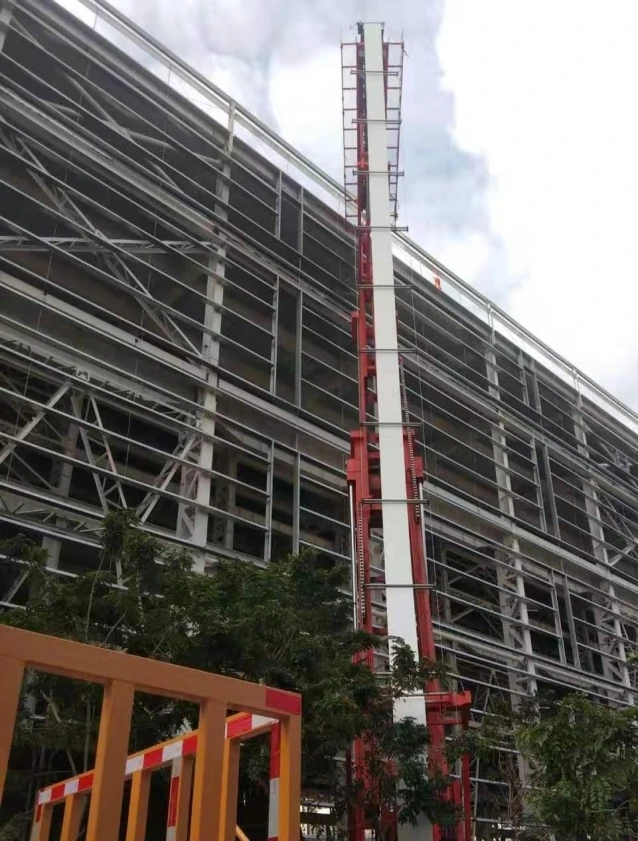
Reference photograph showing a panel beside elevated apparatus and building steelwork. It does not verify panel length, quality, production status or an approved receiving method.
Ask for an equipment-specific purchase discussion
Send the existing-former enquiry to ARCLIFT, naming the retained assets and whether a new-line alternative is permitted. Include the actual records, height reference, roof zone, site access, destination and transport dependencies. Ask which missing input controls the next response. ARCLIFT supports technical selection and supply coordination; final compatibility and scope require project-specific information. The editorial photographs show reference equipment scenes and do not demonstrate a retrofit service or approved conversion.
FAQ
Does an existing machine’s weight establish compatibility?
No. The identified arrangement, mass position, support information, attachments, services and material path also need review. A mass figure with unclear inclusions may itself need clarification.
Must the whole forming line be replaced if one record is missing?
That conclusion does not follow. Identify the missing record and ask the responsible parties what information can be established. Compare replacement separately if the buyer wants that alternative.
Can photographs begin the enquiry?
They can help identify the machine and describe the question. They cannot establish mounting details, concealed alterations or the machine data needed for a compatibility conclusion.
Is a retrofit quotation a conversion instruction?
No. Commercial scope, engineering responsibility and the applicable equipment information must be established separately. This article provides no procedure for physically altering or installing the machine.