
A request for accurate panels is too broad to compare tooling proposals. The buyer needs to identify the actual features the project wishes to assess and the source of their requirements. A tolerance figure without a marked feature, drawing revision or agreed measurement basis can create a different misunderstanding rather than solve one. The useful output is a feature-referenced requirement sheet that asks the supplier for an attributable response.
The profile-input guide defines the complete panel and material brief. This article isolates dimensional requirements and evidence questions. The forming-machine reference is related equipment for the lifting discussion; it supplies no standard tolerance or present accuracy claim.
Contents
- Make each dimensional requirement identifiable
- Ask how the proposed evidence relates to the feature
- Compare defined requirements with general accuracy claims
- Issue a feature-referenced tolerance request
- FAQ
ASME’s description of Y14.5 concerns the language used to state and interpret dimensioning and tolerancing requirements on engineering drawings and models. That distinction supports asking what a drawing requirement means before comparing evidence. The catalogue description does not supply the buyer’s acceptance values, prescribe a measurement procedure or establish the proposed machine’s accuracy.
Make each dimensional requirement identifiable
Mark the feature on the controlled profile
Give each feature a reference that can be located on the actual section or product drawing. Ask the requirement owner to identify the relevant endpoints, edges or areas instead of relying on a phrase such as all dimensions. Keep the drawing revision with the request. A supplier can then respond to a recognisable feature rather than guessing which part of a complex profile the buyer means. Where the project has not established a requirement, mark it as open; procurement should not create a new tolerance merely to make the enquiry sheet look complete.
Preserve the source of the requested requirement
State whether the requirement comes from the governing product drawing, another project document or a question still awaiting a decision. Keep the responsible product owner identifiable in the private enquiry. A supplier’s proposed value is a different type of statement and should remain labelled as a proposal until the appropriate parties agree it. This prevents a commercial response from silently revising the roof-product requirement. It also avoids treating a requirement copied from an unrelated product as though it were a confirmed capability for the actual former being discussed.
Distinguish different product observations
A cross-section feature, a cut-end requirement and an observation along the panel do not become one question simply because all can be described as accuracy. Ask the project owner which observations it needs and link each to its own reference. Keep the intended material and product condition visible. The buyer can then see whether a supplier’s evidence addresses a single feature or a broader stated scope. This article does not define an assessment method or numerical limit for any of them; it helps the parties avoid using one ambiguous claim to cover different physical questions.

Reference photograph showing a suspended blue machine module, not a coil. It does not verify tooling dimensions, measurement equipment or compatibility.
Ask how the proposed evidence relates to the feature
Identify the panel and material in the record
If a provider presents a sample or observation record, ask which profile, material and equipment arrangement it concerns. Retain the connection to the particular object rather than a general statement that the machine is accurate. A useful record can still be limited: it may address one material and one feature under its stated conditions. Keep that scope visible when comparing it with the current requirement. The buyer should not expand the result to another product condition merely because the proposed former looks similar or the sample has the same commercial panel name.
Request the agreed measurement basis
Ask the parties to identify what would be measured, in what stated product condition and under whose agreed procedure. Leave the actual technical method and equipment selection to the responsible reviewers. An enquiry can name the need for an agreement without supplying improvised measurement instructions. Where different parties propose different bases, request a reconciliation before comparing their conclusions. The acceptance guide provides the wider procurement discussion about observations and records; this sheet carries the feature-specific requirement into that agreement.
Separate nominal geometry from an acceptance outcome
A drawing can show the intended nominal shape without reporting an observed panel. An observation record can describe a measured object without proving that every future product meets the requirement. Keep those statements distinct. Ask the provider what it is proposing to supply and what evidence it offers for the requested scope. Do not present a completed drawing, a machine setting or an isolated display image as an acceptance result. This gives procurement a meaningful evidence question while keeping product assessment with the people appointed to make it.

Reference photograph showing a suspended steel coil beside vehicle-mounted apparatus. It does not verify material properties, coil rating or an approved handling activity.
Compare defined requirements with general accuracy claims
Work through a hypothetical feature dispute
Suppose the project identifies a particular edge feature needed for a roof connection. Bidder A returns a marked reply against that feature but leaves the proposed observation basis open. Bidder B states high accuracy without naming a feature. These are hypothetical responses. A has addressed the right product question but is incomplete about evidence. B has not yet shown what its statement covers. Ask each to respond to the same marked requirement. Neither a confident adjective nor a large set of unrelated measurements settles the named interface in the purchase.
Build a feature-to-evidence comparison
| Requirement field | What the buyer supplies | What the provider should address |
|---|---|---|
| Feature identity | Marked drawing location and revision | Same reference on the returned proposal |
| Requirement source | Actual project document or open decision | Any expressly proposed departure |
| Material and condition | Intended input and stated product state | Basis covered by its response |
| Observation scope | Named question requiring evidence | Actual proposed record and its limits |
| Measurement agreement | Request for the responsible parties’ basis | Unresolved method or interpretation |
| Final disposition | Named project decision route | Configuration-specific response, not a generic adjective |
The trade-off is the scope and relevance of the evidence. A tightly bounded response can be more useful than a broad claim because it shows the buyer which question is answered and which remains open.
Keep alternative requirements separate from compliance language
If a provider cannot respond against the nominated requirement, ask it to identify the proposed alternative and affected product features. Keep that proposal separate for the authorised product owner’s decision. Do not rewrite the original requirement to make both offers appear aligned. Conversely, if the discrepancy concerns only how a feature was labelled, retain the clarified interpretation without implying a physical tooling change. The buyer needs to know whether it faces a changed product, a missing evidence agreement or a documentation error, because each has a different next action.
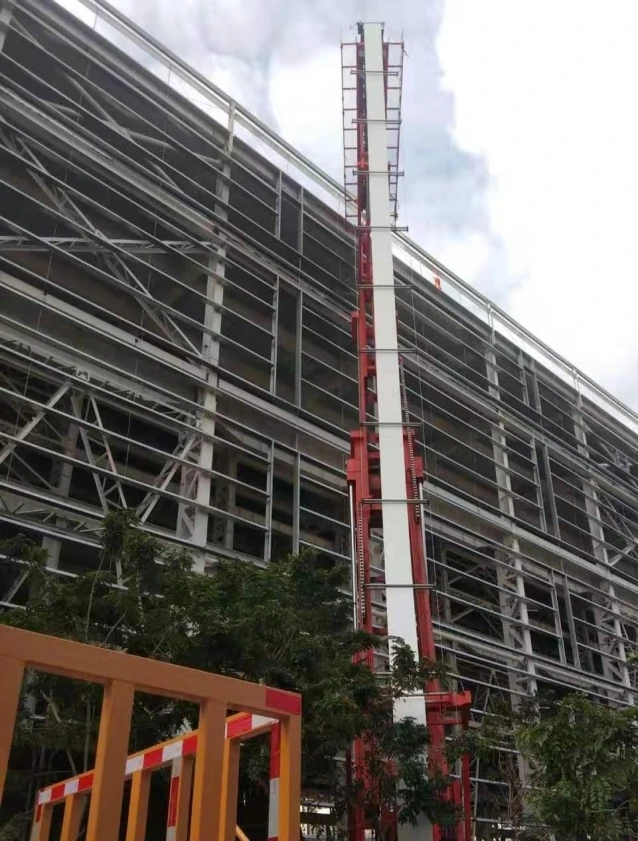
Reference photograph showing a long sheet beside a building and elevated apparatus. It does not verify dimensional acceptance, straightness or a measured panel profile.
Issue a feature-referenced tolerance request
Prepare six connected acceptance inputs
- Mark each required profile feature on the controlled drawing and retain its revision and intended face convention.
- Identify the actual source of each requirement, leaving unresolved values for the responsible product owner.
- Attach material and sample identities and state which product condition each observation is intended to address.
- Request a proposed evidence basis and name the parties who will agree it, without inventing a method or limit.
- Give outlet height, roof-zone geometry and site access context for the separate lifted-former interface review.
- Include destination documentation, transport, ground and power assumptions relevant to the actual machine proposal.
The package should make a supplier’s qualification locatable. A reply should identify the particular feature, product condition or evidence question it cannot yet address rather than excluding accuracy in general.
Use the returned sheet to decide the next purchase step
If the reply addresses the required feature and identifies a proposed evidence activity, the buyer can ask the parties to define that activity within the actual offer. If the product differs, return the proposed departure to the product owner. If only information is missing, obtain that record before seeking another general quotation. These are distinct purchasing steps. The line-specification guide connects any resulting machine or tooling scope to the installed arrangement that will be assessed with the lift.
Recognise a tolerance response that may not fit
An offer may not fit when it answers a different feature, depends on an unresolved material or presents a general accuracy claim in place of the requested evidence. This guide sets no tolerance value, measurement technique, machine capability or adjustment instruction. It cannot convert a photograph into dimensional verification or a nominal drawing into an acceptance result. The final product requirement, assessment basis and configuration-specific equipment response must be established by their responsible parties before the buyer treats the comparison as closed.
Discuss the marked profile requirement
Send the feature-referenced enquiry to ARCLIFT with the controlled section, material and proposed observation questions. Include site roof zone, outlet height, destination and transport context for the lifting project. Ask for a project-specific response identifying which requirements can be addressed and what evidence remains for final agreement. ARCLIFT is a technical selection and supply partner. These editorial photographs illustrate equipment context and establish no measured profile or acceptance result.
FAQ
Can the buyer ask for accuracy without numerical requirements?
It can open a discussion, but ask the product owner to identify the actual features and requirement basis before comparing a final equipment response. Do not invent values merely to complete an enquiry form.
Does a dimensioned drawing prove the machine can make it?
No. It defines the intended geometry. The provider needs to address the actual material, equipment and requested evidence. Keep the requirement separate from an observation of an identified product.
Should different measurement bases be compared directly?
Ask the responsible parties to reconcile them first. A result only addresses its stated feature and conditions. This article supplies no method for translating between different assessment arrangements or declaring them equivalent.
Can one sample settle the whole profile requirement?
Only the agreed scope and actual record can establish which questions it addresses. Identify the sample and its material, features and conditions; retain unobserved requirements rather than expanding the result to the complete purchase.