
A trapezoidal-panel enquiry can contain several different dimensions all called width. The strip entering the former, the overall formed section and the effective coverage used by the roof requirement are different references. The buyer needs a drawing that labels each intended meaning. Comparing two quotations against an unqualified width can conceal a different panel product rather than a different price for the same machine.
The profile and tooling guide covers material, edges and samples together. This guide produces a narrower width-reference sheet for a proposed lifted former. Discuss the related forming machine with the intended lifting family; no width relationship in this article establishes present machine capability.
Contents
- Label the three width references
- Reconcile drawings, samples and enquiry language
- Compare offers without converting their dimensions
- Issue a width-specific request for clarification
- FAQ
The distinction is visible in a manufacturer’s own product information: Tata Steel Colors’ SPANDEK profile page lists overall width and effective cover width separately. Those dimensions belong to that named product. Use the distinction when labelling the buyer’s section, without copying its values, deriving an incoming strip width or assuming that ARCLIFT supplies that profile.
Label the three width references
Identify the incoming strip reference
Record the width stated for the intended strip on the actual material order or supplier document. Name the document and the material condition it describes. Do not copy an overall packed-coil dimension into that field. The input belongs to the forming review, while the package dimensions belong to handling and transport discussions. If the ordered strip width is still being selected, mark that choice as open and ask who will determine it. The buyer should not manufacture the missing value from a panel sketch or a familiar product name.
Mark the formed overall width on the section
Ask the drawing owner to identify the endpoints used for the formed overall-width statement. Retain the complete section, including edges or returns that might disappear in a cropped sketch. The dimension needs its own label rather than the word width alone. A sample photograph can help a reader locate the feature, but the controlled drawing must own the requirement. This is especially useful when two bidders use different commercial terminology for similar-looking outlines: the buyer can ask whether the difference is merely wording or an actual change in the proposed section.
Keep effective coverage with the roof requirement
Ask the responsible roof-product party to identify the effective-coverage reference and the assembly context it belongs to. Do not treat it as the automatic overall width of an isolated sheet. Keep any relevant side relationship visible in the governing drawing without deriving a conversion. The purchase question is whether the proposed panel corresponds to the intended roof product. A lift supplier’s height or machine-platform description cannot settle that question, and a photograph of long panels does not establish the coverage of their installed arrangement.

Reference photograph showing a suspended blue machine module, not a coil. It does not verify strip width, a particular tool set or mounting compatibility.
Reconcile drawings, samples and enquiry language
Use one labelled sketch in every bidder package
Prepare a reference sheet with separate fields for incoming strip width, formed overall width and effective coverage. Each field should cite the actual controlling document or say that the information is not yet established. Include the profile revision and viewing convention. Send the same sheet to each bidder so that a response in a different convention can be recognised. The objective is not to fill every blank immediately. It is to prevent a bidder’s assumption from becoming an unnoticed change to the product being purchased.
Ask which field a quoted number addresses
When an offer says a machine makes a particular panel width, request the supplier’s marked endpoints and section reference. Do not reject it merely because its number differs from another document, and do not declare it equivalent because the commercial profile name matches. Two statements can use different definitions, or they can describe different panels. The marked response should make the distinction visible. Once the meanings are clear, the responsible product and tooling parties can address any real mismatch; procurement should not resolve it by subtracting an assumed overlap.
Treat a sample as an identified object
A physical sample may be useful when its profile, material and purpose are known. Ask whether it represents the proposed output or merely illustrates a visual feature. If it arrives with a handwritten width label, preserve that label beside the drawing reference and ask what was measured. A sample whose edges have been altered or whose origin is unknown cannot quietly become the master product definition. Record the uncertainty and obtain the required drawing rather than presenting the sample as a completed acceptance result.

Reference photograph showing a suspended steel coil beside vehicle-mounted apparatus. It does not verify coil dimensions, permitted handling or an included handling option.
Compare offers without converting their dimensions
Work through a hypothetical ambiguous-width tender
Imagine that a buyer’s brief names the required effective coverage but labels the field only width. Bidder A repeats that value beside an unmarked profile. Bidder B gives a different value described as overall panel width. This hypothetical comparison has not established which bidder addresses the requirement. Ask both for the three-field sheet and marked section. A may have copied the requested coverage without addressing strip input. B may be describing the correct output in another convention. The useful next step is a definition check, not an assumed technical conversion or an immediate price ranking.
Compare dimensions by meaning and source
| Width-related item | What the buyer should attach | What the supplier should clarify |
|---|---|---|
| Incoming strip | Actual material-order width reference | Which intended input the proposal addresses |
| Formed overall section | Dimension endpoints on the section | The corresponding proposed output reference |
| Effective coverage | Governing roof-product definition | Any departure from the nominated product |
| Sample annotation | Sample identity and stated purpose | Whether its label uses the same convention |
| Quotation statement | Supplier’s exact width wording | Drawing revision and endpoints behind it |
| Unresolved field | Named decision owner and missing record | Which part of the offer remains conditional |
This interface check separates information quality from equipment suitability. A complete sheet supports comparison but is not proof that the line can form the material or that the roof assembly is accepted.
Follow a changed profile through the purchase
If a bidder proposes another section, ask which width fields and edge relationships change. Keep the alternative separate from the nominated response. A different stated coverage can affect the project’s panel requirement, while a different strip requirement can affect the material enquiry. The actual roof-product and tooling parties need to address their respective implications. The buyer should not make the alternative appear compliant by retaining the old title on a revised section. Nor should a corrected terminology error automatically be treated as a physical tooling change when the marked geometry has not changed.
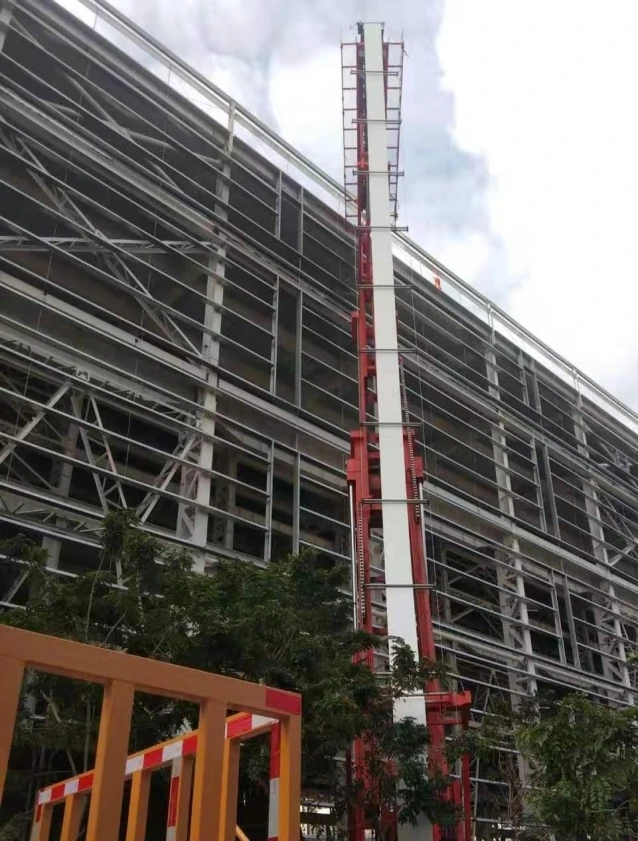
Reference photograph showing a long sheet beside a building and elevated apparatus. It does not verify measured panel width, roof coverage or profile acceptance.
Issue a width-specific request for clarification
Send a connected six-item width brief
- Identify the controlled trapezoidal section and show its complete edges, revision and viewing direction.
- Label incoming strip width, formed overall width and effective coverage as separate fields with document references.
- State the intended material and identify which width information remains provisional or unresolved.
- Attach sample references with their purpose and retain any conflicting labels for explicit clarification.
- Include outlet height, roof receiving geometry and access context for the separate lifted-line interface discussion.
- Give destination documentation and transport assumptions, with ground and power information appropriate to the proposed lifting arrangement.
The brief should let the supplier answer without guessing which meaning the buyer assigned to width. It also gives the product owner a precise discrepancy to resolve when the returned section differs.
Request a revised offer only after the meanings align
Ask the provider to return the marked reference sheet and explain any change in scope before repricing. If the clarification only corrects a label, record that fact with the agreed drawing. If it changes the proposed product or material input, ask for the relevant revised scope and the project decision it requires. This keeps commercial comparison attached to an actual panel definition. The line-specification guide explains how that product definition connects to the installed machine arrangement and lifting review.
Recognise a width enquiry that may not fit
A quotation may not fit when it addresses a different section or depends on an unresolved coverage requirement. An enquiry cannot become a final tooling brief while nobody owns the governing product drawing. This article supplies no width conversion, profile design, coverage calculation or material capability. It also does not decide coil package geometry or machine transport fit. Those separate questions need actual records. Use the sheet to reveal the mismatch, then let the responsible parties provide the technical answer rather than filling the blank from an archive photograph.
Ask about the marked width definitions
Send the width-reference enquiry to ARCLIFT with the labelled section and the intended material. Identify which width a previous offer used and what remains unclear. Include the roof zone, outlet height, site access, destination and transport context for the lifting project. ARCLIFT can coordinate the forming-equipment discussion in its selection-and-supply role. Final scope needs the actual provider response. The editorial photographs show equipment and panel context only; they cannot supply strip, overall or coverage dimensions.
FAQ
Can the three widths be treated as the same number?
Do not assume they are interchangeable. Ask the drawing and material owners to identify each required reference. This guide provides no mathematical relationship between them and no substitute for the actual profile definition.
What if a quotation states only panel width?
Request the marked section, endpoints and drawing revision behind that statement. Compare its meaning with the buyer’s requested field before deciding whether the reply is different terminology or a different product proposal.
Can a sample settle the width requirement?
A sample can support its identified purpose, but it needs a link to the controlled section and material. Ask what its label describes. An unexplained sample should not override the governing roof-product requirement.
Does a matching coverage establish machine suitability?
No. It addresses one product reference. The proposed tooling, material, complete machine assembly and elevated interfaces still require specific review. The roof product also retains its own project requirements beyond a single dimension.