
A maximum panel length does not describe a roof that needs several different products. The buyer needs a schedule showing which length belongs to which roof zone and which changes are still provisional. The useful output is a task-to-length requirement schedule that preserves the product differences without pretending to program the former or decide a production sequence.
The line-specification guide covers the whole machine purchase. The panel-length basis guide explains the endpoints of the ordered dimension. This page adds the project mix. Discuss the forming-equipment scope without assuming recipes, automatic changeovers or a particular control feature.
Contents
- Describe the required products by roof zone
- Keep requirement order separate from machine operation
- Compare a maximum-length reply with a mixed-task reply
- Issue a usable task-to-length schedule
- FAQ
Describe the required products by roof zone
Give each requirement a product reference
Create a separate row for each genuinely different required product or project zone. Retain the profile, material and agreed length basis beside the zone reference. Avoid a list of lengths with no explanation of where they belong. The purpose is to tell the supplier what the equipment purchase is being asked to address. If several zones share the same product, they can reference that common definition while keeping their location and programme relationship visible. Procurement should not turn every repeated roof bay into a new equipment requirement merely to enlarge the schedule.
Preserve short and exceptional requirements
A headline maximum can conceal a shorter product or an exceptional panel detail that the project still needs. Ask the requirement owner to identify those rows explicitly. Do not infer that a line response to the longest panel covers every other requirement. The actual provider should explain the proposed equipment scope against the stated products. If an exceptional item is separately supplied, name that commercial boundary. The buyer can then compare an equipment offer addressing the complete requirement with one that leaves a particular product or service outside its scope.
Label provisional quantities and dimensions honestly
Where the project has not finalised part of the roof, keep its schedule row provisional and identify the deciding party. Separate that uncertainty from a confirmed present requirement. Ask the provider which information it needs before returning a meaningful response. A preliminary schedule can still support discussion if its limits are clear. It becomes misleading when an unresolved drawing is presented as a fixed production instruction or when a supplier’s assumption is copied into the schedule without being identified as a proposal rather than the project’s requirement.

Reference photograph showing a suspended blue machine module, not a coil. It does not verify a cutting control, change function or current machine capability.
Keep requirement order separate from machine operation
Describe programme dependencies without prescribing runs
The purchasing section of HSE’s equipment and machinery FAQs advises buyers in Great Britain to define intended tasks and discuss complex equipment requirements with suppliers. The zone schedule makes that discussion specific to the required panel mix. The source establishes no cutting function, automatic sequence or capability for the proposed former.
The project can state that one zone must be available before another or that an installation window remains uncertain. Keep those requirements distinct from machine operating order. Ask the provider what its actual proposal needs to address the stated mix and which equipment functions it includes. This article does not decide how to program, feed or cut the material. A useful schedule communicates the products and work windows the buyer wants supported while leaving equipment use and production planning to the responsible parties with actual configuration information.
Ask what changes between required products
Request a response identifying whether the offered equipment arrangement differs between schedule rows and what additional supply is proposed. A changed length requirement does not establish a particular control capability. A changed profile or material may create a different question from length alone. Keep those distinctions visible rather than using mixed lengths as a vague promise that the line handles every product combination. The provider should identify the relevant configuration, outstanding input or separately offered function against the actual row it affects.
Pass the same product mix to the receiver
The receiving discussion needs the same product identities and zone references, without treating that schedule as a handling design. A panel at the agreed boundary should be associated with its intended destination by the actual project arrangement. The handover guide owns that interface. A schedule that only describes the former and omits the receiving products can leave two providers comparing different assumptions. Keep product definition connected across the enquiry, while support, movement and installation methods remain separate technical responsibilities.

Reference photograph showing a suspended steel coil beside vehicle-mounted apparatus. It does not verify an included material service or permitted handling.
Compare a maximum-length reply with a mixed-task reply
Work through a hypothetical three-zone roof
Imagine a roof with a repeated main-zone product, a shorter product at another zone and an exceptional product awaiting a drawing decision. The example is hypothetical and uses no machine rating. Bidder A responds only to the longest requirement. Bidder B identifies the confirmed rows it addresses and leaves the exceptional row conditional. A has not established complete coverage merely by naming the maximum. B’s qualification is useful because it locates the open decision. Ask both for the same row-by-row equipment and scope response before comparing the full purchase.
Use a zone-to-product response sheet
| Schedule row | Requirement to retain | Provider response needed |
|---|---|---|
| Repeated main zone | Common product definition and zone reference | Actual proposed equipment arrangement |
| Different length zone | Its own ordered dimension using the agreed basis | Express response to that product requirement |
| Exceptional detail | Governing drawing and open decision | Qualification or separate proposed scope |
| Programme-dependent zone | Stated project window or dependency | Assumptions in the actual equipment/service offer |
| Changed material or profile | Distinct product combination | Which configuration and evidence address it |
| Separately supplied product | External provider boundary | What remains outside the forming purchase |
The trade-off is coverage of the actual project mix and the work left for others. A shorter list of stated capabilities is not necessarily an incomplete offer if its exclusions match the buyer’s intended scope; the boundary must simply be explicit.
Distinguish requested cutting data from automated capability
Ask what information the actual provider proposes to receive or deliver for the schedule. Do not infer a file-import function, stored recipe, automatic sequence or output rate from a statement that different lengths are required. Those would need their own attributable equipment proposal and evidence. The buyer can still request a useful response about supplied records and scope. This keeps the enquiry practical: it defines the needed products and asks the supplier what it actually offers, instead of turning project complexity into an unsupported equipment feature.
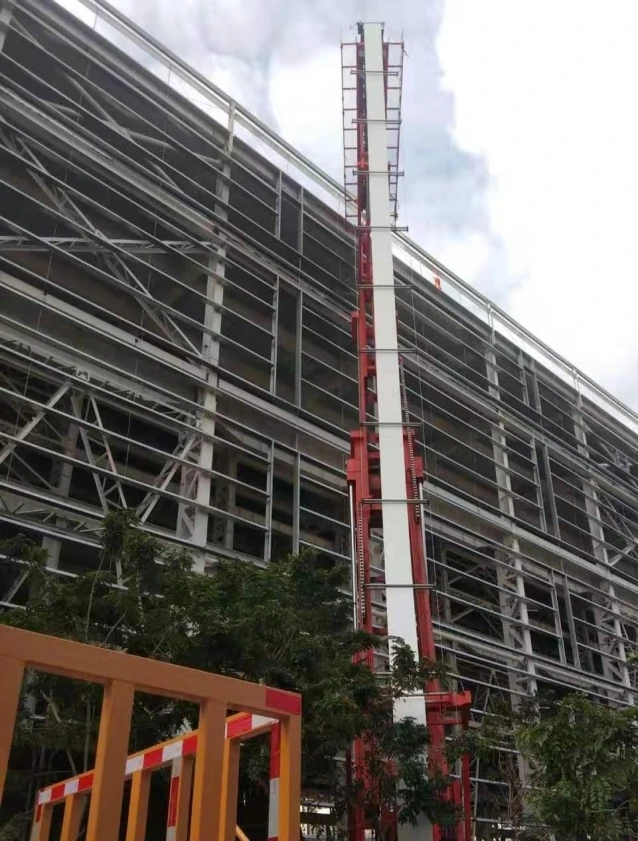
Reference photograph showing a long sheet beside a building and elevated apparatus. It does not verify measured lengths, output rates or an accepted roof sequence.
Issue a usable task-to-length schedule
Attach six connected schedule inputs
- Identify each required roof-zone product, with profile, material and a shared ordered-length basis.
- Keep repeated, different and exceptional products visible without replacing the schedule with one maximum.
- Label provisional dimensions and quantities and name the project party who will resolve them.
- State programme dependencies as project requirements, separate from a proposed machine operating sequence.
- Show outlet height, receiving zone and site access geometry for the separate lift and handover reviews.
- Give destination documentation, transport, ground and power context affecting the actual supplied assembly.
Ask the provider to mark covered rows, exclusions, proposed configuration differences and information still required. The response should tell procurement what product mix the price describes.
Keep later changes traceable to the affected row
When a roof drawing changes, identify the changed product row and issue its new reference. Ask which equipment response and receiving assumptions need another look. Do not reissue an unchanged maximum-length request when the real change concerns a different zone or material. Conversely, do not assume every programme change alters the machinery. The actual provider should state which part of its scope is affected. A clear row reference makes that conversation shorter and more concrete than restarting a general enquiry about whether the line is flexible enough for mixed work.
Recognise a schedule response that may not fit
An offer may not fit when it addresses only a maximum while the buyer requires other identified products, or when its proposed equipment depends on a product decision still unresolved. This guide provides no programmable sequence, changeover procedure, cutting setting, output rate or capacity. The schedule is a purchase input and not a production instruction. Keep final equipment and project planning with the responsible parties and do not treat a long-sheet photograph as proof that every scheduled requirement is covered.
Discuss the actual roof-zone product mix
Send the mixed-length enquiry to ARCLIFT with the task-to-length schedule, controlled product references and expressly provisional rows. Include site roof zone, outlet height, destination and transport assumptions. Ask for a project-specific response identifying covered requirements and missing inputs before final comparison. ARCLIFT is a technical selection and supply partner. The editorial photographs establish no automated cutting sequence, production rate or measured panel length.
FAQ
Is the longest required panel enough for an enquiry?
Not when other products or zones create distinct requirements. Retain those rows and ask the provider to respond to the actual mix. A maximum statement does not automatically address every shorter or exceptional product.
Does mixed-length work imply automatic programming?
No. Ask what actual equipment functions and data scope are proposed. A product schedule states what the buyer needs; it does not establish a control feature or operating method in the offered line.
Should provisional zones be omitted?
Keep them visible if they matter to the purchase, but label them clearly and identify the deciding party. Ask which response remains conditional instead of presenting incomplete requirements as final production information.
Can the same schedule support receiving review?
It can provide common product and zone references. The receiver still needs its actual project-specific interface information and assessment. A shared schedule is not a support design, material-handling plan or installation approval.