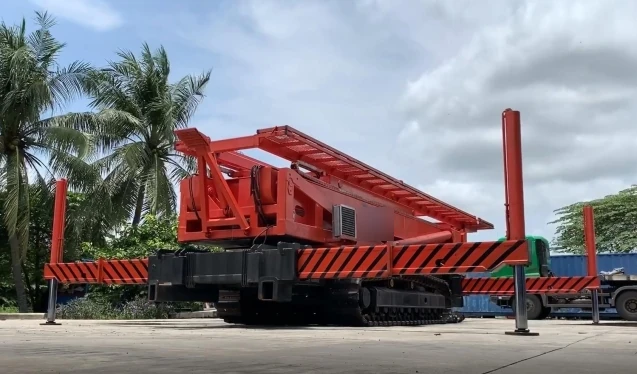
Maintenance and spares handover for a crawler platform should make two things clear: which instructions apply to the delivered equipment, and how a replacement item will be identified and confirmed before purchase. A box labelled spare parts cannot answer either question by itself. The buyer needs configuration references, parts information, supply responsibilities and a usable request route. This guide helps organize that handover without prescribing repairs, service intervals or substitute components.
Start with the configuration actually received and the open items transferred from site acceptance. The operating organization may inherit accessories, revised documents or unresolved supply discrepancies that were not visible in the original inquiry. Link maintenance information to that delivered state. The crawler platform buyer guide provides the earlier selection context; it is not a parts catalogue for every machine in a product family.
Contents
- Establish the equipment basis for maintenance information
- Build a parts request that can be answered accurately
- Compare supply and service responsibilities
- Hand over records the receiving team can maintain
- Questions about maintenance and spares
Establish the equipment basis for maintenance information
Link instructions to the delivered configuration
Ask which equipment identifier, assembly references and instruction revisions define the delivered platform. Include the supplied power and control options and any accepted changes. A manual for a nearby model or an earlier configuration should not be treated as applicable merely because its illustrations look familiar. Where the provider is still confirming a document, record that status and the affected scope. The handover should help the receiving team find the correct information without searching through multiple unlabelled files or relying on a sales description.
Name who owns each maintenance responsibility
The equipment owner needs to determine who plans work, who may perform it and where specialist support is required. Procurement can clarify which information and services are included in supply, while the operating organization controls its maintenance arrangements. The HSE maintenance guidance for Great Britain connects maintenance with competent people and adequate information. It does not establish service intervals, approved replacements or the competence of any particular provider for this platform.
Carry delivery exceptions into the ownership record
A pending document, missing accessory or accepted configuration change should remain visible after the commercial delivery process ends. Identify the equipment scope affected and the party responsible for the response. Do not rewrite a temporary arrangement as the normal parts specification. The owner needs to distinguish the documented delivered state from items still awaiting clarification. This is especially relevant when procurement and maintenance are different departments: a purchasing email should not be the only place where a material handover condition can be found.
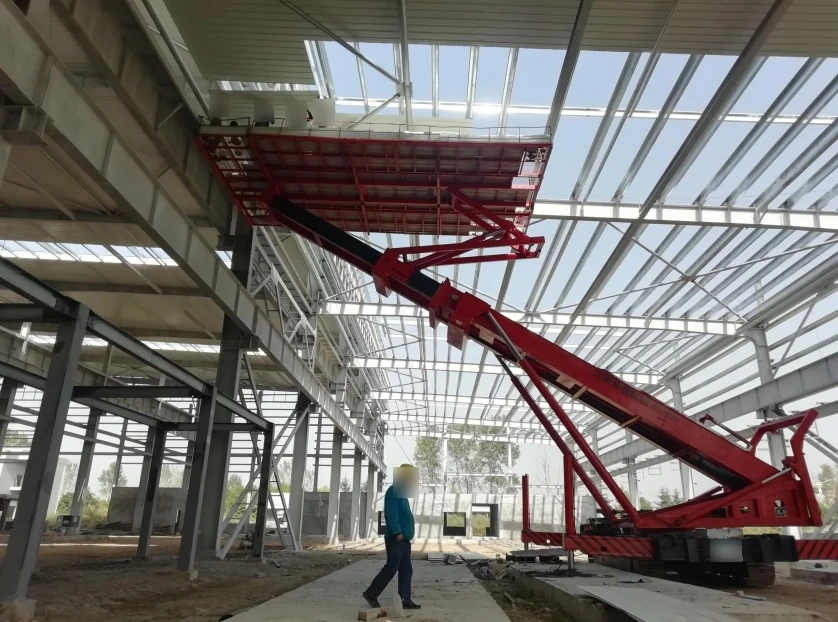
Reference photograph of a platform beneath a roof frame. It does not identify service points, confirm parts compatibility or establish maintenance instructions for the delivered equipment.
Build a parts request that can be answered accurately
Identify the equipment, assembly and requested item
A useful request begins with the equipment identity and the relevant assembly reference from the applicable documentation. Include the item designation and revision where available, then state what is missing or uncertain. A cropped photograph can help communicate a question, but appearance alone cannot determine interchangeability. Where a marking is unreadable, tell the responsible provider rather than guessing a number from a similar component. Keep equipment identifiers and detailed images in the secure support channel so they do not become public project information.
Describe the need without diagnosing the machine
The buyer can report that an item is missing, damaged or requested for an agreed inventory without proposing a technical cause or a repair action. Distinguish a replacement request from a request for diagnosis or authorized service. Those may require different people and information. Avoid suggesting that a part should be fitted because it seems related to a symptom. The technical provider and the owner’s competent maintenance process must establish the appropriate next action using the applicable equipment information, not a general purchasing article.
Record destination and receiving constraints
Ask what delivery information, identification and accompanying documentation the receiving organization needs. Parts may be delivered to a site, a central store or an authorized service provider, each with a different handover owner. Identify destination and transport questions without assuming availability, lead time or shipping suitability. If the supplied instructions specify storage or handling conditions, record where that information can be found and who owns compliance with it. This guide does not create preservation requirements or suggest a standard stock quantity for all crawler platforms.

Reference photograph of a platform in a structural frame. It cannot identify a replacement component, verify a fault or show an approved maintenance activity.
Compare supply and service responsibilities
Separate included spares from future purchasing support
An initial spare package, access to parts information and an agreement to help with later requests are different deliverables. Ask for the included-item list and its relationship to the supplied configuration. Confirm who answers identification questions and who provides a quotation after identification is resolved. Do not infer stock commitments, response times or lifetime availability from the presence of a service contact. Those commitments require explicit agreement. A clear boundary allows the buyer to compare offers without combining several unconfirmed services into one attractive label.
Check the physical access needed by the proposed service scope
A platform may fit its ceiling-work position while the proposed service location remains undefined. When comparing service offers, ask the intended service provider what physical access and facilities its stated scope depends on. The answer should identify the relevant equipment configuration and the access information needed from the site. A service contact and a parts list cannot establish that the work can take place at the operating location.
Consider a hypothetical facility where the platform’s work area is bordered by a finished partition and stored panel packages. The purchaser is also considering a service agreement that could involve an assembly being sent elsewhere for specialist work. Ask the provider to identify, within its proposed scope, the space needed to approach the relevant equipment areas, the description of any item expected to leave the site, its proposed packaging boundary, and the information needed to review its exit route. A route suitable for an incoming spare package is not necessarily the route described for an outgoing assembly. The provider must establish the applicable requirements; the buyer should not derive them from the complete machine’s entry dimensions.
The site response can distinguish available space, space occupied by other work, temporary storage options requiring agreement, and routes whose dimensions or destination are still unknown. Include any handling equipment or external facilities the service offer assumes, identifying whether they are supplied or left to the owner. These are inputs for comparing the service boundary, not instructions for removing a component or arranging lifting equipment. If the intended location cannot yet be matched to the provider’s stated access needs, keep an alternative location or external service scope visible in the purchasing discussion. This lets the buyer compare what the site would actually have to provide. It does not establish that onsite repair is feasible, that an assembly is removable in a particular way, or that a service response time is available.
Compare the evidence needed for each request type
The editorial table below helps route requests. It is neither a recommended stock list nor a repair decision tree. The trade-off is between speed of initial communication and sufficient identity information to avoid an unsupported purchase. A concise request can still be precise when it provides the correct references and states what remains uncertain. Sending more unrelated photographs is not necessarily a better substitute for the applicable assembly information.
| Request type | Information to identify | Party whose response is needed | Do not assume |
|---|---|---|---|
| Missing supplied item | Packing list, equipment scope and discrepancy | Agreed supply contact | Every loose item is a spare |
| Planned spare purchase | Confirmed item and applicable configuration | Parts information provider and purchaser | A generic description proves compatibility |
| Damaged or unidentified component | Equipment identity and available observations | Appropriate technical support provider | Appearance establishes a replacement |
| Instruction clarification | Document title, revision and affected assembly | Responsible information provider | A different version’s procedure applies |
| Service support request | Defined equipment, scope and owner arrangements | Competent service provider and equipment owner | Supplying a part includes installing it |
Keep substitution and revision questions explicit
If a provider proposes a superseding item or another version, ask for confirmation of applicability to the exact configuration and any related information required. Record the provider’s response rather than replacing the old item number in the owner’s list without explanation. A purchasing preference for local availability cannot establish technical equivalence. Likewise, a revised manual does not prove a physical modification occurred. Keep the item history and equipment history connected so later staff can understand what changed, who confirmed it and which documentation now applies.
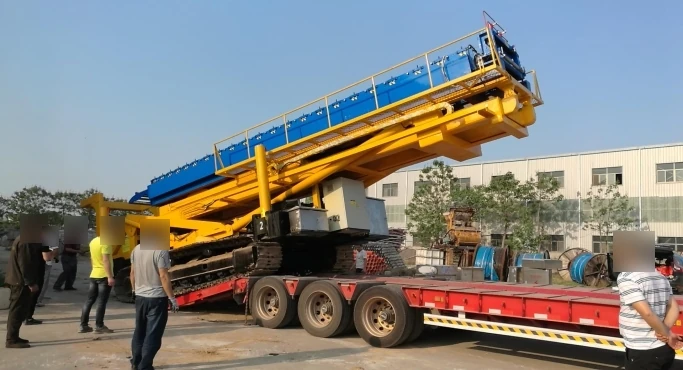
Reference photograph of different equipment at a loading transition. It does not show a spare-part shipment, verify preservation conditions or establish an approved transport or service method.
Hand over records the receiving team can maintain
A proposed spares arrangement may not fit when parts cannot be linked to the supplied configuration, instructions are unavailable, or the owner has no defined route for competent service support. An inexpensive or readily available item is not automatically an acceptable replacement. Keep identity and applicability questions unresolved until the responsible provider supplies a sufficient answer.
Prepare a handover index tied to the platform’s use
- Equipment and assembly identifiers, current instruction revisions and supplied option references.
- Intended task height and ceiling geometry where they affect the owner’s description of equipment use.
- Materials and tools associated with the task, with any changed use routed for appropriate review.
- Floor and access conditions relevant to the planned location of equipment and competent service support.
- Wind or environmental exposure information that the owner must relate to the applicable instructions.
- Destination, receiving organization and the secure contact route for parts and technical queries.
- Transport and storage responsibilities between delivery, commissioning and regular equipment use.
- Power and control configuration references needed to identify the correct technical information.
- Included spares, packing discrepancies and confirmed item references with unresolved entries marked clearly.
- Document language, record ownership, service responsibility and revision-notification arrangements.
Make receipt and identification separate records
A storekeeper can confirm the arrival of a labelled package without confirming that its contents are suitable for an equipment application. The receiving process should identify who reconciles the supply reference with the confirmed parts request. Record shortages, unidentified items and document discrepancies for resolution. Keep accepted items linked to their applicable equipment scope, particularly where the organization owns several similar platforms. This avoids turning a shared storage shelf into an undocumented source of interchangeable components.
Keep equipment history usable after staff changes
The operating organization needs a record location, an owner and a way to identify the current issue. Include references to accepted replacements, relevant provider responses, revised instructions and unresolved questions. The record should remain intelligible to a new maintenance coordinator without relying on the memory of the original buyer. Ask how supplier information will reach that owner when personnel or service providers change. A digital system can support this arrangement, but the existence of an account does not itself establish accurate or complete equipment history.
Send ARCLIFT the supplied equipment reference, available assembly information, destination and receiving arrangements, plus the task height, site access and floor constraints relevant to the proposed support scope. State whether you need missing-item reconciliation, parts identification, documentation or a service contact. As a technical selection and supply partner, ARCLIFT can organize the appropriate supply questions. Final replacement applicability and maintenance work require project-specific information and responsible competent review. This editorial guide and its images provide no repair procedure or universal spare-parts recommendation.
Questions about maintenance and spares
Can a component be ordered from a photograph alone?
A photograph may help describe the question but cannot establish compatibility by itself. Provide the equipment and assembly references available, and ask the responsible parts information provider to confirm the applicable item. Record uncertainty rather than guessing from a similar machine.
Does an initial spare package define the maintenance schedule?
No. Its contents describe a supply scope, while maintenance requirements come from applicable instructions and the owner’s competent arrangements. An included item should not be treated as evidence of a universal replacement interval or a required stock level for every project.
Who should approve a proposed alternative part?
The appropriate technical and ownership responsibilities must be established for the actual equipment. Procurement can collect identity information and the provider’s applicability statement, but commercial convenience alone cannot determine equivalence or authorize fitting an unconfirmed substitute.
What should remain open when handover documents are incomplete?
Identify the missing information, affected equipment scope and responsible provider. Keep the uncertainty visible in the receiving team’s records and ask the appropriate reviewer to determine its consequence. A promised document should not be recorded as received or applied before it is available.