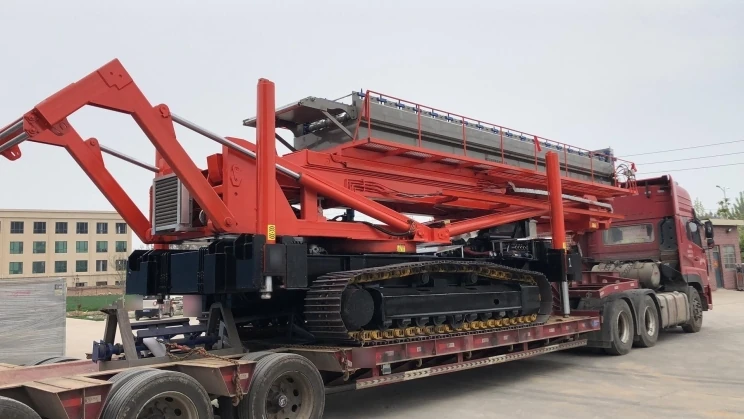
A roll-forming lift purchase can contain several equipment boundaries with different parts and information providers: the forming machine, lifting assembly, base or chassis, feed equipment and agreed options. Compare support at those boundaries before relying on a general after-sales promise. The buyer needs to know who identifies an item, who supplies applicable information and which services remain to be arranged locally.
The system raises a compatible roof-panel roll former; it is separate from a personnel crawler platform. The crawler-platform spares handover guide addresses that other product’s ownership record. Here the focus is the support scope bought with a forming-lift package, without repair instructions or promises of stock and local attendance.
Contents
- Map each equipment boundary to a support provider
- Compare information, parts and service as separate deliverables
- Test the support offer against a hypothetical request
- Ask for a support scope the owner can actually use
- FAQ
Map each equipment boundary to a support provider
Start from the actual supplied combination
Identify which former, lift, vehicle or crawler base, feed items and options belong to the proposed order. Distinguish buyer-owned assemblies from newly supplied equipment. The support discussion must follow that actual combination; a single purchase contact does not establish that every component shares one parts catalogue or one service organization.
The crawler forming-lift and truck-mounted forming-lift families have different base and transport questions. A local chassis may bring another information provider into the purchase. Keep its actual maker and candidate records identifiable in the private project information rather than relying on the lifting-system name to answer chassis support.
Ask who supplies information and who performs work
A contact who coordinates documents may not be the party authorized or able to carry out physical work at the destination. Ask separately about instruction supply, parts identification, component supply, technical advice and local attendance. Identify which are included, optional, conditional or outside the offer.
This is a purchasing distinction, not an instruction to divide responsibility in a particular way. The buyer needs a clear route for each request. If the provider only offers help obtaining information, that can be useful scope, provided it is not described as a committed repair service.
Make a component-to-provider map
The map below is a blank comparison aid. Replace each requested response with the actual proposed provider and written scope. The components shown are categories to examine, not a promise that all are supplied together. Do not create a new support promise by leaving an entire row under a broad heading such as complete system.
| Equipment boundary | Information to identify | Provider response to request | Local scope not to assume |
|---|---|---|---|
| Forming machine and cutter | Applicable assembly and instructions | Parts and document request route | Tooling work or physical service |
| Lifting assembly | Exact configuration and option coverage | Information and component supply scope | Onsite attendance or repair |
| Chassis or crawler base | Candidate-specific equipment records | Relevant support contact and exclusions | Shared coverage with another assembly |
| Feed equipment | Separately supplied or included identity | Applicable item confirmation | Integration with a substitute item |
| Optional handling or accessories | Agreed item and interface boundary | Specific support and instruction scope | Universal option availability |
| Combined interfaces | Coordinated arrangement references | Who answers cross-equipment questions | One component provider owning every interface |
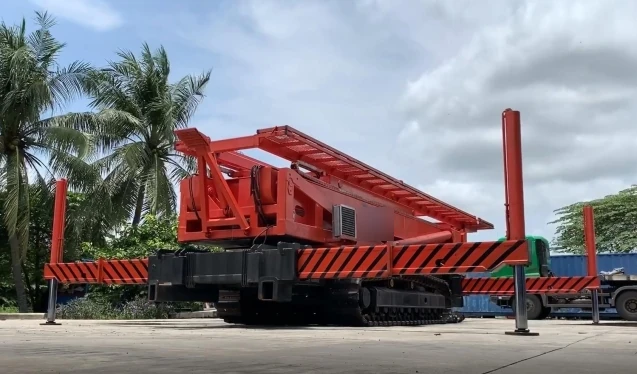
Reference photograph of folded crawler equipment with supports deployed. It does not verify a travel-ready state, condition assessment or suitability for another project.
Compare information, parts and service as separate deliverables
Distinguish available records from future promises
Ask which applicable instructions, assembly references and parts information are already available for the proposed equipment, and which will be supplied later under the actual agreement. A sample manual can explain the intended format without being the applicable delivered record. Likewise, a promise to provide a parts list is different from the list having been issued for the final configuration.
Request the equipment coverage, document language and method for passing later revisions to the owner. These are usable handover questions. They do not require a complicated document system, but they do require the receiving organization to know where the current information can be found and which provider answers a gap.
Define a parts-identification request
The owner should be able to supply the machine identity, assembly reference, item designation if known and the reason for the request. Where a marking is missing or unreadable, report that uncertainty. A photograph can help locate an object without establishing interchangeability with a visually similar part.
Separate ordering an identified item from requesting diagnosis. Procurement can describe observed concerns and available records; it should not infer a technical cause or select a replacement on appearance alone. The actual provider and competent owner arrangements must establish the applicable response. No repair action, fitting method or substitute component is provided here.
Clarify local service dependencies
If a proposal includes attendance, ask which organization would attend, for what scope, under what assumptions and at which location. If attendance is excluded, identify the local support question the buyer must resolve. Do not infer a network, response time, stock level or warranty duration from the existence of a telephone contact.
The HSE inspection guidance is Great Britain context for equipment-specific assessment and competence. It does not identify a provider for this purchase or set a universal interval. The owner needs the applicable information and responsible arrangements for its equipment and destination.
Test the support offer against a hypothetical request
An owned former with a newly supplied lift
Consider a hypothetical buyer retaining its former while purchasing a new lifting assembly. A later enquiry concerns an item near the boundary between those assemblies. The original lift provider can identify its supplied items, but the former’s current assembly records are held by the buyer. A general statement that support is included does not explain who answers the combined question.
Before ordering, ask how such a request would be routed. The useful response identifies the information required from the owner, the provider’s actual scope and how an unresolved cross-equipment question reaches the responsible technical parties. It should not claim that matching a photograph is enough to issue a replacement.
A local chassis changes the support map
Now consider a separately sourced destination vehicle. The vehicle provider and equipment provider may each have complete information for their own assemblies. The joining arrangement still needs an identified technical response route. A chassis service contact is not automatically responsible for the upper equipment, and the lift contact does not automatically undertake all vehicle work.
The destination-chassis guide develops the purchase boundary. Support comparison should carry that boundary forward: which provider answers vehicle information, which answers lift information and who coordinates a question affecting both. This is a scope map, not a diagnosis or claim about an existing service relationship.

Reference photograph showing a suspended blue machine module. It does not verify its identity, compatibility, attachment points or an approved lifting method.
Compare a spare package with a support arrangement
An initial box of listed items is a supply deliverable. Access to item identification is an information service. Attendance and fitting are other possible services that need explicit scope. The trade-off is between the items and support the project actually requires and the obligations the owner must arrange elsewhere.
Do not assume a larger included package is always more useful. Ask how each item relates to the supplied configuration and the owner’s competent maintenance arrangements. Equally, a small included package does not by itself prove weak support. The actual information, confirmation route and service boundary matter more than an unexplained number of parts.
Keep a superseding item tied to its confirmation
If a provider later proposes a revised or alternative item, ask for its applicability to the identified equipment and any related information needed. Procurement should retain that response rather than silently substituting a new designation in the owner’s records. Local convenience cannot establish technical equivalence.
The same rule applies to a revised manual. Its arrival does not prove that physical equipment has changed. Keep document history and equipment history connected, with the provider’s explanation of the difference. The configuration-change guide develops the wider purchase question when the proposed system itself changes.
Ask for a support scope the owner can actually use
Request an example of the information handover
Ask how the final equipment identifiers, applicable instructions, included-item list and request contacts will be provided. The answer should show the expected handover scope without presenting a sample as a completed record. Identify who receives the information in the buying organization and who will keep it accessible after procurement ends.
Where support is conditional on information from the former owner or local vehicle provider, keep that dependency beside the relevant row. It is more useful than a general caveat that all support is project-specific. The buyer can then obtain the missing input or compare a different supply boundary before committing.
Prepare the support-scope enquiry
- Identify the former, lift, base, feed equipment and options in the proposed purchase.
- Provide relevant profile and material context when it defines the forming configuration.
- State the destination and the owner organization receiving the equipment information.
- Identify local transport, chassis and service parties already appointed.
- Describe site access and ground or floor constraints relevant to any proposed attendance.
- State height and roof-zone context only where it affects the defined support request.
- Request applicable power and control documentation, item references and revision coverage.
- Separate included spares, identification support and physical services in the reply.
Recognize an unsupported service assumption
The purchase may not fit an owner who needs local attendance when no actual attendance scope or competent provider has been identified. It may also remain unresolved when parts cannot be connected to the equipment. This guide supplies no service network, warranty, inventory, maintenance interval or repair method. A contact route is useful without establishing the required service.

Reference photograph of elevated apparatus, building steelwork and ground-level coils. It does not verify active production, current performance or the complete equipment arrangement being offered.
Ask for separate answers on parts and services
Request forming-lift support-scope advice from ARCLIFT. Send the proposed component map, former ownership, height and roof-zone context, site access, destination and transport arrangement. State whether the question concerns documentation, item identification, supply or a separately requested service. ARCLIFT coordinates technical selection and supply questions; final commitments require project-specific confirmation. These editorial reference images do not show a parts inventory, maintenance activity or committed service capability.
FAQ
Does a spare package define the maintenance plan?
No. It identifies supplied items. Applicable equipment instructions and the owner’s competent arrangements determine maintenance needs, with no universal interval established by this article.
Can one contact cover the whole system?
A contact can coordinate questions, but the actual agreement should identify its scope and the other providers needed. Coordination does not imply responsibility for every assembly or local service.
Can an item be ordered by matching a photograph?
Appearance alone cannot establish applicability. Provide the equipment and assembly information available and ask the responsible provider to confirm the item for that configuration.
Does remote advice include installation of a replacement?
No such inclusion should be assumed. Information, component supply and physical work are separate scopes to clarify in the actual proposal.